
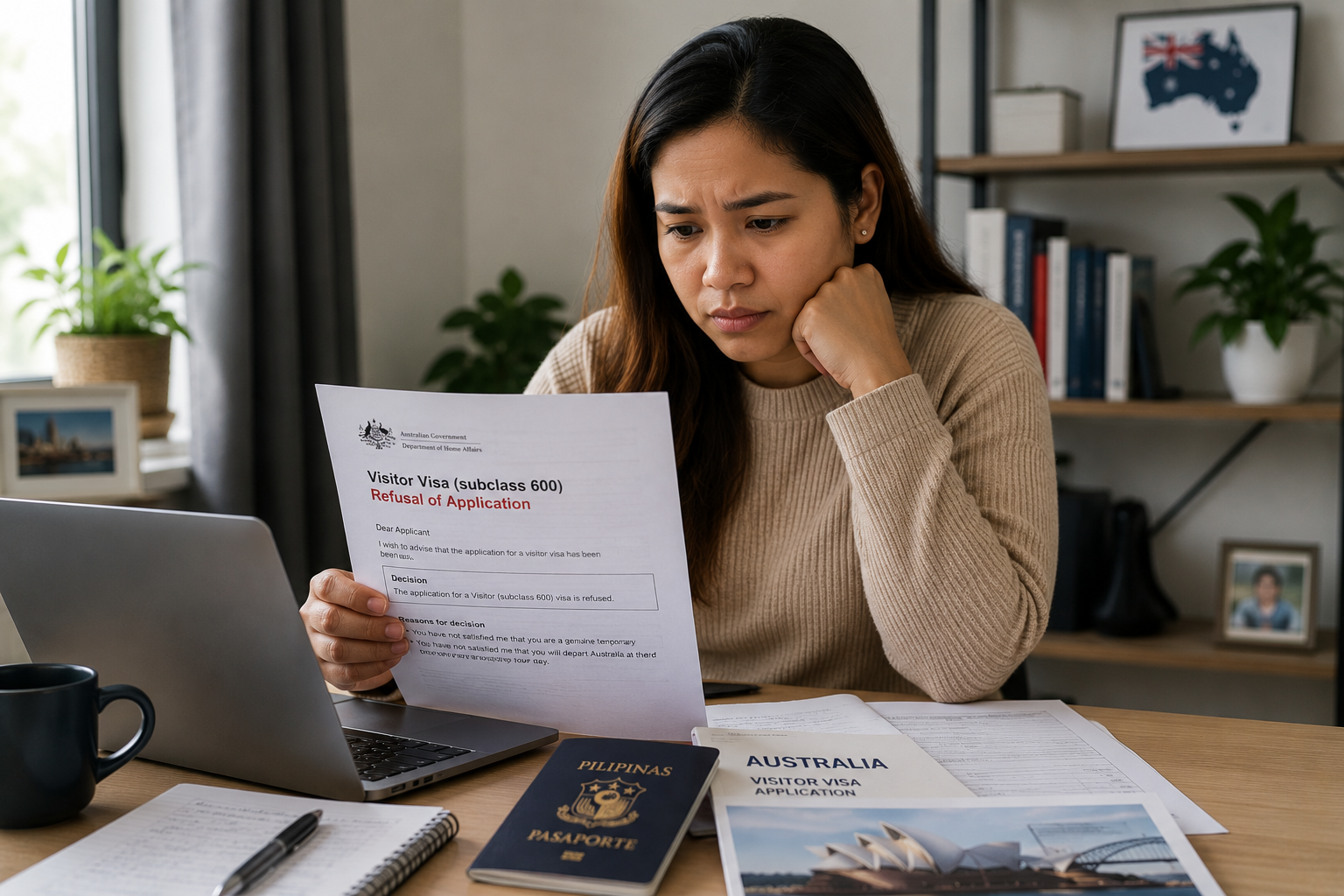
Australian Visitor Visa Refusal Philippines
An Australian Visitor visa refusal is not simply a rejection notice. It is the starting document for deciding whether a new application can realistically succeed, whether circumstances must change, or whether a different visa pathway is more appropriate.
For Filipino applicants, the most important document after refusal is usually the decision letter.
It identifies the visa criterion the decision-maker considered unsatisfied and explains the reasoning applied to the evidence that was lodged.
The Immediate Answer
A Visitor visa refusal does not automatically prevent another application.
The question is whether the refusal resulted from evidence that can be improved, circumstances that remain objectively weak, an inconsistency or credibility problem, or an issue requiring a different visa strategy.
Start With the Refusal Letter
Before thinking about a new application, read the decision letter carefully.
Do not begin by asking:
- how soon another application can be lodged
- whether somebody else was approved after refusal
- whether more bank statements should be uploaded
- whether a stronger invitation letter will solve the problem
Begin with:
- which criterion was not satisfied
- which facts the decision-maker accepted
- which facts were given little weight
- whether evidence was missing
- whether the evidence was present but unpersuasive
- whether the decision identifies inconsistency or credibility concerns
- whether the decision letter states that review rights exist
Simon’s Principle: Diagnose the Refusal Before You Repair the Application
Reapplying only makes sense after identifying what actually failed.
More documents will not fix weak circumstances, and waiting will not fix an inconsistency unless the underlying issue is understood first.
Four Different Types of Visitor Visa Refusal
Visitor visa refusals are often discussed as though they are all the same.
They are not.
1. Evidence Weakness
The applicant’s actual circumstances may be reasonably strong, but the documents did not prove them properly.
Examples can include:
- employment exists but approved leave was not provided
- salary is genuine but the bank records do not show it clearly
- a family responsibility exists but there is no evidence of the practical responsibility
- the applicant has sufficient funds but large recent deposits are unexplained
- the purpose of travel is genuine but the itinerary or invitation is vague
This is often the most straightforward type of refusal to address because the underlying circumstances may not need to change.
2. Weak Underlying Circumstances
Sometimes the evidence was adequate but the circumstances themselves were not persuasive.
For example:
- the applicant has recently stopped working
- the proposed stay is long compared with the applicant’s employment situation
- the applicant has almost no independent financial position
- most close family members are already in Australia
- the Australian inviter will fund every part of the trip
- there is little to explain why the applicant must return at the proposed time
In this situation, submitting the same application with more documents may not change the outcome.
3. Inconsistency or Credibility Problem
This requires much more care.
Examples include:
- different employment dates across applications
- an Australian fiancé previously described as a friend
- a large unexplained financial deposit
- relationship dates that change from one application to another
- previous travel or refusal history omitted
- documents that do not align with information entered in the application form
The issue may not be the absence of evidence. It may be that the Department has difficulty relying on the factual account.
4. Wrong Visa Strategy
Sometimes the problem is larger than the Visitor visa application.
The applicant may be trying to use a temporary visa for circumstances that are fundamentally about permanent migration, joining a partner, employment or another purpose.
In those cases, a new Visitor visa application may not be the strongest next step.
The Difference Between Missing Evidence and Weak Circumstances
This is one of the most important distinctions after refusal.
| Refusal Problem | Possible Response |
|---|---|
| Employment exists but was poorly evidenced | Obtain stronger employment, leave and income evidence. |
| Applicant has no current employment | More employment documents cannot solve a fact that does not exist. |
| Funds exist but source was unclear | Document and explain the source and history of funds. |
| Applicant has no meaningful independent funds | A sponsor bank statement does not change the applicant’s own circumstances. |
| Relationship was not explained properly | Provide an accurate and consistent relationship history. |
| Earlier application contained a materially different account | The inconsistency must be addressed directly rather than ignored. |
Should You Reapply Immediately?
Sometimes.
A prompt reapplication may be defensible where:
- a critical document was accidentally omitted
- the decision was based on a misunderstanding that can be clearly corrected
- the applicant now has evidence that already existed but was not submitted
- the travel purpose remains current
- the refusal can be answered without changing the factual story
An immediate reapplication may be much less sensible where:
- employment has ended
- the applicant’s financial position remains weak
- the proposed travel purpose is no longer current
- the original application contained unresolved inconsistencies
- the applicant wants to submit the same case with more photographs or bank statements
- the real objective has shifted toward permanent migration or joining an Australian partner
A fast reapplication is not automatically a strong reapplication. The new application needs a reason to produce a different decision.
When Waiting May Improve the Case
Waiting only helps where time changes something material.
For example:
- a new job becomes established
- a fixed-term contract is renewed
- savings develop naturally over several months
- the applicant builds travel history
- family or employment circumstances become more stable
- an important civil-status or relationship issue is resolved
Simply allowing three or six months to pass does not itself make the previous refusal disappear.
Australian Partner Cases Need Particular Care
Visitor visa refusals involving Australian–Filipino couples often require a different analysis from ordinary tourism cases.
A genuine relationship does not prevent a temporary visit.
However, the application must be honest about the relationship and the longer-term plans.
Problems arise where:
- a fiancé is described as a friend
- the couple intends permanent migration but presents the trip as ordinary tourism
- the applicant proposes a very long stay with the Australian partner
- all expenses are paid by the Australian partner with little explanation of the applicant’s own circumstances
- a previous application contained a different relationship timeline
- marriage plans are visible in the evidence but omitted from the application narrative
A future intention to apply for a Partner visa does not automatically prevent a genuine temporary visit.
But the Visitor visa application should not conceal the existence or seriousness of the relationship.
For the migration pathway itself, see:
Partner Visa Australia for Filipinos
.
Review Rights After a Visitor Visa Refusal
Not every Visitor visa refusal carries a right of review.
The decision letter should be checked immediately because Home Affairs states that the refusal notice will tell the applicant whether a review right exists.
Where review rights are available, any application to the Administrative Review Tribunal is subject to strict time limits.
Do not assume that an offshore Visitor visa refusal is reviewable simply because the applicant has family or a partner in Australia.
The specific visa stream, sponsorship arrangements and circumstances of the application need to be checked against the refusal decision.
Check the Decision Letter First
If review rights exist, the decision letter will normally identify them and the applicable time limit. That issue should be checked before deciding to lodge a fresh visa application.
Further Assessment Before Refusal
Some applicants notice that the application remained in Further Assessment before the refusal was issued.
That status does not explain why the visa was refused.
The refusal decision does.
Further Assessment is a processing status and does not identify the Department’s reasoning or predict the result.
For the Filipino-specific explanation, see:
Further Assessment Philippines
.
What I See in Filipino Visitor Visa Refusal Files
The refusal letter often makes much more sense when read beside the original application.
I see matters where:
- the refusal refers to weak employment evidence and the employment letter contains no salary or approved leave
- the bank account balance looks strong but almost all of the money arrived shortly before lodgement
- the applicant says they support an elderly parent but the documents do not show any actual financial or care responsibility
- the Australian inviter describes the applicant as a fiancé while the application form says friend
- the applicant proposes a three-month visit despite having only two weeks of approved leave
- a previous Visitor visa application and the new application use different dates for the same relationship
- the refusal is blamed on insufficient documents when the underlying circumstances themselves were weak
The important distinction is whether the case needs better proof, better circumstances, a credibility explanation or a different pathway.
Fictional Worked Example
This is a fictional example created to explain migration strategy. It is not a real client matter.
Camille is a Filipino citizen who applied for a Visitor visa to spend six weeks with her Australian boyfriend.
Her boyfriend offered to pay for the entire trip. Camille had recently left her job and had only a small amount of personal savings.
In the application, she described the Australian partner as a friend because she was worried that disclosing the relationship would make approval less likely.
The Visitor visa was refused because the decision-maker was not satisfied that Camille’s circumstances supported a genuinely temporary stay.
Camille now wants to lodge another application immediately with more photographs, screenshots and a larger transfer from her boyfriend.
That would not address the main problems.
The new application would still need to deal with:
- the absence of current employment
- her financial dependence on the Australian partner
- the proposed six-week stay
- the inaccurate description of the relationship in the first application
- whether the real strategy is temporary travel or relationship migration
More documents are not automatically the answer. The refusal must first be understood as an assessment of Camille’s actual circumstances and the credibility of the previous application.
Common Mistakes After Refusal
- lodging the same application again immediately
- assuming more bank funds will solve every problem
- ignoring the actual wording of the refusal reasons
- changing important facts without explaining the change
- concealing an Australian relationship
- assuming a sponsor can guarantee approval
- waiting several months without any material change in circumstances
- assuming there are no review rights without reading the decision letter
- assuming there are review rights when none exist
Related Guides for Filipino Applicants
Tourist Visa Requirements
Purpose, funding, employment and temporary-stay evidence before lodgement.
Further Assessment
What the ImmiAccount status means before a decision is made.
Processing Time
Visitor visa delay, published timeframes and when follow-up may be appropriate.
Partner Visa
For Australian–Filipino couples considering relationship migration.
Filipino Visa Gateway
The main Australian visa pathways available to Filipino applicants.
Frequently Asked Questions
Can I apply again after an Australian Visitor visa refusal?
Possibly. The stronger question is whether the refusal reasons can now be addressed. A new application should have a rational basis for producing a different outcome.
Should I reapply immediately after refusal?
Sometimes, particularly where important evidence was omitted or the refusal can be answered clearly. Immediate reapplication is less useful where the underlying circumstances remain weak or credibility issues remain unresolved.
Does a Visitor visa refusal mean the Department thinks I was dishonest?
No. A refusal may simply mean the Department was not satisfied that the relevant Visitor visa criteria were met. However, where inconsistent or inaccurate information was provided, credibility may become an important issue.
Will more money in the bank fix a Visitor visa refusal?
Not necessarily. The Department may consider the source and history of the funds as well as the applicant’s employment, purpose of travel, family circumstances and overall temporary-stay position.
Can an Australian partner cause a Visitor visa refusal?
Having an Australian partner does not automatically cause refusal. The relationship can, however, be relevant to whether the proposed stay is genuinely temporary and should be disclosed accurately.
Do I have a right to appeal an Australian Visitor visa refusal?
Not every Visitor visa refusal carries review rights. The refusal letter should be checked because it will state whether review rights exist and, where applicable, the relevant time limit.
Does Further Assessment before refusal mean the Department had concerns?
Not necessarily. Further Assessment is a processing status and does not identify what was being considered. The refusal letter is the document that explains why the application was refused.
About Simon Mander
Simon Mander is a Registered Migration Agent with more than 23 years of experience in Australian migration.
He advises Filipino applicants and Australian family members or partners on Visitor visa refusals, reapplication strategy, temporary-stay evidence, credibility issues, review rights and alternative visa pathways.
His approach begins with the refusal letter and the original application before deciding whether another application is actually worth lodging.
MARN 0318058
Understand the Refusal Before You Reapply
A paid consultation can review the refusal reasons, identify whether the problem is evidence, circumstances, credibility or visa strategy, and assess whether a new application is realistic.
This information is general in nature and does not constitute migration advice for your individual circumstances. Australian migration law and policy can change, and eligibility should be assessed based on the circumstances existing at the time of application.