
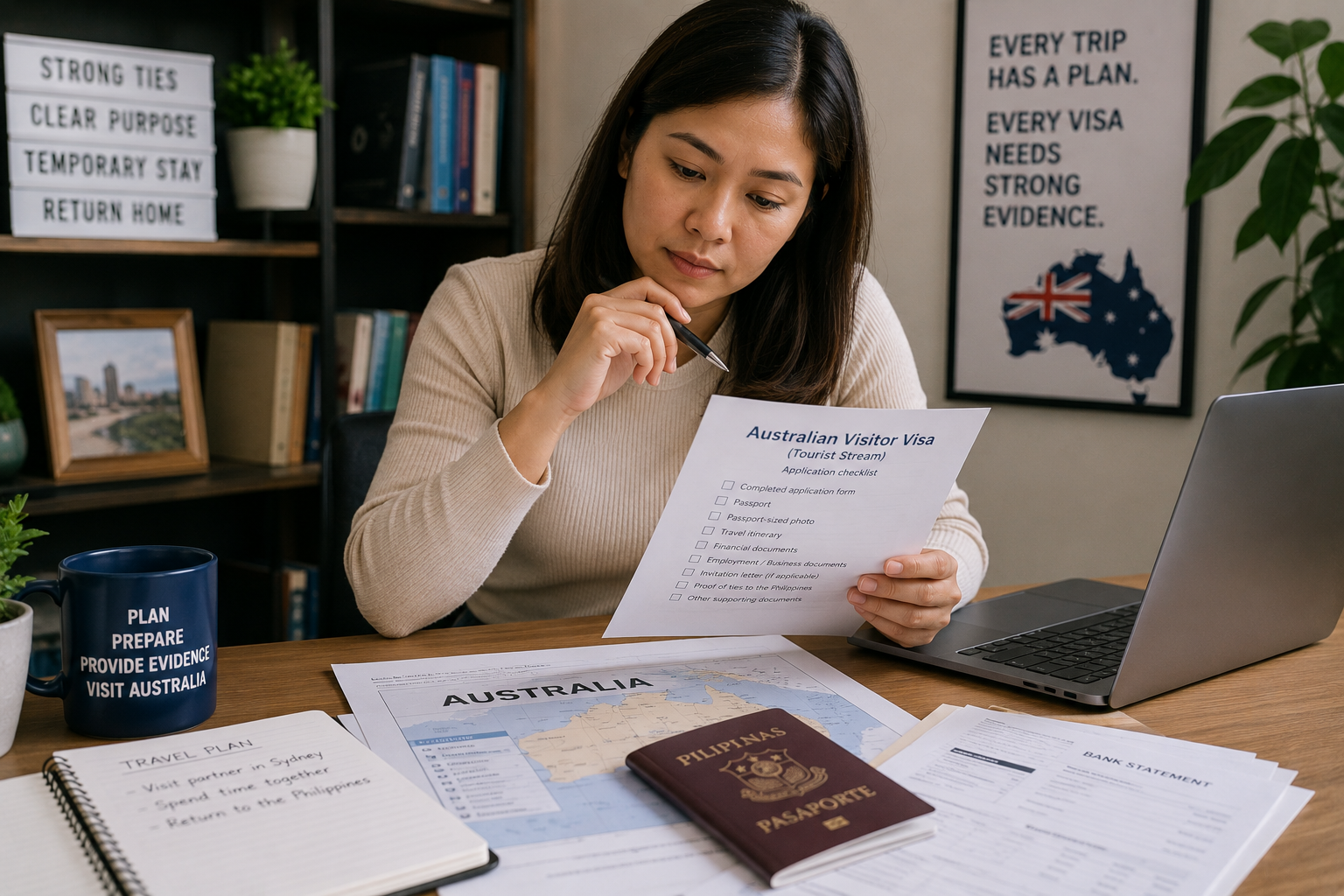
Australia Tourist Visa for Filipinos
Filipino citizens need a visa to visit Australia.
That part is simple.
The harder question is whether the Visitor visa application will be accepted as a genuine temporary visit.
Many Filipino applicants assume that a tourist visa is straightforward because they only want to visit Australia for a short time.
Unfortunately, the Department does not assess the application only by asking whether the applicant wants to visit.
It also considers whether the applicant is likely to leave Australia at the end of the authorised stay.
That is where many applications become difficult.
Do Filipinos Need a Visa to Visit Australia?
Yes. Filipino passport holders need an appropriate Australian visa before travelling to Australia.
For tourism or short visits, this is usually a Visitor visa pathway.
But the visa is not approved simply because the purpose of travel is tourism.
The Department must be satisfied that the applicant meets the relevant visa requirements, including the requirement to genuinely stay temporarily.
Simon’s Principle: Explain the Whole Temporary Journey
A Visitor visa application should do more than show why the applicant wants to come to Australia.
It should explain the purpose of the visit, how it will be funded, what the applicant will do during the stay, and why the applicant will leave Australia when the visit is over.
The Real Issue Is Temporary Stay
Many applicants focus on the form.
They ask whether they have uploaded the correct documents or selected the correct purpose of travel.
Those things matter.
But the more important issue is often whether the evidence supports the applicant’s overall temporary-stay position.
That may involve:
- employment in the Philippines
- family responsibilities
- financial circumstances
- travel history
- purpose and length of travel
- ties to Australia
- previous visa history
A genuine applicant can still be refused if the evidence does not adequately explain those circumstances.
Employment Evidence for Filipino Applicants
Employment is often one of the most important parts of a Filipino Visitor visa application.
A Certificate of Employment by itself may not tell the whole story.
Depending on the circumstances, useful evidence may include:
- Certificate of Employment
- approved leave
- recent payslips
- bank records showing salary payments
- BIR records
- SSS records
- Pag-IBIG records
- employment contracts
The strongest evidence usually tells a coherent story about where the applicant works, how long they have worked there, what they earn and when they are expected to return.
Agency, Contract and Overseas Employment
Filipino employment structures can sometimes be more complicated than a single employer and a single workplace.
An applicant may be:
- recruited by a Philippine agency
- legally employed by one entity
- assigned to an overseas principal
- working at a host company
- paid through a separate payroll arrangement
Those relationships should be explained accurately.
The application should not simply use the best-known company name if the actual employment records show a different structure.
Financial Evidence Is About More Than the Balance
Applicants often focus heavily on the amount of money showing in the bank account.
The amount matters, but so does the history and source of the funds.
A decision-maker may look at whether the account activity is consistent with:
- the applicant’s salary
- normal saving patterns
- the proposed cost of the trip
- the applicant’s broader financial circumstances
Recent large deposits may need explanation.
The money may be:
- a genuine gift
- a loan
- a reimbursement
- sale proceeds
- transferred savings
The important point is not simply to upload a bank statement, but to make the source of significant funds understandable.
What If an Australian Sponsor Is Paying?
Many Filipino applicants are invited by an Australian partner, relative or friend.
The Australian inviter may offer to pay for:
- airfares
- accommodation
- food
- transport
- other living costs during the visit
That can help establish that the trip is financially realistic.
But sponsorship does not replace the need to assess the applicant’s own circumstances.
The Department may still consider why the applicant intends to return after the visit.
Family Circumstances in the Philippines
Family responsibilities can be relevant, but they should not be treated as a simplistic checklist.
Saying “my family is in the Philippines” may not be enough.
The useful question is what the applicant’s actual role is.
For example:
- Does the applicant financially support children?
- Do they care for an elderly parent?
- Do they live with dependent family members?
- Are there practical responsibilities requiring their return?
Where those circumstances are relied upon, the evidence should show the reality rather than merely state it.
Travel History
Previous travel can be relevant to a Visitor visa application.
A history of travelling overseas and complying with visa conditions may help demonstrate travel behaviour.
But no previous international travel does not automatically mean the application should fail.
Travel history is one factor among many.
Invitation Letters
An invitation letter can be useful because it helps explain:
- who the applicant is visiting
- the relationship between the parties
- where the applicant will stay
- who will pay for the visit
- the proposed dates
But an invitation letter should not be treated as approval evidence by itself.
The applicant’s own circumstances remain important.
Tourist Stream and Sponsored Family Stream
Visitor visa applications can arise through different streams depending on the purpose and circumstances of the visit.
The correct stream should be identified before lodgement rather than assuming every family visit should use the same approach.
The existence of an Australian relative or partner does not, by itself, determine the appropriate stream.
Tourist Visa Applications Involving Australian Partners
Applications involving Australian and Filipino couples need particular care.
A Visitor visa is not a Partner visa.
But that does not mean a genuine Australian relationship should be concealed or minimised.
Problems can arise where:
- a fiancé is described as a friend
- marriage plans are omitted
- relationship dates differ from previous applications
- the applicant presents the trip as ordinary tourism despite clear relationship evidence
A future intention to pursue a Partner visa does not automatically mean a temporary visit is impossible.
The important issue is that the application accurately explains both the current visit and the longer-term circumstances.
For relationship migration options, see:
Partner Visa Australia for Filipinos
.
Why Australian Tourist Visas for Filipinos Can Be Refused
Many refusals occur because the Department is not satisfied that the applicant genuinely intends to stay temporarily.
That does not always mean the applicant has been dishonest.
The problem may instead be:
- weak evidence
- unclear circumstances
- unexplained finances
- inconsistent information
- a travel purpose that is not well supported
If a refusal has already occurred, the refusal letter should be analysed before another application is lodged.
See:
Australian Visitor Visa Refusal Philippines
.
Processing Time and Further Assessment
Many Filipino applicants become worried when their Visitor visa application takes longer than expected.
A longer processing time does not, by itself, tell you whether the Department has concerns or what the eventual decision will be.
Published processing times are guides rather than guaranteed decision dates for individual applications.
Likewise, if an application shows Further Assessment in ImmiAccount, that status does not tell you what particular issue is being considered or whether the visa will be granted or refused.
For more on these issues, see
Australia Visitor Visa Processing Time Philippines
and
Further Assessment Philippines.
What I See in Practice
After more than twenty years in migration practice, I have found that many Visitor visa problems begin before the application is lodged.
The applicant often provides documents, but not a coherent explanation.
I see applications where:
- bank statements are provided but the source of recent funds is unclear
- employment evidence confirms a job but says nothing about approved leave
- the applicant proposes a long stay inconsistent with their employment commitments
- an Australian partner funds the entire trip but the relationship is barely mentioned
- the applicant says they support family in the Philippines but provides no evidence of that responsibility
- the stated travel purpose does not align with the itinerary or invitation
These cases are not usually solved by simply uploading more documents.
The documents need to explain the applicant’s actual circumstances.
Fictional Worked Example
This is a fictional example created to explain migration strategy. It is not a real client matter.
Lea is a Filipino administrative officer who wants to spend three weeks in Australia with her Australian fiancé.
She has modest personal savings and her fiancé will pay for the flights and accommodation.
Lea has never travelled overseas before.
She works under a fixed-term employment contract and has approved leave for the three-week trip.
She also financially supports her mother and young child in the Philippines.
A weak application might simply include:
- the fiancé’s invitation letter
- his bank statements
- Lea’s passport
- a generic employment certificate
A stronger application would explain the whole temporary journey.
That may include:
- the genuine relationship with the Australian fiancé
- the exact length and purpose of the visit
- approved leave from employment
- Lea’s return-to-work position
- how the trip will be funded
- the source of any recent funds
- her ongoing responsibilities to her child and mother
The issue is not that Lea has an Australian fiancé. The issue is whether the evidence presents a coherent temporary visit despite that relationship.
Australian Tourist Visa Requirements Are Not Just a Checklist
It is tempting to think of the Visitor visa as a checklist:
- passport
- bank statements
- employment letter
- invitation letter
- travel plan
But the Department does not assess those documents in isolation.
The question is whether the overall evidence supports the application.
For the broader Filipino migration framework, see:
Australia Visa Requirements for Filipinos
.
Related Guides for Filipino Applicants
Filipino Visa Gateway
The major Australian visa pathways available to Filipino applicants.
Visitor Visa Refusal
How to analyse a refusal and decide whether another application is viable.
Further Assessment
What the ImmiAccount status means and what it does not reveal.
Processing Time
How to interpret Visitor visa delays and published processing times.
Partner Visa
Relationship migration pathways for Australian–Filipino couples.
Frequently Asked Questions
Do Filipinos need a visa to visit Australia?
Yes. Filipino passport holders need an appropriate visa before travelling to Australia.
Is an Australian Tourist visa easy for Filipinos?
Not necessarily. The Department must be satisfied that the applicant meets the relevant Visitor visa requirements, including that the proposed stay is genuinely temporary.
How much money does a Filipino applicant need for an Australian Tourist visa?
There is no single bank-balance figure that guarantees approval. The financial evidence should be reasonable for the proposed trip and consistent with the applicant’s circumstances and source of funds.
Can an Australian partner pay for the trip?
Yes. An Australian partner may fund some or all of the visit, but that does not remove the need to assess the Filipino applicant’s own circumstances and temporary-stay position.
Can a Filipino Visitor visa be refused even with an Australian sponsor?
Yes. An invitation or financial support from an Australian person does not guarantee that the Visitor visa criteria will be satisfied.
Does Further Assessment mean refusal?
No. Further Assessment is a processing status and does not identify the eventual outcome of the application.
What should I do before applying?
The application should be assessed as a whole: purpose of travel, funding, employment, family circumstances, Australian connections, previous travel and any previous visa history should tell a coherent temporary-stay story.
About Simon Mander
Simon Mander is a Registered Migration Agent with more than 23 years of experience in Australian migration.
He advises Filipino applicants and Australian family members or partners on Visitor visa applications, temporary-stay evidence, financial evidence, relationship circumstances, Further Assessment and visa refusals.
His approach focuses on whether the evidence tells a coherent temporary-visit story rather than treating the application as a document checklist.
MARN 0318058
Assess Your Visitor Visa Before Lodgement
A paid consultation can assess your travel purpose, employment, finances, Australian connections and previous visa history and identify whether the proposed Visitor visa application is realistically supportable.
This information is general in nature and does not constitute migration advice for your individual circumstances. Australian migration law and policy can change, and eligibility should be assessed based on the circumstances existing at the time of application.