
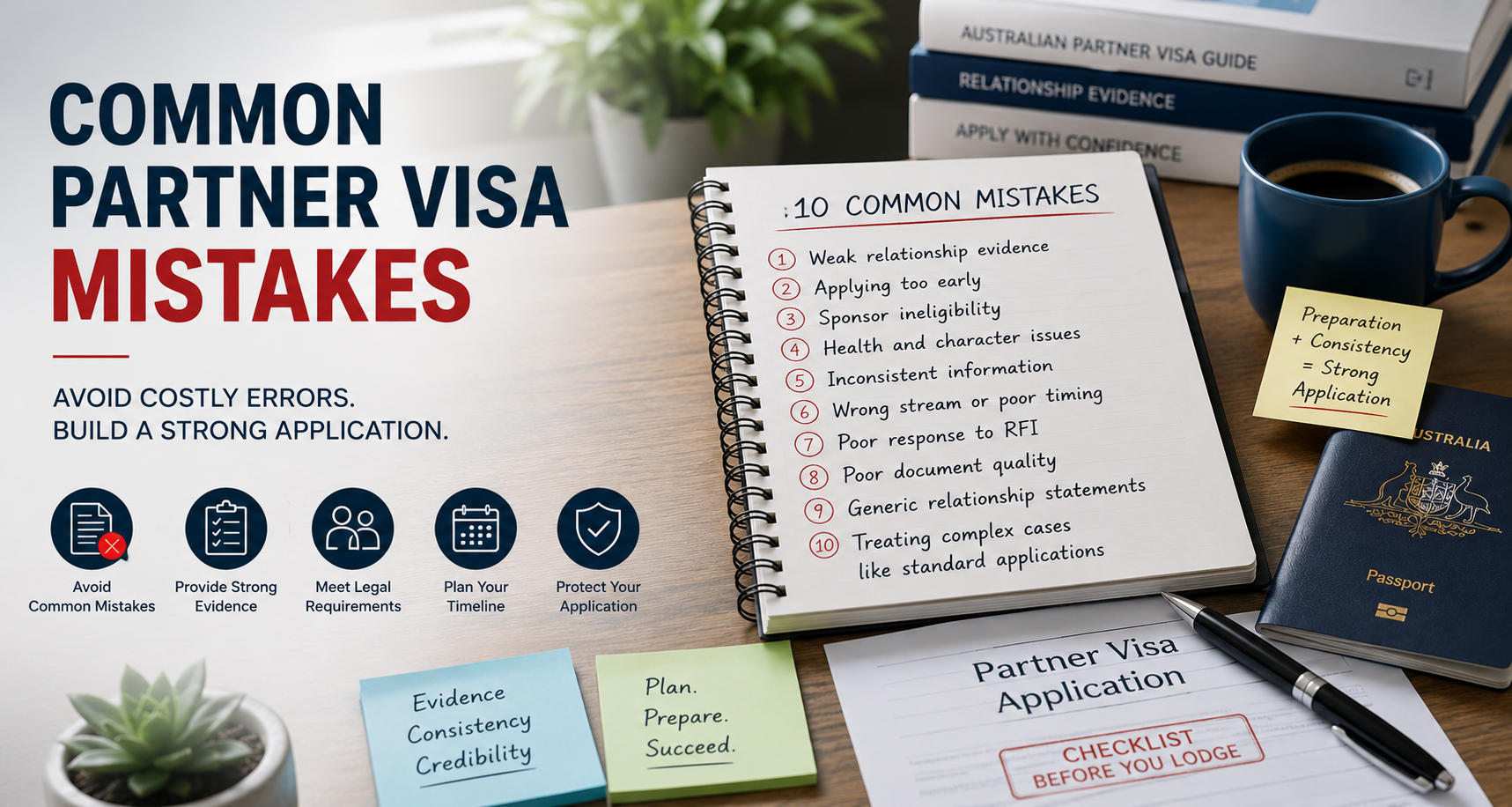
Common Partner Visa Mistakes
Many common Partner visa mistakes occur long before the Department makes a decision. Weak evidence, inconsistent information, poor timing, sponsor issues and unresolved legal risks can turn a genuine relationship into a difficult application. The strongest Partner visa applications are not simply complete. They are coherent, credible and strategically prepared.
Executive Summary
Partner visa applications are often weakened by avoidable mistakes rather than by an absence of a genuine relationship.
Common problems include one-dimensional evidence, inconsistent forms, applying before the relationship requirements are properly established, overlooking sponsor eligibility, failing to address health or character concerns, choosing the wrong timing strategy and responding poorly to Department requests.
In my experience, the most damaging mistakes are rarely dramatic. They are usually small assumptions, unexplained inconsistencies or poorly considered timing decisions that accumulate until the application becomes difficult to understand or trust.
This guide explains ten common Partner visa mistakes and how they can affect eligibility, evidence, credibility, legal strategy and the final decision.
How Partner Visa Mistakes Escalate
Most difficult Partner visa applications do not begin with one catastrophic error. Problems usually develop through a chain:
Incorrect Assumption
The couple misunderstands an eligibility, timing, evidence or sponsorship requirement.
Missing or Poorly Chosen Evidence
The application does not adequately support the relationship or legal position being claimed.
Inconsistency
Forms, statements and documents begin telling different versions of the case.
Credibility Concern
The decision-maker must consider whether the overall account is reliable.
Further Questions, Delay or Refusal Risk
What began as a manageable evidence issue becomes a problem affecting the application as a whole.
The purpose of strategy is to interrupt this chain before an avoidable mistake becomes a credibility or legal problem.
At a Glance
| Topic | Summary |
|---|---|
| Main risk | Avoidable mistakes that weaken an otherwise genuine application |
| Common evidence issue | Relying too heavily on photographs or one evidence category |
| Common legal issue | Poor timing, sponsor eligibility, Schedule 3, health or character concerns |
| Common credibility issue | Forms, statements and documents that do not align |
| Best protection | Strategic review before lodgement |
| Simon Principle | Strategy Before Paperwork |
The Most Common Partner Visa Mistakes
The most common Partner visa mistakes are not simply administrative errors. They usually arise because the couple has not first identified what the Department must legally assess.
A Partner visa application must address:
- the legal relationship requirements
- applicant eligibility
- sponsor eligibility
- relationship evidence
- health and character requirements
- immigration history
- credibility and consistency
In practice, I rarely see one mistake operating alone. More often, several apparently minor issues reinforce one another: a vague relationship date, inconsistent address histories, an unexplained period of separation and a witness statement based on assumptions rather than personal knowledge.
Each issue may appear manageable in isolation. Together, they can change how the entire application is read.
The following ten mistakes can weaken a Partner visa application before or after lodgement.
1. Weak or One-Dimensional Relationship Evidence
Photographs alone will not normally carry a Partner visa application.
The Department usually considers evidence across four broad areas:
- Financial aspects
- Nature of the household
- Social aspects
- Nature of commitment
An application that relies almost entirely on photographs, messages or social media may fail to show how the couple has built a shared life.
Useful evidence may include:
- joint bank account records
- shared expenses
- leases or housing documents
- utility accounts
- travel records
- insurance or beneficiary nominations
- Form 888 statements
- evidence of shared decisions and future plans
The evidence should support the relationship naturally over time rather than appear to have been assembled only for the visa application.
I have reviewed applications containing hundreds of pages that still failed to explain the relationship clearly. I have also seen much smaller applications that were persuasive because each document had an identifiable purpose and supported the same relationship history.
Document volume is therefore not the measure of strength. Relevance, continuity and consistency matter more.
Documents should also be clear, complete, readable, correctly translated where required and organised so that their relevance can be understood.
See How to Prove a De Facto Relationship.
2. Applying Too Early as a De Facto Couple
Applicants generally need to establish that they were in a de facto relationship for the required period immediately before the application, unless a recognised exception applies.
The usual 12-month requirement concerns the period during which the couple was actually in a de facto relationship. It is not necessarily the same as:
- knowing each other for 12 months
- dating for 12 months
- having met 12 months earlier
- being engaged for 12 months
- simply sharing an address for 12 months
- maintaining precisely 12 months of uninterrupted cohabitation
The real question is when the relationship acquired the characteristics of a de facto partnership and whether the evidence supports that conclusion.
Relevant considerations may include:
- when the couple developed a mutual commitment to a shared life
- when financial and household arrangements developed
- how the relationship was recognised socially
- whether the couple lived together or remained apart temporarily
- whether the relationship was registered under an applicable law
- whether compelling and compassionate circumstances may be relevant
- whether another recognised exception applies
Registration may remove the separate 12-month duration requirement in an eligible case. It does not remove the need to establish that a genuine de facto relationship exists.
Strong applications I have prepared involved couples who spent significant periods living apart. Their cases were strong because the separation was properly explained and the continuing relationship was demonstrated through conduct, communication, support and future planning.
Time at the same address is evidence. It is not the complete legal test.
Applying before the legal and evidentiary position is properly understood can create a problem that additional documents cannot easily repair.
3. Overlooking Sponsor Eligibility
A strong relationship case can still encounter serious difficulty if the sponsor is not eligible or if sponsorship restrictions have not been identified.
Couples often spend months collecting relationship evidence before checking the sponsor’s history. That reverses the correct order of analysis.
| Sponsor Issue | Why It Matters |
|---|---|
| Australian status | The sponsor must hold the relevant Australian citizenship, permanent residence or eligible New Zealand citizen status |
| Previous sponsorships | Previous Partner or Prospective Marriage sponsorships may engage number or timing limitations |
| Previously sponsored as a partner | A relevant waiting period may apply before the person can sponsor another partner |
| Relevant criminal history | Certain offences and significant criminal records may require disclosure and may prevent sponsorship approval |
| Applicants or dependent children under 18 | Additional child-protection provisions may apply |
| Possible discretion or exception | Some restrictions contain a discretion, but the legal basis must be established rather than assumed |
Sponsor eligibility should be reviewed before substantial fees are paid and before the application pathway and timing are finalised.
A relationship can be genuine while the proposed sponsorship remains legally problematic.
4. Failing to Identify Health, Character or Sponsor Protection Issues Early
Health, character and sponsor protection issues can materially change an otherwise strong Partner visa strategy.
Applicant Health
Relevant issues may include:
- significant medical conditions
- additional examinations or specialist reports
- possible cost or community-service implications
- incomplete medical information
- whether the applicable visa criteria permit a health waiver
A health waiver is not automatically available in every case. Its availability depends on the particular visa criteria and public-interest requirements applying to the application.
Applicant Character and Immigration History
Relevant issues may include:
- criminal convictions or pending charges
- unresolved court proceedings
- difficulty obtaining police certificates
- previous visa refusals or cancellations
- periods of unlawful status or non-compliance
- incorrect or incomplete answers in earlier applications
Sponsor Protection and Criminal-History Issues
Relevant matters may include:
- criminal history involving violence or sexual offences
- stalking, intimidation or breaches of protection orders
- offences involving children
- weapons, trafficking or related offences
- whether the sponsor has a significant criminal record
- information that may need to be disclosed to the applicant
In my experience, these cases are usually easier to manage when the issue is identified before lodgement. Discovering it only after a Department request limits the time available to investigate the legal position and prepare appropriate evidence.
Attempting to minimise or conceal a health, character, sponsor or immigration issue can create a more serious credibility problem than the underlying event.
5. Providing Inconsistent Information
Inconsistencies between forms, statements and documents are a major source of credibility concern.
Problems may arise where:
- the partners provide different relationship start dates
- addresses differ across forms and documents
- employment or travel histories do not align
- relationship statements describe events differently
- Form 888 witnesses provide conflicting information
- information differs from previous visa applications
A useful preparation step is to create a shared chronology covering:
- relationship milestones
- addresses
- employment history
- travel
- periods of separation
- marriage or relationship registration
- important shared decisions
Consistency does not mean using identical language. It means describing the same underlying facts.
Consistency does not mean repeating information after discovering that it is wrong.
If an answer in the application is incorrect, or circumstances change after lodgement, the correct approach is to notify the Department transparently. Later evidence should not be manipulated to conform to an original error.
I have seen relatively minor mistakes become serious credibility issues because applicants were more concerned about appearing consistent than about correcting the record honestly.
Simon’s Perspective
Most Partner visa mistakes do not happen because applicants are dishonest or careless. They happen because couples begin with documents instead of strategy.
Some of the strongest applications I have prepared involved couples who had spent long periods living apart, had limited joint financial evidence or had unusual relationship histories. They were strong because the apparent weaknesses were understood, explained and supported by evidence.
I have also reviewed applications involving married couples who had lived together for years but could not agree on basic dates, addresses or important events. The apparent strength of the relationship did not prevent the application from developing credibility problems.
The number of photographs, messages or bank statements is not what makes an application persuasive. The question is whether the material allows a decision-maker to understand the same coherent relationship from beginning to end.
The strongest applications are not simply complete. They make sense.
6. Choosing the Wrong Pathway or Lodging at the Wrong Time
Onshore and offshore Partner visa pathways involve different legal and practical consequences.
Timing can affect:
- whether a valid onshore application can be lodged
- the applicant’s lawful status
- bridging visa arrangements
- work rights
- travel while the application is pending
- Schedule 3 risk
- periods of separation
- the evidence available at lodgement
Lodging as early as possible is not always the same as lodging strategically.
A couple should consider:
- current visa expiry
- onshore eligibility
- relationship evidence
- de facto timing
- intended travel
- the consequences of delay
See Why Partner Visa Timelines Often Become Complicated.
For the detailed pathway differences, see Onshore Partner Visa Australia: Subclasses 820 and 801 and Australia Partner Visa Offshore: Subclasses 309 and 100.
7. Misreading or Responding Poorly to a Department Request
Not every Department communication serves the same purpose.
| Communication | What the Applicant Must Identify |
|---|---|
| Routine document request | What document is missing, incomplete or requires updating |
| Further-information request | What unresolved issue the additional information is intended to address |
| Invitation to comment | What potentially adverse or contradictory information must be answered |
| Health or character request | What separate legal assessment remains incomplete |
| Verification enquiry | What document, statement or claim the Department is testing |
A poor response may:
- fail to answer the actual question
- provide large quantities of irrelevant material
- introduce new contradictions
- repeat the original evidence without addressing the concern
- miss the response deadline
- attempt to preserve an incorrect original answer
A strong response should:
- identify each issue raised
- distinguish routine requests from potentially adverse concerns
- answer each issue directly
- provide targeted evidence
- correct any earlier error transparently
- explain inconsistencies honestly
- be submitted within the applicable timeframe
In practice, the most effective responses are not always the longest. They are the responses that show the Department that the concern has been understood.
A Department request is not a generic invitation to upload more documents.
8. Treating Lodgement as the Finish Line
A Partner visa application continues to develop after it is lodged.
Applicants may need to:
- notify changes of address, passport or contact details
- correct incorrect answers
- disclose relevant changes in circumstances
- provide updated health or character information
- continue preserving relationship evidence
- respond to Department requests and deadlines
- manage travel and bridging visa consequences
- prepare updated evidence for the permanent Partner visa stage
- notify the Department if the relationship ends or materially changes
- provide information about an eligible child added to the family
Some applications become weaker after lodgement because the couple stops preserving evidence or assumes that the original documents will be sufficient several years later.
I advise couples to treat the pending period as part of the application rather than an empty waiting period. The relationship continues to develop, and the evidence should continue developing with it.
Lodgement submits the application. It does not freeze the facts.
9. Using Generic Relationship Statements
A relationship statement should do more than describe affection.
It should help explain:
- how the couple met
- how the relationship developed
- when commitment became serious
- how financial arrangements developed
- how household responsibilities were managed
- how friends and family recognised the relationship
- how periods of separation were handled
- what future plans were made
- why any unusual circumstances occurred
Statements that are vague, copied or written in identical language can appear artificial.
Each partner should use their own voice while remaining consistent on the important facts.
A useful relationship statement normally performs four different functions:
- Chronology — explaining what happened and when
- Explanation — addressing separation, limited evidence or other unusual circumstances
- Evidentiary connection — connecting important claims with supporting records
- Personal perspective — showing how each partner experienced the relationship in their own words
Copied or artificially identical statements usually fail because they remove the individual perspective without improving factual consistency.
10. Treating a Complex Case Like a Standard Application
Some Partner visa applications involve issues that require more than a standard evidence checklist.
Complex cases may involve:
- Schedule 3
- unlawful status
- previous visa refusals
- health waiver issues
- character concerns
- complex sponsor history
- long periods of separation
- limited cohabitation
- inconsistent prior information
- adverse credibility findings
- relationship breakdown or family violence issues
The mistake is not simply failing to obtain professional help.
The deeper mistake is assuming that a case involving serious legal or evidentiary complications can be prepared in the same way as a straightforward application.
The cases requiring the greatest care are often not those with one obvious problem. They are cases where several ordinary-looking issues interact: limited cohabitation combined with inconsistent dates, previous visa problems combined with late lodgement, or sponsor history combined with incomplete disclosure.
A checklist may identify each document separately. Strategy identifies how the issues affect one another.
See How Schedule 3 for Partner Visas Actually Works.
How Several Small Mistakes Can Become a Refusal Issue
A single minor error does not necessarily determine a Partner visa application.
The greater danger is cumulative:
- weak evidence creates uncertainty
- inconsistent explanations damage credibility
- poorly timed lodgement introduces legal complications
- an inadequate Department response leaves the concern unresolved
What began as an evidence gap can therefore become a credibility problem, and what began as a credibility problem can eventually affect whether the legal criteria are accepted as satisfied.
In my experience, refusals often appear surprising to couples because they focus on the genuineness of their relationship while the decision-maker is considering whether the application has actually proved it.
A genuine relationship is the foundation of the application. It is not a substitute for satisfying the legal and evidentiary requirements.
See Why Genuine Relationships Still Get Refused.
How to Reduce Avoidable Partner Visa Risk
Before I regard a Partner visa matter as ready for lodgement, I want five central questions answered.
- Is the proposed visa pathway legally available?
- Are the applicant and sponsor eligible?
- Does the relationship chronology make sense?
- Does the evidence support that chronology across the relevant relationship considerations?
- Have the legal, immigration, health, character and credibility risks been identified?
The preparation process should then include:
- confirming the correct onshore or offshore pathway
- reviewing de facto timing or marriage status
- checking sponsor history and restrictions
- constructing one accurate relationship chronology
- organising evidence across the relationship considerations
- checking forms and statements against independent records
- identifying health, character or immigration complications
- planning for visa expiry, travel and bridging visa consequences
- reviewing the complete application from the perspective of a decision-maker
The purpose is not to create a perfect-looking application. It is to create an honest, coherent and properly supported application that addresses the real issues in the case.
Simon Principle
Strategy Before Paperwork
Paperwork records a Partner visa strategy. It cannot create eligibility, reverse a missed deadline, remove a sponsorship restriction or make contradictory information disappear.
The correct order is:
- identify the legal pathway
- establish the relevant relationship timeline
- identify applicant and sponsor risks
- construct an accurate chronology
- decide what evidence is required
- complete the forms and statements
- review the application as one coherent case
Collecting documents before understanding the legal and strategic issues often produces more paperwork without producing a stronger application.
Strategic Question
Which part of your Partner visa application would create the greatest concern if a decision-maker examined it closely?
Related Partner Visa Guides
Partner Visa Pathways and Strategy
- Partner Visa Strategy Australia
- Onshore Partner Visa Australia: Subclasses 820 and 801
- Australia Partner Visa Offshore: Subclasses 309 and 100
- Why Partner Visa Timelines Often Become Complicated
- Partner Visa Strategy Assessment
Relationship Evidence
- https://simonmander.com/partner-visa-australia-guide/prove-de-facto-relationship/”>How to Prove a De Facto Relationship
- Why Relationship Evidence Is About Consistency, Not Volume
- Living Apart Does Not Automatically Destroy a De Facto Claim
Credibility and Complex Cases
- Why Genuine Relationships Still Get Refused
- How Schedule 3 for Partner Visas Actually Works
- Partner Visa Further Assessment
- Visa Appeals Australia and ART Reviews
Common Partner Visa Mistakes FAQs
What is the most common Partner visa mistake?
One of the most common mistakes is collecting documents before identifying the legal, evidentiary and credibility issues in the case. This often produces large amounts of evidence without a coherent application strategy.
Can inconsistent information cause a refusal?
Yes. Inconsistent dates, addresses, statements or histories can create credibility concerns. A minor inconsistency does not automatically cause refusal, but several unresolved contradictions may affect how the application is assessed as a whole.
Do de facto couples always need 12 months of living together?
No. The usual legal requirement concerns the period during which the couple has been in a de facto relationship, not simply whether they have continuously occupied the same address for 12 months. Recognised exceptions may also apply.
Can a sponsor cause a Partner visa refusal?
Sponsor eligibility, previous sponsorships, relevant waiting periods and criminal-history provisions can affect whether a sponsorship is approved. These issues should be reviewed before lodgement.
Does a request for information mean the visa will be refused?
Not necessarily. Some requests seek routine or missing documents. Others may raise potentially adverse information or credibility concerns. The communication should be read carefully and answered according to its actual purpose.
Can I correct a mistake after lodging a Partner visa application?
Yes. An incorrect answer should be corrected transparently, and relevant changes in circumstances should be notified. Repeating information known to be wrong in an attempt to appear consistent can create a more serious problem.
Is the Partner visa application finished once it is lodged?
No. Applicants may need to respond to Department requests, report changes, correct information, continue preserving relationship evidence and later provide updated material for the permanent Partner visa stage.
When is a Partner visa case complex?
A case may be complex where it involves Schedule 3, unlawful status, previous refusals, health or character concerns, sponsorship restrictions, weak evidence, long separation or adverse credibility information.
About Simon Mander
Simon Mander is a Registered Migration Agent (MARN 0318058) with more than 23 years of experience in Australian migration law.
He has assisted couples with Partner visa applications involving de facto evidence, long-distance relationships, sponsor issues, Schedule 3, health waivers, refusals and Administrative Review Tribunal matters.
His approach focuses on identifying legal, evidentiary and credibility risks before they become avoidable delays or refusal issues.
Identify the Risks Before They Become Part of the Application
A Partner visa problem is usually easier to address before lodgement than after it appears in a Department request or refusal decision.
The $750 Partner Visa Strategy Assessment includes:
- a focused 40-minute consultation with Simon Mander
- assessment of the appropriate Partner visa pathway
- review of applicant, sponsor, evidence and timing risks
- practical strategic advice about the application
- a comprehensive written assessment following the consultation