
Further Assessment Australia Visa: What the ImmiAccount Status Means
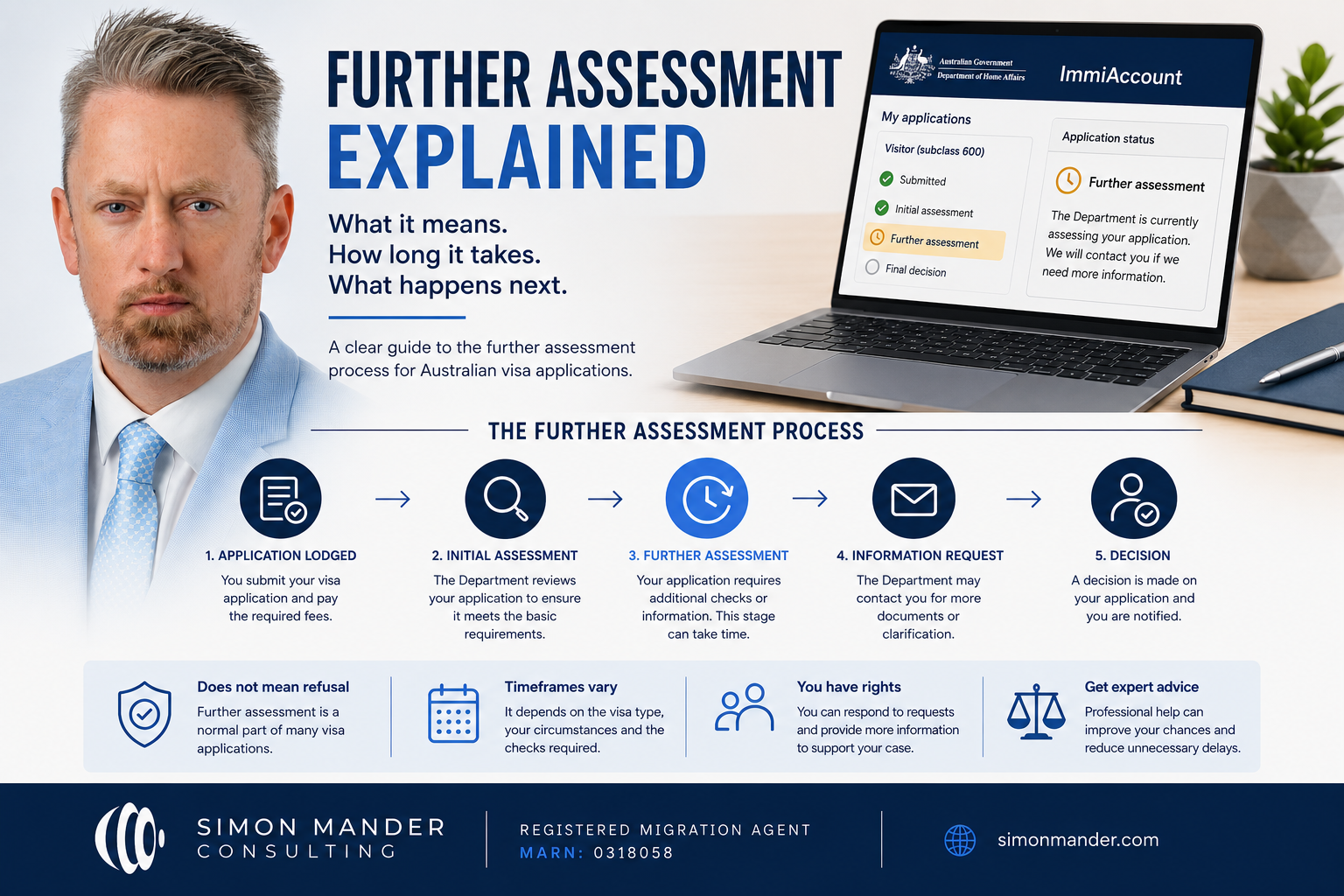
If your Australian visa application shows Further assessment in ImmiAccount, the Department is continuing to assess the application. The status does not itself mean that the visa will be granted or refused, and it does not explain why the application remains under assessment.
Some applications remain in Further assessment while routine checks are completed. Others may require document verification, health or character assessment, consideration of the visa criteria or additional information. This guide explains what the status means, how long it may remain and what applicants should—and should not—do while waiting.
By Simon Mander, Registered Migration Agent (MARN 0318058).
Simon has more than 23 years of experience in Australian migration practice, including visa application strategy, Department information requests, evidence issues, refusals and review options.
Quick Answer
Further assessment means the Department is still assessing your visa application.
The status does not, by itself, mean:
- that the visa will be refused
- that the Department has identified a problem
- that additional documents are required
- that a decision is about to be made
- that another application with the same status is directly comparable to yours
The Department will contact you if it requires further information. Until then, the status should be treated as an administrative update rather than a prediction of the outcome.
Further Assessment Guides: Find Your Situation
What further assessment means depends on your situation — start with the guide that matches yours:
- Worried the wait means refusal? —
Can further assessment lead to refusal?
- Received a letter from the Department? —
Natural justice letters and information requests: how to respond
- Already refused? —
Visa refused after further assessment: what happens next
- In Australia with a refusal looming? —
The Section 48 bar: the trap that closes your onshore options
- Thinking about pulling out before a decision? —
Withdrawing a visa application: when it may be the stronger option
- Waiting on an 820 or 309? —
Partner visa further assessment
What Further Assessment Tells You — and What It Does Not
| The Status Tells You | The Status Does Not Tell You |
|---|---|
| The application is still being assessed | Whether the visa will be granted or refused |
| A final decision has not yet been recorded | Whether the Department has identified a specific concern |
| The Department may contact you if further information is required | Whether you should upload more documents without being asked |
| You should continue monitoring ImmiAccount and your email | How long the remaining assessment will take |
| The application remains active | Whether another application showing the same status is comparable to yours |
Two visa applications can display the same Further assessment status for completely different reasons. One may be awaiting a routine check, while another may involve verification or a substantive issue requiring closer consideration.
The status identifies the stage of processing. It does not explain the reason or predict the outcome.
How Long Does Further Assessment Take?
There is no separate published processing timeframe for the Further assessment status.
An application may remain in Further assessment for days, weeks or longer depending on:
- the visa subclass
- the complexity of the application
- health, character or identity checks
- document verification
- whether information is required from another agency
- whether the Department requests further documents or explanations
- the Department’s workload and processing priorities
The amount of time spent in Further assessment is not a reliable prediction of the outcome.
I have seen applications remain in Further assessment for months and then be granted. I have also seen applications move quickly and be refused. The length of the wait does not, by itself, reveal what the decision-maker thinks about the application.
A longer wait does not necessarily mean a worse outcome, and a quick decision does not necessarily mean a favourable one.
Applicants should compare the overall processing time with the Department’s published processing information for the relevant visa subclass, rather than expecting a separate timeframe for the Further assessment stage.
Further Assessment on Visitor Visa Applications
Visitor visa applications can remain in Further assessment while the Department considers whether the applicant genuinely intends a temporary stay and satisfies the other requirements of the relevant Visitor visa stream.
The assessment may involve consideration of:
- the purpose and proposed length of the visit
- available funds and who will pay for the trip
- employment, study, business or family circumstances
- reasons to return to the applicant’s home or usual country of residence
- previous travel and immigration history
- information provided by an inviter or supporting family member
- the consistency and authenticity of supporting documents
Limited travel history or modest financial resources do not automatically mean refusal. The Department considers the application as a whole and whether the stated visit is credible in the applicant’s circumstances.
I have seen visitor visa applications with substantial bank balances refused because the source of the funds and the purpose of travel were poorly explained. I have also seen applicants with relatively modest finances succeed because the trip was realistic, clearly funded and consistent with their personal circumstances.
The size of a bank balance matters less if the application cannot explain where the money came from, who controls it and how it relates to the proposed visit.
See Australia Visitor Visa Processing Time, Australia Visitor Visa Duration and Australia Visitor Visa Checklist.
What Does Further Assessment Mean for an Australian Visa?
Further assessment means the Department is continuing to assess the visa application before recording a final decision.
The status may remain while the Department:
- considers whether the visa criteria are satisfied
- verifies identity or supporting documents
- reviews financial, employment or business information
- assesses health or character requirements
- considers previous travel or immigration history
- waits for information from another agency
- reviews documents or explanations already provided
The words Further assessment do not identify which of these activities is occurring in a particular application.
They also do not establish that the Department has found a problem. In many cases, the status reflects ordinary assessment or verification rather than an identified refusal concern.
A Status Is Not a Reason
An ImmiAccount status identifies where an application sits administratively. It does not explain what the decision-maker thinks about the evidence.
Two applications may display the same status while involving completely different assessments, checks and legal issues.
Why an Application May Remain in Further Assessment
There is no single reason why an Australian visa application may remain in Further assessment, and ImmiAccount does not identify the reason.
Depending on the visa and the applicant’s circumstances, assessment may still be continuing because the Department is:
- considering whether the applicable visa criteria are satisfied
- verifying identity or supporting documents
- reviewing financial, employment or business information
- assessing health or character requirements
- examining previous travel or immigration history
- checking information with another agency or organisation
- considering inconsistent or incomplete information
- waiting for the application to progress within its processing priorities
Some of these reasons are part of ordinary visa processing. Others may involve an issue that requires closer consideration. The status alone does not reveal which applies.
Applicants often try to interpret the length of the wait or compare their status with another person’s application. Those comparisons are rarely reliable because two applications with the same ImmiAccount status may involve completely different evidence, checks and legal requirements.
For a more detailed explanation, see Further Assessment Triggers: Health, Character and Document Verification.
Does Further Assessment Mean Refusal?
No. Further assessment does not automatically mean that an Australian visa application will be refused.
The status also does not establish that the Department has identified a problem or is preparing to refuse the application. Many applications are granted after remaining in Further assessment.
The risk of refusal depends on the application itself, including:
- whether every applicable visa requirement is satisfied
- whether the supporting evidence is credible and sufficient
- whether statements, dates and documents are consistent
- whether health, character or identity requirements are met
- whether any Department request is answered properly and on time
- whether adverse information or previous immigration history affects the application
A prolonged assessment does not create a refusal ground. Equally, a quick decision does not guarantee approval.
Applicants also sometimes assume that receiving no request for further information means the Department has no concerns. That is not necessarily correct. A decision-maker may decide the application using the documents and information already provided.
The important question is not whether the status is good or bad. It is whether the application satisfies the legal requirements and whether the evidence can withstand verification.
See Can Further Assessment Lead to Refusal? and Why Australian Visas Get Refused.
What Should You Do During Further Assessment?
The appropriate response depends on whether the Department has actually asked you to provide anything.
If You Have Not Received a Request
- check ImmiAccount regularly
- monitor your email, including spam and junk folders
- confirm that your contact details remain current
- keep copies of all documents previously submitted
- preserve any new evidence that may become relevant later
- avoid uploading documents merely because the status has changed
Silence does not necessarily mean that the Department has no concerns. It also does not mean that a refusal is approaching. The application may simply remain under assessment while checks or consideration continue.
If You Receive a Request for Information
Read the request carefully and identify:
- exactly what information or documents are required
- the deadline for responding
- whether the request concerns evidence, verification, health, character or another legal requirement
- whether any statement in the original application needs clarification or correction
The response should address the actual issue rather than overwhelm the Department with unrelated documents.
Where a requested document cannot be obtained, explain why, provide evidence of the attempts made to obtain it and identify any reliable alternative evidence.
Do Not Upload Random Additional Documents
Applicants often assume that more evidence must improve an application. That is not always true.
An unnecessary document may:
- introduce a date that conflicts with the application
- contradict an earlier statement
- raise a new issue requiring verification
- distract from the evidence that actually matters
- make the application more difficult to understand
Additional evidence should solve an identifiable problem. It should not be uploaded simply to relieve anxiety about the status.
If the Department correspondence raises potentially adverse information, allegations or a possible refusal issue, see Natural Justice Letters and Information Requests: How to Respond.
Can You Speed Up Further Assessment?
There is no general fee that allows an applicant to purchase faster processing simply because an application is showing Further assessment.
Some visa categories are processed according to formal priorities. In limited circumstances, the Department may also consider a request for priority processing where the relevant visa arrangements allow it and there are sufficiently urgent, compassionate or compelling circumstances.
A request for faster processing should not be made merely because:
- the application has been waiting longer than expected
- another applicant received a decision sooner
- travel has already been booked
- the ImmiAccount status has not recently changed
- the applicant is anxious about the outcome
Where a genuine priority request is available, it should clearly explain the circumstances and include evidence supporting the urgency.
What Can Reduce Avoidable Delay?
Applicants cannot control the Department’s workload or the time required for external checks. However, they can reduce avoidable delay by:
- providing complete and accurate information at lodgement
- responding to Department requests within the stated deadline
- uploading documents in a clear and organised format
- explaining any inconsistency rather than leaving it unresolved
- notifying the Department promptly of material changes
- avoiding repeated enquiries or unrelated document uploads
A complete application may prevent avoidable delay, but it cannot guarantee when the Department will make a decision.
When Should You Contact the Department?
If the application remains within the Department’s published processing timeframe, contacting the Department will not usually provide any additional information about its progress.
The published timeframe is an indication based on recently decided applications. It is not a guarantee that every application will be decided within that period.
Before Making a Progress Enquiry
Check that:
- the application is genuinely outside the published processing timeframe for the relevant visa
- all Department requests have been answered
- the response and supporting documents were uploaded successfully
- no correspondence has been missed in ImmiAccount, email, spam or junk folders
- the applicant’s contact and passport details remain current
Where the application is outside the published timeframe, use the enquiry channel specified for the relevant visa or processing location.
A progress enquiry may confirm that the application remains under assessment, but it does not require the Department to make an immediate decision or change the application’s processing priority.
When You Should Not Simply Wait
Contact or update the Department promptly if:
- your address, email, telephone number or passport details have changed
- there has been a material change in your circumstances
- you discover that information in the application was incorrect
- you cannot provide a requested document by the stated deadline
- you have received correspondence that you do not understand
- there are genuine urgent, compassionate or compelling circumstances relevant to the application
Contacting the Department is useful when you have relevant information to provide. Repeatedly asking for a status update will not usually make the application move faster.
Official processing estimates can be checked using the Department of Home Affairs visa processing times guide.
Related Further Assessment and Visa Guides
Further Assessment
Can Further Assessment Lead to Refusal?
Natural Justice Letters and Information Requests
Visa Refused After Further Assessment
Withdrawing a Visa Application
The Section 48 Bar
Partner Visa Further Assessment
Visitor Visa Guides
Refusal and General Visa Guidance
Visa Refused in Australia: What to Do First
Visa Appeals Australia and ART Review
Australian Visas
Australian Visa Information Hub
Further Assessment Australia Visa FAQs
What does Further assessment mean?
Further assessment means the Department is continuing to assess your visa application. It does not identify why the application remains under assessment or predict whether the visa will be granted or refused.
How long does Further assessment take?
There is no separate published timeframe for the Further assessment status. An application may remain at this stage for days, weeks or longer depending on the visa subclass, the checks required and the individual circumstances.
Does Further assessment mean refusal?
No. Further assessment does not automatically mean refusal, and it does not establish that the Department has identified a problem. The outcome depends on whether the application satisfies the relevant visa requirements.
Can my visa still be approved after Further assessment?
Yes. Many visa applications are granted after showing Further assessment. The status means assessment is continuing rather than indicating a particular outcome.
Why has my application gone into Further assessment?
The status may remain while the Department considers the visa criteria, verifies documents, completes health, character or identity checks, reviews immigration history or waits for information from another agency. ImmiAccount does not identify the particular reason.
Should I upload more documents during Further assessment?
Not merely because the status has changed. Additional documents should be uploaded where the Department requests them, where relevant information needs to be corrected or updated, or where a targeted document addresses an identifiable issue.
Will uploading more documents speed up the application?
Not necessarily. Unrequested documents may introduce inconsistencies or make the application harder to assess. A complete and clearly organised response can prevent avoidable delay, but it cannot guarantee when a decision will be made.
Can I pay to speed up Further assessment?
There is no general fee that allows an applicant to purchase faster processing simply because an application is showing Further assessment. Processing priorities and any ability to request urgent consideration depend on the visa category and the circumstances.
When should I contact the Department?
A progress enquiry may be appropriate where the application is outside the published processing timeframe and all requests have been answered. You should also update the Department promptly if your contact details, passport or material circumstances change.
Will calling the Department make my application move faster?
Usually not. If the application is within the standard processing timeframe, the Department generally cannot provide additional progress information even if you call. Repeated enquiries do not usually change the application’s processing priority.
Simon’s Perspective
Applicants naturally focus on the words showing in ImmiAccount because that is often the only visible sign of progress.
In practice, the status label is usually the least informative part of the application.
I have seen applications remain in Further assessment for months and then be granted. I have also seen applications move quickly and be refused. The length of the wait and the wording of the status are not reliable indicators of the likely outcome.
The more useful exercise is to review the application itself:
- What visa requirements still need to be satisfied?
- What information may need verification?
- Are the statements and documents consistent?
- Has the Department requested anything?
- Is there an issue that should be corrected or explained?
Applicants sometimes upload more documents simply because they feel they must do something. That can create new inconsistencies without resolving the issue actually being assessed.
Simon Principle
A Status Is Not a Reason
An ImmiAccount status identifies where an application sits administratively. It does not explain why the application remains there or what the decision-maker thinks about the evidence.
Two applicants may see exactly the same Further assessment status while their applications involve completely different checks, evidence and legal issues.
The application should be assessed by examining the visa requirements, information provided and Department correspondence—not by attempting to interpret the status label as a prediction.
Strategic Question
Are you trying to interpret an ImmiAccount status, or have you reviewed the application itself to identify what the Department may still need to assess, verify or understand?
About Simon Mander
Simon Mander is a Registered Migration Agent (MARN 0318058) with more than 23 years of experience in Australian migration practice.
His work includes visa eligibility and application strategy, evidence assessment, Department requests for information, natural justice issues, visa refusals and Administrative Review Tribunal matters.
In Further Assessment matters, Simon’s focus is on the application itself rather than trying to interpret the ImmiAccount status as a prediction. The relevant questions are what criteria remain to be assessed, whether the evidence is coherent and whether anything now requires a targeted response.
Understand the Application, Not Just the Status
If your application is showing Further assessment, the status itself may not reveal whether any action is required.
A paid assessment can consider the visa pathway, application history, evidence already supplied, Department correspondence and any apparent risks or inconsistencies.
This information is general in nature and does not constitute migration advice for your individual circumstances. Australian migration law and policy can change, and eligibility should be assessed based on the circumstances existing at the time of application.