
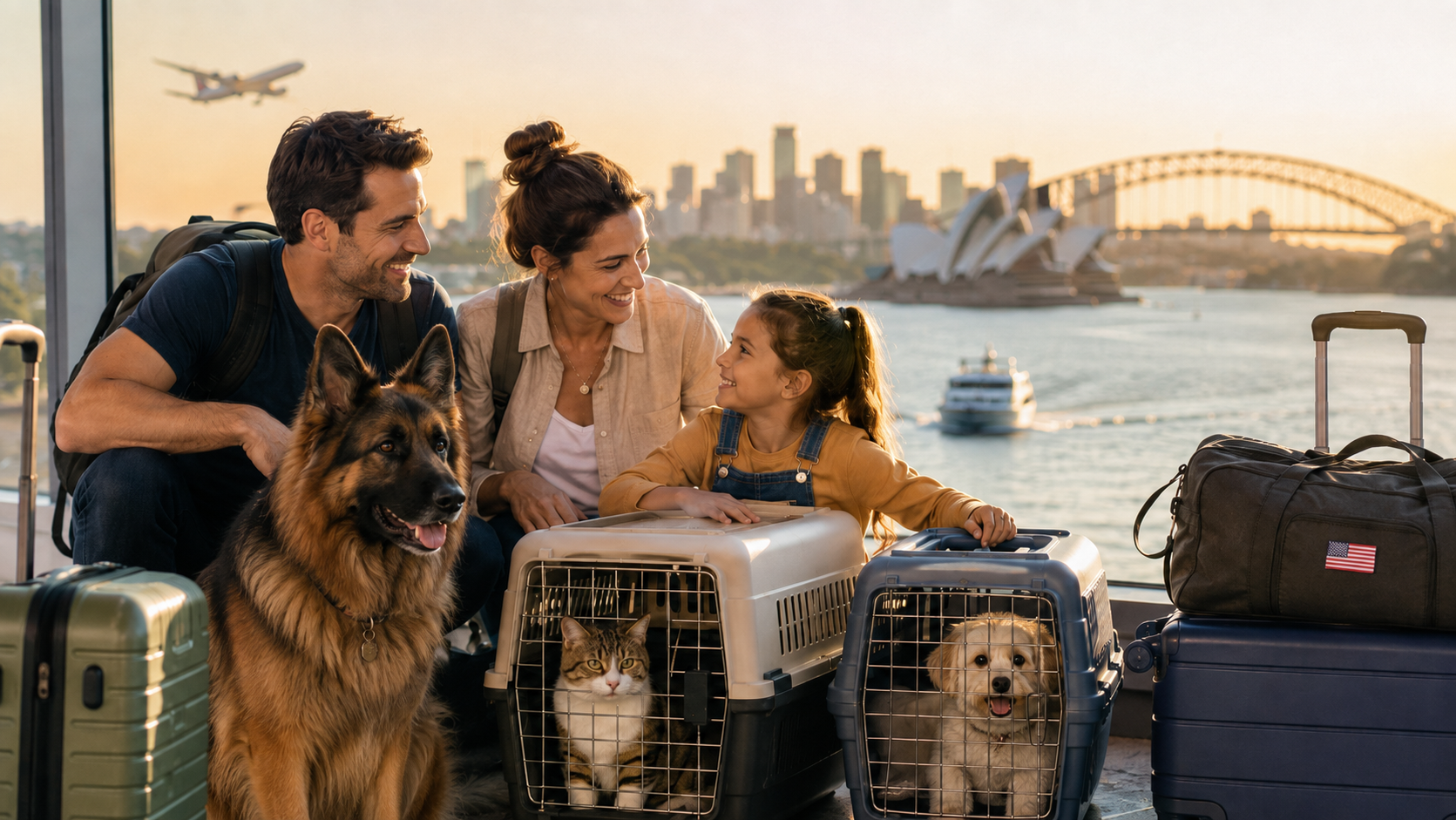
Moving Pets from the USA to Australia: What Americans Need to Know
Moving pets USA to Australia requires serious advance planning. Dogs and cats can be brought from the mainland United States to Australia, but Australia has strict biosecurity rules involving microchip identification, rabies vaccination, blood testing, an import permit, veterinary certification and mandatory post-entry quarantine.
For many Americans considering migration, pets are part of the family. The question is not simply whether you can obtain an Australian visa. It is whether the entire household can make the move.
The good news is that there is an established pathway for bringing eligible dogs and cats from the United States to Australia.
The important part is timing.
You should begin investigating the pet-import process at least six months before the earliest date you want your animal to travel.
Australia’s requirements are sequential. If an important step is completed incorrectly or at the wrong time, the animal’s travel date can be delayed significantly.
Simon Mander — Registered Migration Agent (MARN 0318058) — more than 23 years’ experience in Australian migration law.
Establish your Australian visa pathway early so your migration and pet-relocation planning can run together.
Can you bring a dog or cat from the USA to Australia?
Yes.
Dogs and cats can be imported from the mainland United States to Australia provided they satisfy Australia’s import conditions.
Australia currently classifies the United States of America — excluding Hawaii and Guam — as a Group 3 approved country for dog and cat imports.
Group 3 countries are approved countries where rabies is present or where Australia does not recognise the country as rabies-free.
That is why the process includes strict rabies vaccination, testing and waiting-period requirements.
The USA follows Australia’s Group 3 pet-import pathway
This is an important point because older websites may describe the United States using outdated country categories.
Under the current Australian system, dogs and cats travelling from mainland USA follow the Group 3 pathway.
The requirements differ from those applying to animals coming from recognised rabies-free countries.
The Department of Agriculture, Fisheries and Forestry publishes separate step-by-step guides for importing dogs and cats from Group 3 countries.
Those government guides and the conditions on the animal’s actual import permit should always be treated as the authoritative instructions.
Start at least six months before your pet needs to travel
The process cannot normally be organised a few weeks before departure.
A central part of the Group 3 pathway is a 180-day period associated with the rabies preparation process.
Your animal needs to satisfy the relevant residency and rabies requirements during this period.
This is why pet relocation should be considered early in your migration planning.
A reasonable planning sequence can involve:
- confirming that your dog or cat is eligible for import;
- checking or implanting a compliant microchip;
- considering formal identity verification;
- ensuring rabies vaccination is current;
- undertaking the Rabies Neutralising Antibody Titre Test;
- completing the required waiting period;
- applying for the Australian import permit;
- booking post-entry quarantine;
- completing further veterinary tests and parasite treatments;
- obtaining the required veterinary health certification and USDA endorsement; and
- arranging compliant transport to Australia.
The exact requirements differ between dogs and cats and can change, so the current Australian step-by-step guide must be followed.
Microchipping comes first
Your dog or cat must have a compliant microchip.
The microchip links the animal to its:
- rabies vaccination;
- blood tests;
- laboratory reports;
- import permit;
- veterinary health certificate; and
- other import documentation.
The microchip needs to be scanned and correctly recorded throughout the preparation process.
If the microchip cannot be read, or the number on the documentation does not match the animal, import can be jeopardised.
This is one reason you should not simply begin vaccinations and blood tests without first understanding the required sequence.
Identity verification can reduce quarantine from 30 days to 10 days
This is now one of the most important strategic steps in the process.
For dogs and cats coming from a Group 3 country, the normal minimum post-entry quarantine period is 30 days.
However, an animal may qualify for a minimum 10-day quarantine period if its identity is formally verified by the relevant competent authority before the blood sample is taken for the Rabies Neutralising Antibody Titre Test.
This identity verification is not the same as simply having:
- a microchip certificate;
- a vaccination record;
- a pet passport; or
- a veterinarian confirming the microchip number informally.
It is a specific government identity-verification process.
For US animals, the USDA provides instructions for completing the identity declaration required for Australian import.
If you want to pursue the shorter quarantine pathway, investigate identity verification before the RNATT blood sample is taken.
Rabies vaccination
Your dog or cat needs to satisfy Australia’s rabies vaccination requirements.
The animal’s rabies vaccination must remain valid throughout the relevant preparation period and through export.
If the vaccination lapses, the animal may need to be vaccinated again and repeat parts of the preparation process.
That can include restarting the waiting period.
Do not allow a required rabies vaccination to expire during the process.
What is the RNATT?
RNATT stands for Rabies Neutralising Antibody Titre Test.
This is a blood test used to demonstrate that the animal has developed an adequate antibody response following rabies vaccination.
The sample must be collected and tested in accordance with Australia’s requirements.
The microchip needs to be scanned before the blood sample is collected so that the test can be linked to the correct animal.
For animals prepared in the United States, the veterinary and government documentation requirements also involve USDA procedures.
The 180-day waiting period
For animals coming from Group 3 countries, Australia imposes a minimum 180-day period connected with the rabies preparation and residence requirements.
This period exists because an animal infected with rabies can potentially remain clinically healthy for a significant period after infection.
The animal does not spend those 180 days in Australian quarantine.
It normally remains with you in an approved country while the required period passes and the remaining import preparations are completed.
The important consequence is simple:
you cannot compress a six-month biological waiting requirement into a last-minute relocation plan.
How long is an RNATT valid?
Australia currently recognises a valid RNATT for 12 months from the date the blood sample is collected, provided the relevant requirements continue to be met.
If the test expires before export, additional testing may be required.
If continuity is not maintained, the 180-day waiting period may need to restart.
This makes timing important at both ends of the process: do not start too late, but also do not allow important tests or vaccinations to lapse.
You need an Australian import permit
Dogs and cats imported from Group 3 countries require an Australian biosecurity import permit.
The application is made to the Australian Department of Agriculture, Fisheries and Forestry.
For Group 3 animals, supporting documents include the required rabies testing documentation and associated government declarations.
If you are seeking the minimum 10-day quarantine period, the relevant formal identity-verification evidence must also be provided.
The permit will set out the conditions your animal must satisfy before travel.
Read the actual permit carefully once it is issued. It is not enough to rely on a checklist from a relocation company or an older internet article.
Additional veterinary tests and parasite treatments
Rabies preparation is only part of the import process.
Dogs and cats also need to satisfy additional veterinary requirements before export.
Depending on the species and circumstances, this can include:
- internal parasite treatments;
- external parasite treatments;
- additional blood testing;
- specific disease testing;
- clinical examination; and
- final health certification.
Some of these steps have strict windows measured in days before export.
Following the correct sequence matters.
American dogs can have additional testing requirements
Dog imports generally involve more disease-specific preparation than cat imports.
The Australian Group 3 dog guide contains additional testing and treatment requirements that need to be followed precisely.
The requirements may also differ according to factors such as the dog’s sex, reproductive status and health history.
Your USDA-accredited veterinarian and any specialist pet-relocation provider should work from the current Australian dog import guide and the conditions stated on the import permit.
You need a USDA-accredited veterinarian
For dogs and cats being prepared for export from the United States, the veterinarian undertaking the relevant export work must be appropriately USDA accredited.
This includes important preparation steps such as:
- scanning and confirming the microchip;
- drawing blood;
- completing laboratory submissions;
- administering required treatments; and
- preparing export health documentation.
Do not assume your usual local veterinarian automatically has the accreditation required for international export certification.
USDA endorsement
Australia requires official government involvement in aspects of the certification process.
For pets exported from the United States, this involves the US Department of Agriculture Animal and Plant Health Inspection Service — USDA APHIS.
Australia-specific health certification and supporting documentation need to be completed and endorsed in accordance with the current USDA instructions.
The USDA currently uses its Veterinary Export Health Certification System — VEHCS — for relevant electronic documentation processes.
This stage needs to be built into your travel timeline.
Post-entry quarantine at Mickleham
Dogs and cats imported into Australia from the United States enter post-entry quarantine after arrival.
The Australian Government’s Post Entry Quarantine facility for imported dogs and cats is at Mickleham in Victoria, near Melbourne.
Your animal therefore does not simply arrive at your final Australian home city and leave the airport with you.
The quarantine arrangements need to be booked as part of the import process.
How long will my pet spend in quarantine?
For Group 3 dogs and cats, the standard minimum quarantine period is generally 30 days.
That may be reduced to a minimum of 10 days where the animal satisfies Australia’s identity-verification requirements before the RNATT blood sample is collected.
Australian-origin animals with appropriate Australian export identity evidence may also qualify for the shorter period.
This is why the identity-verification step can make a substantial difference to the relocation plan.
The final quarantine period is determined under the applicable import conditions and may be extended if biosecurity issues arise.
Can quarantine be avoided completely?
No.
Dogs and cats arriving under the Group 3 pathway are subject to post-entry quarantine.
Formal identity verification can potentially reduce the minimum stay from 30 days to 10 days, but it does not remove the quarantine requirement.
Can my pet quarantine in Sydney or another Australian city?
Imported dogs and cats requiring post-entry quarantine are processed through the Australian Government facility at Mickleham in Victoria.
If you plan to live in Sydney, Brisbane, Adelaide, Perth or another city, you need to account for the pet’s release and onward transport from Victoria after quarantine.
How do pets travel to Australia?
International pet transport is different from ordinary passenger travel.
The animal needs to travel in a compliant crate and satisfy the relevant airline, routing and Australian biosecurity requirements.
Transport arrangements can involve:
- airline cargo bookings;
- approved travel crates;
- transit-country requirements;
- coordination with the quarantine booking;
- airport handling; and
- final documentation checks.
Do not book the animal’s flight simply because you have booked your own passenger ticket.
Do pets have to fly on the same flight as their owners?
Not necessarily.
The animal’s travel is governed by its own biosecurity, quarantine and transport arrangements.
In many cases, the pet’s relocation schedule will be coordinated separately from the family’s passenger flights.
The important issue is meeting all Australian import conditions rather than trying to place the pet on the same aircraft as the owner.
Should you use a professional pet-relocation company?
For many families, yes.
It is possible to understand and manage much of the process yourself, but pet importation involves several different systems:
- Australian biosecurity;
- USDA requirements;
- veterinary preparation;
- laboratory testing;
- airline cargo;
- import permits; and
- Australian quarantine.
A specialist international pet-relocation company can coordinate much of the logistics.
However, using a relocation company does not remove the need to understand the important dates and requirements yourself.
How much does it cost to move a pet from the USA to Australia?
There is no single fixed price.
Costs can include:
- microchipping;
- rabies vaccination;
- RNATT laboratory testing;
- other veterinary testing;
- parasite treatments;
- veterinary appointments;
- USDA endorsement;
- Australian import permit fees;
- quarantine charges;
- travel crates;
- air freight;
- pet-relocation company fees; and
- transport after release from quarantine.
Australian government fees are reviewed periodically, so use the current DAFF fee schedules rather than relying on figures quoted in an old article.
Can all dog breeds be imported into Australia?
No.
Australia restricts the import of certain dog breeds and types.
There can also be restrictions relating to domestic/non-domestic hybrids.
If your dog is a restricted breed, resembles one, or has unusual ancestry, check eligibility before spending money on the preparation process.
What about hybrid cats?
Restrictions can also apply to certain hybrid cats.
If your cat has serval, Asian leopard cat or other wild-species ancestry, you should investigate the Australian eligibility rules specifically.
Do not assume that every animal legally kept as a pet in the United States can automatically be imported into Australia.
What about birds, reptiles and other pets?
Dogs and cats have established import pathways.
Other animals are a different matter.
Australia has extremely strict biosecurity and wildlife-import rules.
Some birds, reptiles and other species cannot be imported as household pets at all, while others may face highly specialised conditions.
If your household includes anything other than ordinary domestic dogs or cats, investigate that animal separately before committing to migration plans.
Should you wait until your Australian visa is granted before starting the pet process?
Not necessarily.
This requires judgment.
The pet-import process can take many months, while Australian migration processes can also take substantial time.
Waiting until the day a visa is granted before beginning pet preparations could delay the family’s relocation by another six months or more.
On the other hand, veterinary preparation, permits and transport involve real financial costs.
The sensible approach is to understand both timelines early and decide when the pet preparation should begin based on the strength and likely timing of your visa pathway.
Run the visa and pet timelines together
For a family migrating permanently, I would think about the process as two parallel projects:
Migration pathway
- occupation or family eligibility;
- skills assessment where applicable;
- English testing where relevant;
- state nomination or employer sponsorship;
- visa application; and
- expected travel timing.
Pet relocation
- eligibility;
- microchip;
- identity verification;
- rabies preparation;
- RNATT;
- 180-day period;
- permit;
- veterinary preparation;
- USDA certification;
- transport; and
- quarantine.
The two timelines do not need to begin on exactly the same day, but they should be considered together.
How Simon Mander Consulting can help
I provide Australian migration advice rather than veterinary or animal-import services.
For the actual pet-import requirements, your sources should include:
- the Australian Department of Agriculture, Fisheries and Forestry;
- USDA APHIS;
- a USDA-accredited veterinarian; and
- where useful, a specialist international pet-relocation provider.
My role is to establish whether the family’s Australian migration plan is realistic in the first place.
That may involve:
- skilled migration;
- state nomination;
- employer sponsorship;
- partner migration;
- parent migration; or
- another Australian visa pathway.
If your pets are part of your family, their relocation timeline should form part of the planning from the beginning.
Establish whether you have a realistic visa pathway early enough to coordinate the rest of the move properly.
Related guides for Americans
-
Australia Visa Requirements for Americans
-
Living in Australia as an American: What to Expect
-
Medicare for Americans in Australia
-
Do Americans Need a Job Offer to Migrate to Australia?
-
English Test Requirements for Americans
-
Do Americans Have to Renounce US Citizenship to Live in Australia?
-
Can American Tradespeople Migrate to Australia?
Frequently asked questions
Can I bring my dog or cat from the USA to Australia?
Yes. Eligible dogs and cats can be imported from mainland USA under Australia’s Group 3 import pathway provided all biosecurity requirements are met.
How long does it take to move a pet from the USA to Australia?
You should allow at least six months. Group 3 imports involve rabies vaccination, an RNATT and a minimum 180-day period, as well as permits, further veterinary preparation, certification, transport and quarantine.
Is the USA a Group 2 or Group 3 country for Australian pet imports?
Mainland United States is currently a Group 3 approved country for dog and cat imports. Hawaii and Guam have separate treatment and should be checked against the current Australian rules.
How long do American dogs and cats stay in Australian quarantine?
The standard minimum for Group 3 animals is generally 30 days. This can potentially be reduced to a minimum of 10 days where the animal’s identity was formally verified by the competent authority before the RNATT blood sample, or where qualifying Australian-origin evidence applies.
Where do pets quarantine after arriving in Australia?
Imported dogs and cats requiring post-entry quarantine are accommodated at the Australian Government Post Entry Quarantine facility at Mickleham in Victoria.
What is an RNATT?
RNATT means Rabies Neutralising Antibody Titre Test. It is a blood test used to demonstrate an adequate antibody response to rabies vaccination and is a central requirement for dogs and cats coming from Group 3 countries.
Do I need a USDA-accredited veterinarian?
Yes, for the relevant export preparation undertaken in the United States. USDA requires the veterinarian preparing the dog or cat for Australian export to be appropriately accredited.
Can identity verification reduce my pet’s quarantine period?
Potentially yes. Formal government identity verification completed before the RNATT blood sample can allow an eligible Group 3 dog or cat to qualify for a minimum 10-day rather than minimum 30-day quarantine period.
Can I bring a bird or reptile from the USA to Australia?
Possibly not. The import rules for animals other than dogs and cats are very different, and some species cannot be imported as household pets. The requirements need to be checked specifically for the species concerned.