
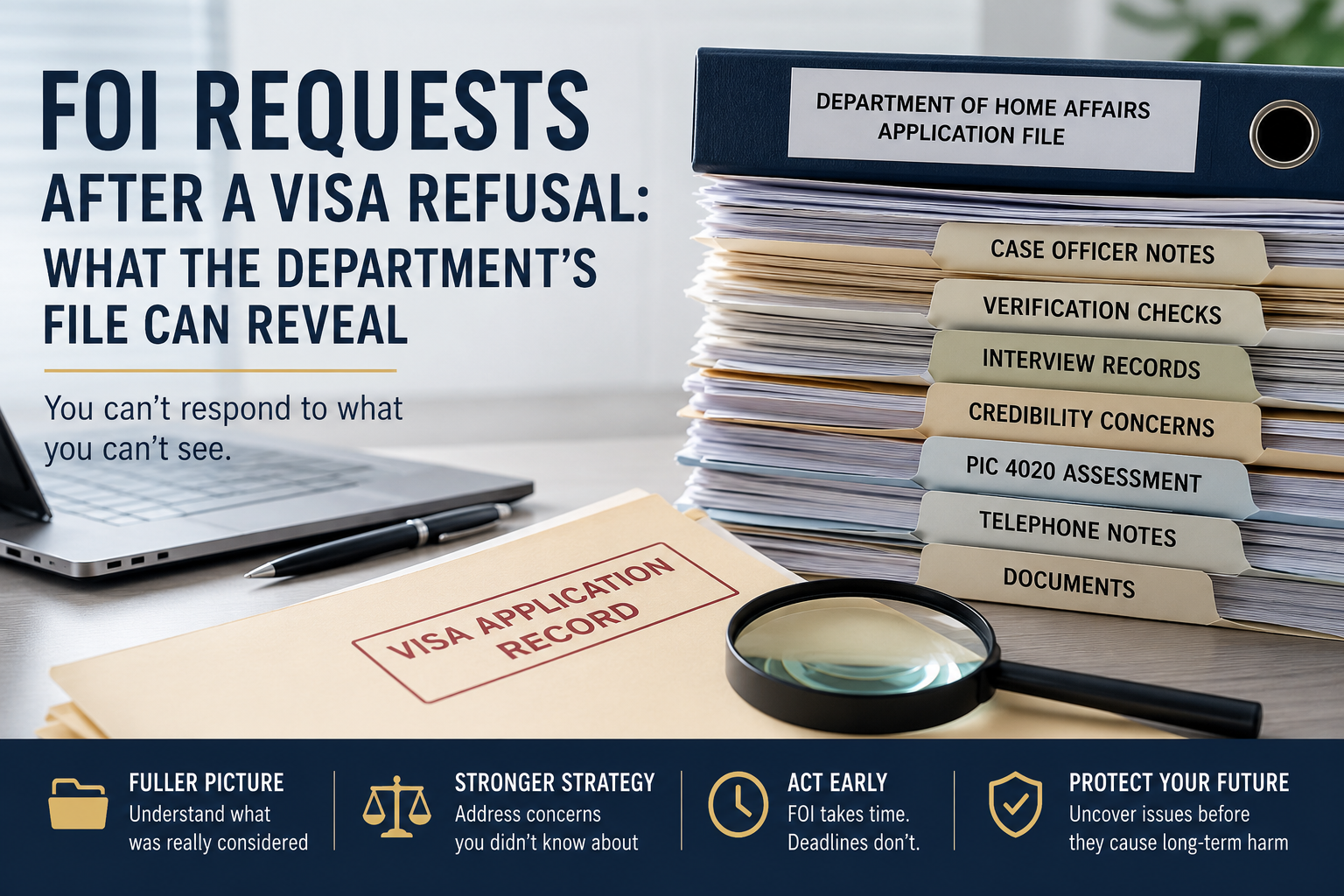
FOI Requests After a Visa Refusal: What the Department’s File Can Reveal
FOI request after visa refusal: this process can sometimes help reconstruct the application record, identify documents the applicant no longer holds and clarify information relevant to an ART review or future visa strategy.
It is not automatically the first or best access method in every case. The starting point is to collect what is already available, identify what is genuinely missing and decide whether the missing material is important enough to justify a Privacy Act request, FOI request, Client Merits Review File Request or another access process.
The Simon Principle
You Cannot Safely Rebuild a Refused Application from Memory.
A refusal response should be checked against the application that was actually lodged, the documents supplied, earlier immigration records and the information held by the applicant or their former representative. Memory becomes particularly unreliable when dates, employment periods, financial figures or earlier explanations are already disputed.
The Available–Missing–Material–Method Framework
Before lodging an FOI request, work through four questions:
- Available — what is already accessible through ImmiAccount, email, retained records, earlier applications and the former representative’s client file?
- Missing — which specific forms, documents, correspondence or records cannot be located?
- Material — could the missing information affect the refusal finding, credibility assessment, ART strategy or future application?
- Method — what is the most appropriate way to obtain it: the former representative, Home Affairs personal access process, FOI, Client Merits Review File Request or ART material?
This framework avoids two opposite mistakes:
- preparing a new account without checking what was said previously; and
- making an extremely broad access request for every departmental document when the important missing material is narrow and identifiable.
The purpose of access is not to collect the largest possible file. It is to obtain the records needed to understand and respond to the actual decision problem.
Visa Refused — But You Don’t Have the Complete Application File?
If your visa has been refused and you cannot establish exactly what was lodged, preparing an ART review or another visa application without reconstructing the original record can create further problems.
I can assess the refusal against the documents currently available, identify which missing records may be material and recommend whether further information should be obtained from a former representative, Home Affairs or the ART.
The objective is not necessarily to obtain every document. It is to identify the records needed to understand the refusal and prepare a reliable strategy.
Important: if an ART deadline is approaching, protecting any available review right must take priority. A strategy assessment does not itself lodge an ART application or extend the deadline.
At a Glance
- Start with what you already have:
email, ImmiAccount, retained forms, previous applications and the former representative’s file. - Do not wait for FOI before protecting an ART deadline:
access requests and review applications operate on separate timelines.
See
How Long Do You Have to Apply for ART Review?. - FOI may not produce everything:
documents can be redacted, exempt, unavailable or outside the scope of the request. - The refusal decision is not always the whole record:
the application file may contain forms, correspondence, interview material, verification records or earlier information relevant to strategy. - Request records for a purpose:
identify what information is missing and why it matters before defining the request. - Compare every recovered record with the new account:
earlier dates, figures and explanations should be reconciled before further evidence is prepared.
Contents
Step 1 — Collect What Is Already Available
Home Affairs recommends checking ImmiAccount, VEVO and the records held by the applicant or migration representative before making a personal access request.
The first reconstruction exercise should therefore begin with:
- the complete refusal notification;
- the formal decision record;
- every attachment supplied with the decision;
- the application form available through ImmiAccount;
- documents shown as uploaded to the application;
- Home Affairs requests for information;
- responses to those requests;
- procedural-fairness correspondence;
- interview invitations and retained notes;
- emails exchanged with Home Affairs;
- earlier drafts and retained copies of statements;
- the former representative’s correspondence;
- earlier visa, sponsorship, nomination or skills-assessment records; and
- the applicant’s current visa information in VEVO.
Some applicants assume they need FOI because they cannot find a copy of the visa form.
The form or uploaded documents may already be accessible through:
- the applicant’s ImmiAccount;
- an account controlled by the former representative;
- email attachments;
- cloud-storage folders;
- documents supplied to a sponsor, employer or family member;
- a former migration agent’s client records; or
- another related immigration application.
The Applicant’s Copy Is Often Not the Lodged Copy
An applicant may still hold:
- a draft form completed before final instructions were given;
- a résumé that was later revised;
- an unsigned version of a statement;
- a reference letter that was replaced before lodgement; or
- a folder containing only the documents the applicant personally supplied.
That material is useful, but it should not automatically be treated as the final application record.
The important question is whether the document was actually submitted to Home Affairs, and in what form.
Build a Lodged-Record Register
Create a simple table showing:
| Record | Available? | Confirmed as lodged? | Why it matters |
|---|---|---|---|
| Visa application form | Yes / No | Yes / No / Unclear | Contains the applicant’s formal answers |
| Supporting statements | Yes / No | Yes / No / Unclear | Establishes the earlier narrative and chronology |
| Uploaded documents | Yes / No | Yes / No / Unclear | Shows what evidence was originally before Home Affairs |
| Home Affairs correspondence | Yes / No | Not applicable | May identify concerns raised during processing |
| Response material | Yes / No | Yes / No / Unclear | Shows how the applicant previously answered the concern |
Step 2 — Identify What Is Actually Missing
Do not define the problem merely as:
“I need the Department’s whole file.”
Identify the specific records that cannot be located.
Examples may include:
- the final application form;
- the final version of a personal statement;
- the sponsor’s or employer’s related application;
- a response supplied to Home Affairs;
- an uploaded employment reference;
- the documents attached to a natural-justice response;
- an interview record;
- a telephone file note;
- verification correspondence;
- an earlier visa application containing related dates or claims;
- the decision record and material supplied to the ART; or
- a particular departmental record referred to in the refusal reasons.
The request can then be framed around identifiable records, dates and applications.
A targeted request is generally easier to understand and process than a request for:
“Every document Home Affairs has ever held about me.”
Separate a Missing Document from a Missing Explanation
Sometimes the applicant has the complete lodged file but still does not understand why the decision-maker rejected it.
That is different from missing the application record itself.
The problem may require:
- analysis of the refusal reasons;
- comparison between the documents and the relevant visa criterion;
- identification of inconsistencies already visible in the file;
- the ART review documents;
- a targeted personal access request; or
- legal or professional interpretation rather than additional records.
An FOI response cannot replace analysis of the documents already available.
Once the original record has been reconstructed, the next question is whether the evidence can address the actual refusal findings. The ART does not simply reward applicants for supplying more documents. The material must be relevant to the legal criteria, reliable and capable of answering the issues in dispute.
See
What Wins at an ART Visa Appeal: Evidence, Credibility and Legal Strategy
for the distinction between recovering the application record and developing a persuasive review case.
Step 3 — Decide Whether the Missing Material Matters
Not every missing document affects the strategy.
A missing record is more likely to be material where it may show:
- what answer was given to the question that later caused the refusal;
- which version of a document was actually lodged;
- how a disputed date or financial figure first entered the record;
- whether the applicant was given an opportunity to respond to a concern;
- what was said during an interview or verification contact;
- whether an employer, sponsor or institution gave different information;
- why Home Affairs considered a document unreliable;
- whether an earlier visa application contains a contradictory account;
- which documents were provided to the ART; or
- whether a new statement would conflict with information already held.
A missing document may be less important where:
- the refusal finding is already clear from the decision;
- the final lodged version is available from another source;
- the record concerns an issue the decision-maker accepted;
- the document would not affect the legal criterion in dispute;
- the same information appears in multiple available records; or
- the immediate procedural issue can be resolved without it.
Do Not Assume the File Contains a Hidden Second Refusal
The Department’s records may provide useful context, identify verification activity or help reconstruct what was considered.
That does not mean every refusal has an undisclosed “real reason” hidden in an internal file.
The formal decision reasons remain the starting point.
Access records should be used to understand the application and the decision process—not to build a strategy around speculation that an unknown adverse case must exist.
PIC 4020 and Integrity Concerns
Where the decision, correspondence or application record raises a concern about false or misleading information, identity or document reliability, the issue must be assessed carefully.
Do not assume that an access request will necessarily reveal a separate or undisclosed PIC 4020 finding.
Instead, check:
- whether PIC 4020 or another integrity criterion appears in the decision;
- whether Home Affairs sent procedural-fairness correspondence;
- what information or document was questioned;
- how the applicant previously responded;
- whether the concern affected the formal decision;
- whether related information appears in another immigration application; and
- whether additional records are needed before a further response is prepared.
Integrity issues should not be added to the case merely because an internal record might hypothetically contain one.
Step 4 — Choose the Correct Access Method
Different access routes produce different records.
1. Request Documents from the Former Migration Representative
Where a registered migration agent prepared the original application, make a written request for the documents to which the client is entitled.
The request should identify:
- the client and immigration matter;
- the application or review reference;
- the documents sought;
- where the records should be sent;
- any new registered migration agent authorised to receive them; and
- the urgency created by a refusal or review deadline.
The Code of Conduct requires a registered migration agent, after receiving a written request, to return within 14 days the documents to which the client is entitled.
That entitlement includes, without limitation, documents:
- given to the agent by or on behalf of the client; and
- paid for by or on behalf of the client.
The client’s entitlement should not automatically be described as every internal note or administrative record held by the former business.
Nevertheless, a practical written request can ask for:
- the lodged application form;
- documents uploaded with the application;
- statements and submissions;
- Home Affairs correspondence;
- responses sent on the client’s behalf;
- documents obtained or paid for by the client; and
- any other material the former representative is willing and able to provide.
2. Home Affairs Personal Access Request
A person can request access to personal information held by Home Affairs under the Privacy Act 1988 or the Freedom of Information Act 1982.
Home Affairs directs applicants to check first:
- ImmiAccount;
- VEVO;
- their own retained records;
- the records held by their migration representative; and
- whether the Client Merits Review File Request is available.
A personal access request may be appropriate where specific personal records cannot otherwise be obtained.
The request should identify:
- the visa or citizenship application;
- the relevant application or transaction reference;
- the approximate date range;
- the specific records sought;
- the applicant’s identity; and
- the authority to receive another person’s information, where applicable.
Home Affairs identifies access under the Privacy Act as generally faster and free of charge. An FOI Act request provides a formal statutory access process, including review rights concerning an FOI access decision. The appropriate route depends on the information required and the circumstances of the request.
Official information:
Home Affairs — Personal Access Requests.
3. Client Merits Review File Request
A person with a pending ART merits-review matter may be eligible to request a copy of the review file through the Home Affairs Client Merits Review File Request process.
This process is available only for eligible pending migration or protection review matters. It does not cover citizenship or character-decision reviews, and the applicant must provide the relevant ART reference number when making the request.
Home Affairs describes the review file as containing:
- the decision record;
- the application form;
- applicable supporting documents; and
- other material relevant to the review that Home Affairs provided to the ART.
This process may be more direct than a broad FOI request where the immediate purpose is to obtain the material supplied for the pending ART review.
It is not necessarily a copy of every document ever held by Home Affairs.
Official information:
Home Affairs — Client Merits Review File Request.
4. The ART’s T Documents
After an ART application is made, the original decision-maker must provide the Tribunal with the decision and relevant review documents.
The ART calls these the T documents.
The ART states that:
- the original decision-maker sends the relevant documents within 28 days after being told that the review application has been received;
- the documents are also sent to the parties;
- where a representative is appointed, they will usually be sent to the representative; and
- some content may be subject to a confidentiality or non-disclosure direction.
T documents can be important because they provide an indexed record of the material considered relevant to the review.
They should not automatically be described as the Department’s complete internal file.
Official information:
ART — T Documents After You Apply.
5. A Separate FOI Request
A separate FOI request may still be appropriate where:
- there is no pending ART review;
- the required records are not contained in the review file or T documents;
- older application records are needed;
- the request concerns non-personal agency material;
- particular verification, interview or correspondence records are sought; or
- the request has a purpose extending beyond the immediate ART review file.
The scope should be framed around the records genuinely required.
Compare the Available Access Routes
| Access route | Best used for | Important limitation |
|---|---|---|
| ImmiAccount and retained records | Immediate recovery of forms, uploads and correspondence already accessible | May be incomplete or controlled through a former representative’s account |
| Former representative | Client documents, lodged forms, uploads, submissions and correspondence | The client’s legal entitlement is not necessarily identical to every internal record held by the business |
| Personal access request | Personal information and specified Home Affairs records not otherwise available | Processing can take time and exemptions or redactions may apply |
| Client Merits Review File Request | Material supplied by Home Affairs for an eligible pending ART review | Eligibility requirements apply and it is not necessarily the complete departmental file |
| ART T documents | The indexed decision and relevant review documents provided to the ART | Confidential material may be restricted and the bundle is not necessarily every Home Affairs record |
| Targeted FOI request | Specific older, internal, personal or non-personal records unavailable through another route | Time, scope, exemptions and redactions must be considered |
Do Not Delay ART Review While Waiting for Records
An access request and an ART review application operate on separate timelines.
The applicable ART deadline must be identified from:
- the complete Home Affairs decision notification;
- the particular decision made;
- the person or organisation entitled to apply for review;
- the relevant review category; and
- any circumstances affecting the applicable period.
Do not assume that:
- every visa refusal has a 28-day review deadline;
- an FOI or personal access request extends that deadline;
- Home Affairs will provide the requested records before the deadline;
- the ART can extend the immigration-review application period while records are obtained; or
- the review application should wait until the complete evidentiary strategy has been prepared.
Protect the Review Right First
Where ART review is available and is the chosen immediate process, the application and any required payment must be completed within the applicable period.
The original application record can then be reconstructed and further evidence or submissions prepared in accordance with the ART process.
For the dedicated deadline guide, see
How Long Do You Have to Apply for ART Review After a Visa Refusal?.
Home Affairs currently reports substantial delays in processing personal access requests. The published processing figures should be checked directly before relying on any expected response date.
Official information:
Home Affairs — After Submitting a Personal Access Request.
Define the Request by Application, Period and Record Type
A useful request should allow Home Affairs to identify the documents sought without having to search every record ever connected with the applicant.
Include, where available:
- the applicant’s full name and date of birth;
- any previous names;
- passport details;
- the visa subclass;
- the visa application or transaction reference number;
- the date the application was lodged;
- the date of the refusal or other decision;
- the approximate date range of the records;
- the particular documents or categories sought;
- evidence of identity; and
- authority where a representative is making the request.
Target the Records That Matter
Depending on the case, a request might identify:
- the final lodged visa application form;
- documents uploaded with the application;
- Home Affairs requests and the responses received;
- interview records or summaries;
- telephone file notes relating to a specified verification contact;
- correspondence with a named employer, sponsor or institution;
- verification records concerning a specified employment document;
- earlier visa applications containing the disputed dates or history;
- the decision record;
- documents supplied by Home Affairs to the ART; or
- other clearly identified records connected with the refusal finding.
Avoid unnecessarily broad wording such as:
“All documents, notes, emails and information ever held about me.”
A broad request may capture large volumes of irrelevant material while failing to make the urgent records easy to identify.
Example of a Targeted Description
Example only:
I seek access to the final visa application form, supporting documents, requests for information, responses, interview records and verification records relating to visa application [reference number], lodged on [date] and decided on [date].
In particular, I seek records concerning the Department’s verification of the employment claimed with [employer name] between [date] and [date].
The scope should be adapted to the actual missing record and the reason it matters.
What May Be Redacted, Withheld or Unavailable?
A right to request access does not mean that every document will be released in full.
Depending on the applicable access process, material may be withheld or redacted because it concerns:
- another person’s personal information;
- national security, defence or international relations;
- law-enforcement or public-safety interests;
- confidential information;
- legal professional privilege;
- certain agency operations or deliberative material;
- business or commercial information;
- information protected by a secrecy provision; or
- material outside the scope of the request.
The response may therefore contain:
- pages released in full;
- pages released with passages removed;
- documents described but withheld;
- records excluded as outside scope;
- duplicate material omitted from the release; or
- a decision that the requested document cannot be found or does not exist.
A Redaction Is Not Proof of a Hidden Adverse Finding
Applicants sometimes assume that every blacked-out passage contains damaging information.
The redaction may instead protect:
- staff contact details;
- another person’s personal information;
- internal system information;
- law-enforcement methods;
- privileged material; or
- information unrelated to the decision issue.
The exemption reason and surrounding context should be examined before any strategic conclusion is drawn.
Official information:
OAIC — What Is Freedom of Information?.
What to Do When the Records Arrive
Do not upload the entire access response to the ART without first analysing it.
The records should be compared with:
- the refusal decision;
- the applicant’s retained application documents;
- the former representative’s file;
- the ART T documents;
- earlier immigration applications;
- the new evidence being prepared; and
- the account the applicant now proposes to give.
Create a Difference Register
Record any differences involving:
- employment commencement or completion dates;
- hours, salary or payment arrangements;
- job titles and duties;
- addresses and periods of residence;
- relationship dates;
- study and enrolment history;
- financial figures;
- family composition;
- travel history;
- answers given in interviews or telephone calls; and
- documents the applicant believed were lodged but which do not appear in the record.
For each difference, identify:
- what the earlier record says;
- what the applicant now says;
- why the accounts differ;
- which account is said to be accurate;
- what independent evidence supports that account; and
- whether the difference affects the refusal finding.
The purpose is not to replace the old version with a more favourable one.
It is to understand the existing immigration record before another statement or application is submitted.
Why the Reconstructed File May Matter Beyond ART Review
The original application record can also be important when assessing what options remain after a refusal. For an applicant in Australia, the refusal history, current visa status and applicable legal restrictions may affect whether another onshore visa application can be made.
Section 48 of the Migration Act can restrict certain further visa applications where its statutory conditions are met. Reconstructing the original record does not remove those restrictions, but it can help establish the circumstances that need to be assessed before choosing another pathway.
Read
Section 48 Bar Australia: When a Visa Refusal Restricts Further Applications
.
What If Home Affairs Refuses or Partly Refuses Access?
Read the access decision carefully.
It should identify:
- the documents located;
- what was released;
- what was withheld or redacted;
- the reasons relied upon;
- whether documents were outside scope;
- whether searches found no responsive records; and
- the available review or complaint rights.
Where the decision was made under the FOI Act, review options may include:
- requesting internal review by Home Affairs; or
- seeking review by the Australian Information Commissioner.
The applicable period and procedure should be taken from the decision notice and current OAIC guidance.
An internal review is not always necessary before seeking Information Commissioner review, although the OAIC notes that internal review gives the agency an opportunity to reconsider its original decision.
Review should be considered where, for example:
- the request appears to have been misunderstood;
- the searches appear not to cover an identified record system;
- a document known to exist was not addressed;
- the scope was incorrectly narrowed;
- the exemption reasoning appears incomplete; or
- partial access would meet the request without revealing protected material.
Review should not be pursued merely because the released file did not contain the damaging internal note the applicant expected to find.
Official information:
Home Affairs — After a Personal Access Decision
and
OAIC — Freedom of Information Reviews.
Fictional Worked Example: The New Statement Conflicted with the Application Nobody Could Find
The following example is fictional and is included to demonstrate the Available–Missing–Material–Method Framework.
Meera’s visa application is refused because Home Affairs is not satisfied about the period and nature of her claimed employment.
She no longer has access to the ImmiAccount used by her former representative.
Meera remembers that the application said she began working for the employer in March. She prepares a new statement for ART review confirming:
- she commenced full-time paid employment in March;
- she worked 40 hours each week;
- she held the same position throughout the claimed period; and
- the employer’s earlier reference contained only minor administrative errors.
Before the statement is submitted, the original application record is reconstructed.
Available
Meera already has:
- the refusal decision;
- some payslips;
- a copy of one employer reference;
- bank statements;
- her current résumé; and
- email correspondence with the former representative.
She does not have the final visa application form or the complete response previously sent to Home Affairs.
Missing
The records that matter are narrowly identified as:
- the final lodged visa form;
- the employment history entered in that form;
- the final employer reference uploaded with the application;
- the response to Home Affairs’ employment concerns; and
- any verification record concerning the employer.
Material
Those records matter because the refusal turns on:
- the commencement date;
- whether the first part of the period was paid employment;
- the hours worked; and
- the consistency of Meera’s employment history.
Method
Meera first requests the lodged documents from the former representative.
The file supplied by the former representative contains the final visa form. It records May—not March—as the employment commencement date.
It also shows that an earlier response described March and April as an unpaid training period.
The review file later confirms that Home Affairs focused on whether the qualifying paid employment began in March, May or June.
The Problem Revealed
Meera’s proposed new statement would have created another version:
- March — new ART statement;
- May — final lodged visa application;
- June — original employer reference; and
- March and April as unpaid training — earlier Home Affairs response.
The statement was not deliberately false. It was based on Meera’s memory of when she first attended the workplace.
But it would have confused:
- initial training;
- the formal employment commencement date;
- the first payroll period; and
- the period that could potentially satisfy the relevant requirement.
The Correct Response
The review strategy is rebuilt around:
- the dates appearing in the original application record;
- the distinction between training and paid employment;
- payroll and banking records showing when payment began;
- an employer explanation based on archived personnel records;
- a chronology confronting each earlier version; and
- only the period that can honestly be supported.
The value of reconstructing the record was not that it uncovered a hidden reason for refusal. It prevented Meera from submitting a confident new account that conflicted with information already in her immigration history.
Visa Application Record Reconstruction Checklist
After a visa refusal:
- Save the complete refusal notification and decision record.
- Download everything currently available through ImmiAccount.
- Search email, cloud storage and retained document folders.
- Request the relevant client documents from the former representative.
- Identify which documents are confirmed as the versions actually lodged.
- Create a register of available, missing and uncertain records.
- Identify whether each missing record could affect the refusal strategy.
- Check whether a Client Merits Review File Request is available.
- Review the ART T documents when supplied.
- Use a targeted personal access or FOI request where another route does not produce the required material.
- Do not delay protecting the ART deadline while waiting for records.
- Compare recovered documents with earlier visa, nomination, sponsorship and skills-assessment applications.
- Create a difference register for disputed dates, figures and explanations.
- Explain inconsistencies before submitting new evidence or statements.
- Do not upload an entire access response without identifying which records matter.
Simon’s Perspective
Applicants often believe they know what was lodged because they remember preparing the application.
That is not always the same as knowing what the final application said.
A file may have passed through several stages:
- an initial questionnaire;
- a draft visa form;
- a revised résumé;
- a replacement employment letter;
- a response to a Home Affairs request;
- a final statement;
- documents uploaded by a representative; and
- later correspondence sent without the applicant retaining a copy.
After refusal, the applicant remembers the underlying events.
The immigration record preserves the particular way those events were described.
That difference matters.
I regularly see applicants prepare a new statement that is broadly truthful but uses:
- a different employment commencement date;
- a different relationship milestone;
- a new explanation of financial arrangements;
- a revised job title;
- a different residential history; or
- a cleaner chronology than the one previously lodged.
The later account may be more accurate.
But unless the earlier version is identified and explained, the new statement can look like an attempt to repair the file after refusal.
This is why I do not start every case by lodging the widest possible FOI request.
I start by asking:
- What do we already have?
- What exact record is missing?
- Why does it matter?
- What is the fastest and most appropriate way to obtain it?
Sometimes the answer is the former representative’s client file.
Sometimes it is ImmiAccount.
Sometimes the Client Merits Review File Request or the ART T documents will provide the material needed.
Sometimes a targeted personal access or FOI request is justified.
The strategic value lies in knowing what record is needed and why—not in automatically requesting every document the Department may hold.
The other important discipline is timing.
Access processes can be slow. The right to seek ART review must be protected according to the deadline applying to the actual decision.
A missing application record may affect how the case is prepared. It should not be allowed to destroy the review right while the applicant waits for it.
The purpose of reconstructing the file is simple: before asking the Tribunal or Home Affairs to accept a new account, know precisely what the immigration record already says.
Strategic Question
Are you preparing the next statement from the documents that were actually lodged, or from your memory of what you intended the application to say?
Official Access and Review Resources
About Simon Mander
Simon Mander is a Registered Migration Agent (MARN 0318058) with more than 23 years of experience in Australian migration law.
His work includes visa refusals, credibility issues, Administrative Review Tribunal matters and reconstruction of incomplete immigration records.
When reviewing a refused application, Simon identifies what was actually lodged, which records are missing, whether the missing material could affect the strategy and which access process is most likely to produce the required documents without delaying urgent review steps.
FOI Requests After a Visa Refusal: Frequently Asked Questions
Do I always need an FOI request after a visa refusal?
No. Start by checking ImmiAccount, retained documents, email, the former representative’s file, the Client Merits Review File Request and the ART T documents. A targeted personal access or FOI request may be useful where material records remain unavailable.
Should I wait for my Home Affairs file before applying for ART review?
No. The access request does not extend the ART deadline. The review right should be protected within the period applying to the actual decision, while the original application record is reconstructed separately.
What can a Home Affairs access request reveal?
Depending on the request and available records, it may provide application forms, supporting documents, correspondence, interview records, verification material or earlier information relevant to the refusal. Not every record will necessarily be released.
What is the Client Merits Review File Request?
It is a Home Affairs process through which an eligible person with a pending migration or protection review may request the information Home Affairs supplied to the ART, including the decision record and other documents relevant to the review.
What are the ART T documents?
T documents are the decision and relevant review documents supplied to the ART by the original decision-maker. They are ordinarily also sent to the parties or their representative, although some material may be restricted.
Can an FOI response contain redactions?
Yes. Information may be redacted or withheld under applicable exemptions, including where release would affect privacy, law-enforcement interests, legal professional privilege or other protected interests.
What should I do if the recovered file contradicts my new statement?
Do not ignore the difference. Identify what the earlier record says, explain why the accounts differ, determine which version is accurate and support the corrected account with reliable independent evidence.
Get a Visa Refusal Strategy Assessment
A refused application should be assessed against the application that was actually lodged—not reconstructed from memory after the decision.
The paid Visa Refusal Strategy Assessment examines the decision notification, the available application record and the key supporting documents. You receive written strategic advice identifying the refusal problem, the urgent procedural issues and which further records may be required.
The assessment does not itself lodge an ART review, submit a Home Affairs access request or obtain documents from a former representative.
This information is general in nature and does not constitute migration advice for your individual circumstances. Australian migration law and policy can change, and eligibility should be assessed based on the circumstances existing at the time of application.