
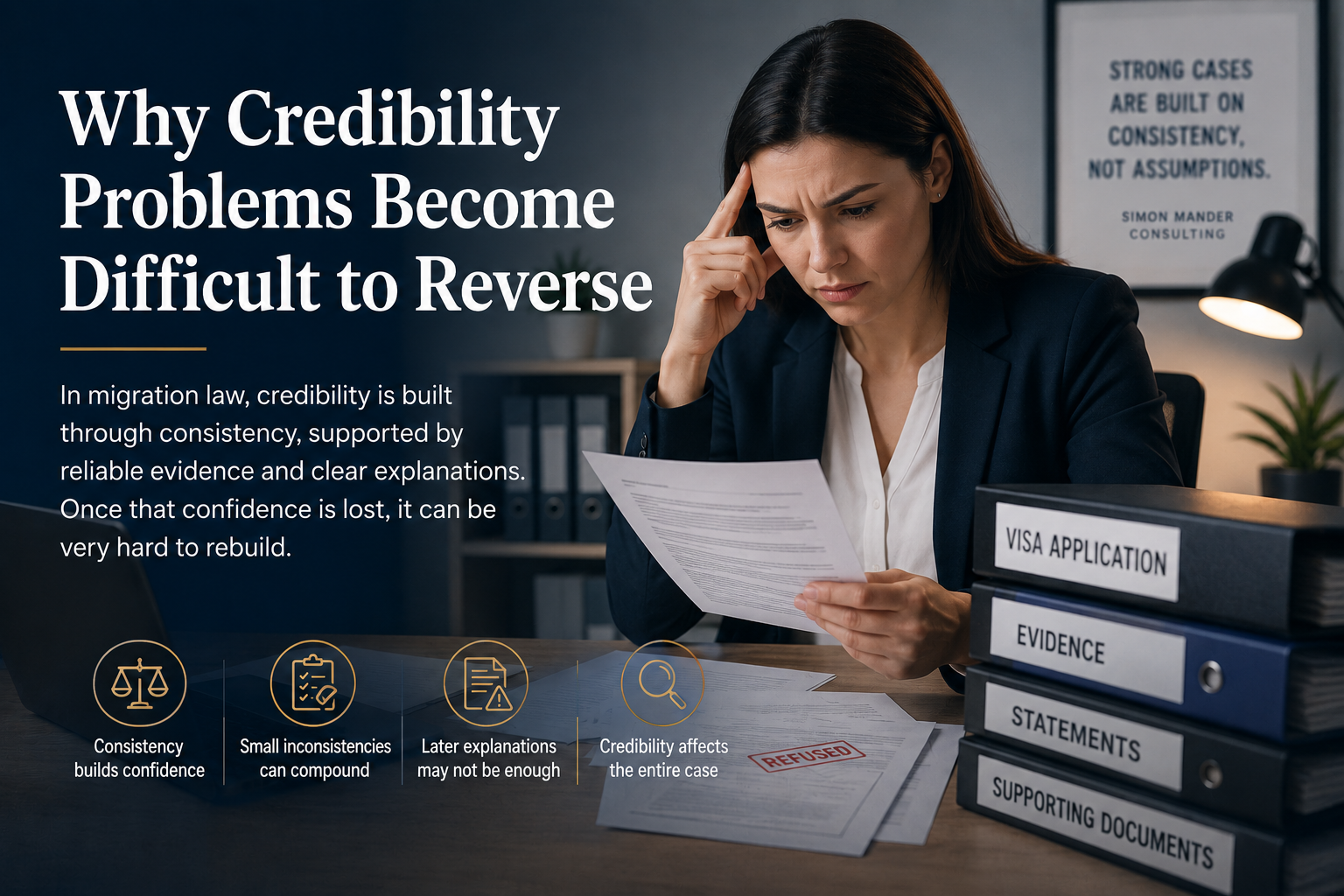
Why Credibility Problems Become Difficult to Reverse in Australian Visa Applications
An applicant can have a truthful explanation and still face a serious evidentiary problem. Once one account has been recorded in a visa form, statement, résumé, employment reference, interview or previous application, a later account is not assessed in isolation. It is compared with what was said before.
The applicant must then establish more than the underlying facts. They must also explain why the first version was incomplete, inaccurate or different. That is why credibility problems often become progressively harder to reverse: the later explanation must repair both the factual issue and the reliability of the existing record.
The Simon Principle
The First Version Becomes the Record.
Once one version of events has been supplied in a form, statement, document or previous application, every later version is compared against it. A later explanation may be true, but it must now explain both what happened and why the earlier record said something different.
Executive Summary
A credibility problem does not necessarily mean that an applicant has deliberately provided false information. It may begin with a misunderstood question, an approximate date, a poorly prepared document, an incomplete disclosure or a genuine failure to check information supplied in an earlier application.
The difficulty begins when the immigration record contains two or more versions that cannot readily be reconciled. The decision-maker must then determine what weight can safely be given to the applicant’s statements and supporting evidence when assessing the actual visa criteria.
A later correction does not simply replace the first version. It creates a second version. The applicant must therefore explain:
- which account is accurate;
- how the original discrepancy arose;
- why it was not identified earlier;
- whether the corrected account is independently supported; and
- whether connected claims are also affected.
This is why credibility repair requires more than producing another statement or a larger document bundle. It requires a disciplined reconstruction of the existing record, the chronology and the evidence supporting each important fact.
What You’ll Learn
- why the first version of events shapes how later explanations are assessed;
- the difference between correcting a fact and repairing confidence in the evidence;
- how several individually explainable inconsistencies can become one larger credibility problem;
- why an explanation first given after a concern is identified may receive closer scrutiny;
- how additional documents can deepen rather than resolve an existing conflict;
- why previous visa applications remain relevant to a current application;
- how credibility issues may be reconsidered during ART merits review; and
- what should be examined before another explanation or document is submitted.
The Record–Conflict–Repair Framework
Credibility problems usually develop through six connected stages:
- Original record — an account of the facts enters the immigration record through a form, statement, document, interview or previous application.
- Comparison — that account is compared with other forms, records, documents, witness evidence or later applications.
- Conflict — a different date, omitted fact, changed explanation or unsupported claim becomes apparent.
- Reliability question — the issue becomes not only which version is correct, but why the information changed and whether the evidence can be relied upon.
- Wider reassessment — an unresolved problem in one part of the case may cause connected claims and documents to be examined more cautiously.
- Repair — the applicant must identify the precise conflict, establish a coherent chronology, explain how the first version arose and support the corrected account with reliable evidence.
This framework explains why a correction is not necessarily a repair. Correcting a date may identify the preferred answer. Repairing the credibility problem requires an explanation for the existence of the competing answer already in the record.
At a Glance
- The original account remains relevant: a later version does not automatically replace what was previously supplied.
- Truth and reconciliation are different tasks: stating what really happened does not by itself explain why the record said something else.
- Not every inconsistency is fatal: the importance of a discrepancy depends on the fact involved, the explanation and the supporting evidence.
- Timing affects weight: an explanation given voluntarily may be assessed differently from one first produced after the contradiction is identified.
- More evidence can create more conflicts: every new document must be checked against the entire existing record.
- Previous applications matter: current claims may be compared with employment, relationship, residential, family and travel information supplied earlier.
- ART review is a fresh merits review, not an erasure of history: the original application, evidence, explanations and refusal findings may still need to be confronted.
- Repair begins with the record: before supplying another explanation, determine exactly what has already been said and where the accounts diverge.
Credibility Is About Reliability, Not Personal Character
When applicants hear the word credibility, they often assume they are being accused of dishonesty.
That is not always what the issue means in practice. A decision-maker may accept that an applicant is sincere while remaining uncertain about whether a particular date, event, employment period, relationship history or explanation can safely be relied upon.
The practical question is therefore not simply:
“Do I believe that this applicant is generally an honest person?”
The more important question may be:
“Can I rely on this account when deciding whether the legal requirements have been met?”
Reliability may be affected where:
- the applicant gives different versions of the same event;
- a document does not establish what the applicant believes it establishes;
- the chronology changes between forms, statements and supporting records;
- important information is omitted and disclosed only later;
- a witness gives an account that does not align with the applicant’s account;
- a new explanation resolves one problem but creates another; or
- the current claim conflicts with information supplied in a previous visa application.
The concern can therefore arise without any finding that every part of the case is false. The issue may instead be that the decision-maker is unable to determine which version should be accepted.
How the First Version Enters the Immigration Record
Applicants often think of their personal statement as the main account of their case. In reality, the first version may already have entered the record somewhere else.
It may appear in:
- an online visa application form;
- a previous visa application;
- an expression of interest;
- a résumé;
- an employment reference;
- a skills assessment application;
- a relationship statement;
- a Form 888 or other witness statement;
- a police, court, medical or identity record;
- an interview response;
- information supplied by a sponsor or employer; or
- a document uploaded without any explanation of what it was intended to prove.
Once that information has been supplied, it forms part of the history against which later material may be assessed.
A corrected answer may be accurate. But it does not cause the earlier answer to disappear.
Why Small Differences Can Become Structural Problems
One incorrect date does not necessarily destroy a visa application.
The difficulty is that dates are rarely isolated. They often connect to other claims about:
- how long an applicant worked in an occupation;
- whether employment was undertaken before or after a qualification;
- how many migration points were claimed;
- when a relationship became de facto;
- where the applicant was living;
- whether two events could have occurred in the sequence described;
- whether information should have appeared in an earlier application; or
- whether a witness could have directly observed the claimed circumstances.
What initially appears to be a minor date error may therefore affect several connected parts of the case.
For example, changing an employment commencement date may also change:
- the number of years of qualifying employment;
- the points claimed in an expression of interest;
- the period described in an employment reference;
- the salary records expected for that period; and
- what was stated in an earlier visa application.
The problem is no longer simply identifying the correct date. It is determining which related claims remain reliable after the date changes.
What I Check Before Accepting a New Explanation
When I review a credibility problem, I do not begin by drafting a more persuasive statement. I begin by reconstructing the record.
I ordinarily check:
- the exact wording of the original question;
- the answer that was actually supplied;
- whether the applicant completed the material personally or relied on someone else;
- where the competing version first appeared;
- whether the difference concerns a central or peripheral fact;
- what independent records existed at the time;
- whether those records support one version more strongly than another;
- whether changing the answer affects any connected eligibility claim; and
- why the discrepancy was not identified before it became an issue.
The purpose is not to find wording that makes the problem sound smaller. It is to understand exactly how the conflicting accounts arose and whether they can honestly be reconciled.
Why a Later Explanation Has Two Jobs
A later explanation does not only need to establish what actually happened.
It must usually perform two separate tasks:
- Establish the underlying fact — for example, the correct employment date, relationship commencement date, residential address or reason for an omission.
- Explain the existing record — why a different answer was previously supplied and why the later account should now be preferred.
Applicants frequently concentrate on the first task and overlook the second.
They may provide a new statement saying:
- “This is the correct date.”
- “The earlier answer was a mistake.”
- “My former employer prepared the letter incorrectly.”
- “I misunderstood the question.”
- “The Department misunderstood what I meant.”
Any of those explanations may be true. But each one raises further questions.
What caused the mistake? Why did it appear in more than one document? What information was available when the original answer was given? Why was it not checked? Does independent evidence support the corrected account?
A credible repair therefore requires more than selecting the preferred version. It requires a coherent explanation for the existence of both versions.
Fictional Worked Example: Three Employment End Dates
The following example is fictional and is included to demonstrate the evidentiary problem.
Daniel applies for a skilled visa and claims employment with the same company from January 2018 until March 2022.
When the documents are compared, the record contains three different end dates:
- his résumé says that the employment ended in December 2021;
- the visa application says March 2022; and
- the employer’s reference says June 2022.
After the inconsistency is raised, Daniel explains that:
- he stopped performing his normal duties in December 2021;
- he remained on paid leave until March 2022;
- his formal employment was not terminated in the employer’s system until June 2022; and
- different documents used different meanings of the phrase “employment end date”.
That explanation may be entirely accurate. But the later statement does not automatically resolve the problem.
The record must still establish:
- which date was relevant to the particular visa criterion;
- whether Daniel was actually performing qualifying work after December 2021;
- whether he was paid during the leave period;
- why the visa application used March 2022 without explaining the distinction;
- why the employer used June 2022;
- whether the claimed employment points depended on any disputed period; and
- whether earlier applications contained a fourth version.
A weak response would simply obtain a new reference letter using the preferred date.
A stronger response would reconcile the employment contract, payroll records, leave records, termination documents, résumé, previous applications and the precise visa claim. It would then explain why each date appeared and which date is relevant for each purpose.
The issue is not merely whether Daniel worked for the company. The issue is whether the claimed period of qualifying employment can be established through one coherent and reliable account.
Why Additional Evidence Can Deepen the Problem
Applicants often respond to a credibility concern by collecting as many new documents as possible.
That approach can be dangerous where the existing conflict has not first been understood.
A new document may:
- use a fourth date;
- introduce a fact that has never previously been disclosed;
- describe events differently from the applicant’s statement;
- appear to have been created specifically to answer the concern;
- overstate what the author personally knows;
- conflict with independent records; or
- resolve one part of the chronology while undermining another.
Evidence should therefore be tested before it is submitted.
The correct question is not:
“Does this document support my preferred explanation?”
It is:
“How does this document fit with every version and record already in the case?”
One Credibility Mechanism, Different Visa Contexts
Credibility problems arise differently across visa categories, but the underlying mechanism is usually the same:
- an important claim is made;
- the claim is compared with documents, earlier applications or other evidence;
- a difference or evidentiary gap appears;
- the applicant provides a later explanation; and
- the decision-maker must decide which account and evidence can safely be relied upon.
What changes between visa categories is the fact that matters and the legal consequence attached to it.
A disputed date may affect the commencement of a de facto relationship in a Partner visa, the amount of qualifying employment in a skilled visa, the explanation for a course choice in a student visa or whether an applicant possesses the experience claimed for a sponsored position.
Partner Visa Applications
In a Partner visa application, credibility issues often develop around the chronology of the relationship.
The applicant, sponsor and witnesses may all believe that they are describing the same genuine relationship while using different dates for:
- when the couple first met;
- when they began dating;
- when the relationship became exclusive;
- when they began living together;
- when they considered themselves de facto partners; or
- when family and friends first became aware of the relationship.
Those dates do not necessarily refer to the same event.
The problem arises when the application treats them as interchangeable or selects one date without explaining what changed at that point.
A witness may truthfully say that the relationship began in June because that is when the couple told the witness about it. The applicants may say that they began living together in March. A lease may begin in September. Those records are not automatically contradictory, but the application must explain what each date represents.
The central issue is not simply whether the relationship is genuine. It is whether the evidence establishes the legally relevant relationship history through one coherent account.
See:
Why Genuine Relationships Still Get Refused.
Skilled Visa Applications
In a skilled visa matter, the most important credibility questions often arise from the relationship between:
- the expression of interest;
- the skills assessment application;
- the subsequent visa application;
- employment references;
- résumés and professional profiles;
- payroll, taxation and bank records; and
- previous visa applications.
An invitation may have been generated using employment, qualification, English-language or other claims entered in the expression of interest. Those claims must then be supported in the visa application.
A positive skills assessment does not necessarily establish every employment period relied upon for migration points. The assessing authority and the visa decision-maker may be considering different questions under different requirements.
An employment period can therefore appear credible for one purpose while remaining insufficiently established for another.
For example, an employer may confirm that the applicant was formally employed until June. Payroll records may show that the applicant stopped receiving ordinary salary in March. The applicant may have ceased performing the relevant duties in December.
Before selecting one date, the application must identify which period is legally relevant to the particular claim being made.
Student Visa Applications
In a student visa matter, the credibility issue may concern the explanation connecting the applicant’s past circumstances with the proposed course.
Relevant records may include:
- previous study and course changes;
- academic results and periods of non-enrolment;
- employment history;
- earlier statements about career plans;
- financial records;
- previous visa applications; and
- the explanation for choosing the particular course and provider.
A generic statement about career advancement may appear plausible when read alone. It may become less persuasive if the applicant’s previous qualifications, employment history or earlier applications point in a different direction and the change is not explained.
A change in study or career direction is not inherently adverse. People change professions, discover new interests and make decisions based on circumstances that did not previously exist.
The credibility problem arises when the application avoids the change rather than explaining it.
Employer-Sponsored Visa Applications
Employer-sponsored matters can create two overlapping credibility records:
- the applicant’s record concerning qualifications, experience and capacity to perform the nominated role; and
- the employer’s record concerning the position, duties, business need and proposed employment arrangements.
Problems may arise where:
- the applicant’s claimed duties differ from the earlier employment records;
- the position description uses occupation language that does not reflect the actual workplace;
- the organisational chart does not support the claimed reporting structure;
- payroll or roster information conflicts with the proposed hours;
- the employer and applicant describe the role differently; or
- documents prepared for the application do not align with ordinary business records.
A detailed position description is not persuasive merely because it contains the language of the nominated occupation.
The question is whether the business records, workplace structure and applicant’s actual experience support the position being presented.
What I Often Find Across Different Visa Files
The visa category changes, but several recurring patterns remain remarkably similar.
I often find:
- One date being used for several different events. An applicant may use “employment end date” to mean their final working day, the end of paid leave or the formal payroll termination date without recognising that those are different facts.
- A document being asked to prove more than it actually proves. A bank transfer proves that money moved. It does not necessarily prove why it moved. A lease proves contractual liability. It does not always establish who actually lived at the property throughout the period.
- Applicants treating a favourable earlier outcome as proof of a later claim. A positive skills assessment, course admission, nomination or sponsorship approval may be important, but it does not necessarily determine every separate requirement in the visa application.
- Witnesses repeating the applicant’s account rather than describing what they directly observed. This can produce several polished statements that appear consistent but add little independent evidentiary value.
- An applicant relying on the fact that someone else prepared the earlier application. That may help explain how an incorrect answer arose, but it does not establish what the correct answer is or why the applicant accepted the earlier version.
- New documents becoming unnaturally uniform after a concern is raised. Several new statements may use the same date, wording and explanation without showing how each author independently knows those facts.
The practical task is not to force every document to use identical language. It is to identify what each record genuinely proves and explain why any differences exist.
Previous Visa Applications Are Not Separate Islands
Applicants sometimes approach each new application as though the information supplied previously is no longer relevant.
That is unsafe.
Earlier applications may contain information about:
- employment and education;
- residential addresses;
- relationship status;
- children and other family members;
- travel and immigration history;
- health and character matters;
- financial circumstances; and
- the purpose of previous travel or study.
A later answer may legitimately be different because circumstances have changed, better records have become available or an earlier answer was genuinely mistaken.
But where the answer has changed, the application should distinguish between:
- a change in the applicant’s circumstances;
- a correction to an earlier factual mistake;
- a different interpretation of the same question;
- a more precise answer based on better records; and
- a genuinely competing version of events.
Those situations are not the same and should not receive the same explanation.
Before preparing a current application or responding to a credibility concern, the earlier record should be reviewed rather than reconstructed from memory.
That review may need to include:
- copies of previous forms and uploaded documents;
- earlier résumés and employment references;
- expressions of interest and state nomination applications;
- skills assessment material;
- sponsor or employer submissions;
- interview records or written responses; and
- the reasons given for any earlier refusal or cancellation.
How One Inconsistency Can Spread Through a Case
An inconsistency becomes strategically important when it affects other claims that depend on the same fact.
| Original discrepancy | Connected questions | Records that may require reconciliation |
|---|---|---|
| Different employment end dates | Duration of qualifying work, migration points, duties performed and accuracy of the expression of interest | Contract, payroll, leave records, termination documents, references, résumé and previous applications |
| Different relationship commencement dates | Dating history, commencement of cohabitation, de facto period and what witnesses directly observed | Statements, leases, address records, messages, travel history, financial records and witness evidence |
| Conflicting residential addresses | Cohabitation, regional residence, travel history, household arrangements and previous declarations | Leases, utilities, bank correspondence, licences, taxation records, mail and travel records |
| Changed study or career explanation | Course rationale, progression, employment objectives and consistency with earlier visa statements | Academic records, enrolment history, employment evidence, course research and previous applications |
| Position duties do not align | Occupation classification, claimed experience, genuine position and actual workplace arrangements | Contracts, references, organisational charts, work records, payroll, rosters and business documents |
This table is illustrative. The documents and legal questions that matter will depend on the particular visa, criterion and facts.
Its purpose is to show why a correction in one document should not be made without checking the claims connected to it.
What Changes—and What Does Not—at the ART
The Administrative Review Tribunal conducts merits review. It takes a fresh look at the relevant facts, law and policy and makes its own decision.
That fresh review can provide an important opportunity to address the real issues in a refusal. It does not, however, cause the original application and evidentiary history to disappear.
The review materials may include:
- the original visa application;
- documents supplied to the Department;
- requests for information and the responses provided;
- interview or other recorded evidence where relevant;
- the refusal decision and its findings;
- later statements and documents; and
- any changed explanation relied upon during the review.
The Tribunal’s task is not limited to deciding whether the Department wrote a good refusal decision. It makes its own assessment of the reviewable decision under the applicable law.
That can assist an applicant where the original material was misunderstood, incomplete or capable of being supported through stronger evidence.
But where the new case depends on a different version of events, the Tribunal may still need to assess:
- why the earlier account was different;
- when the new explanation first arose;
- whether it is independently supported;
- whether it resolves the original concern;
- whether it creates inconsistencies elsewhere; and
- what weight should be given to the applicant’s present account.
A new statement can provide a better explanation. It does not erase the statement that came before it.
This is why an ART strategy should begin with the original application and refusal record, not merely with a list of additional documents that can now be obtained.
See:
ART Appeals Are Not Simply Second Chances.
See also:
What the ART Actually Reassesses.
Why Sincerity Does Not Resolve an Evidentiary Conflict
Applicants facing a credibility concern often respond from a position of personal certainty.
They know that:
- the relationship is genuine;
- the employment occurred;
- the qualification is real;
- the study plan is sincere;
- the position genuinely exists; or
- the omission was not deliberate.
That certainty may be completely genuine. It does not, by itself, resolve the decision-maker’s problem.
A visa decision must be made from the available evidence and the legal criteria. Where the record contains competing accounts, the decision-maker must determine which account should be accepted and what weight should be given to the supporting material.
Statements such as these are therefore rarely sufficient on their own:
- “I am telling the truth.”
- “It was only a small mistake.”
- “The relationship was obviously genuine.”
- “The employment definitely happened.”
- “My agent completed the form.”
- “The Department misunderstood me.”
Each statement may form part of an explanation, but none identifies:
- the exact conflict in the record;
- how the conflicting information arose;
- which version should be accepted;
- what independent evidence supports that version; or
- whether connected claims are also affected.
A credibility response must therefore move beyond personal reassurance and confront the evidentiary problem directly.
Common Ways Credibility Repair Goes Wrong
1. Denying an Obvious Inconsistency
A response loses force where it insists that there is no inconsistency even though the forms and documents plainly contain different answers.
Acknowledging that two records differ is not the same as accepting dishonesty. It is often the necessary first step in explaining what happened.
2. Replacing the Old Version Without Explaining It
Applicants sometimes submit a corrected statement that confidently sets out the preferred account but says very little about the earlier version.
That leaves the central question unanswered:
Why should the later version be accepted when a different version was previously supplied?
3. Describing Every Problem as a Typographical Error
A genuine typing mistake can occur. The explanation becomes less persuasive where several connected dates, addresses or events are all described as unrelated typographical errors.
The response should identify the actual source of each difference rather than applying one convenient label to every problem.
4. Blaming a Former Agent or Adviser Without Reconstructing the Instructions
An applicant may have relied heavily on another person to prepare an earlier application. That can be relevant, particularly where the applicant did not understand the question or was not shown the final form.
But saying that an agent completed the application does not establish:
- what information the applicant originally supplied;
- whether the applicant reviewed or approved the final answers;
- how the incorrect answer entered the form;
- what records were available at the time; or
- why the corrected account should now be accepted.
The preparation history must itself be explained and supported where possible.
5. Producing Uniform Witness Statements
Several new witness statements may appear impressive because they all support the corrected version.
They may instead create concern where:
- they use identical language;
- every witness gives the same precise date;
- the witnesses do not explain how they know that date;
- the statements repeat information supplied by the applicant; or
- none addresses why earlier evidence was different.
Independent evidence does not become stronger merely because several people repeat the same prepared account.
6. Submitting a Large Bundle Without an Evidentiary Theory
A large volume of material can obscure the issue rather than resolve it.
The decision-maker should not be left to work out:
- which document supports which fact;
- why one record should be preferred over another;
- what period each document covers;
- which documents are independent; or
- how the evidence answers the actual concern.
The stronger approach is to organise the material around the disputed facts and explain the evidentiary role of each document.
What I See When a Case Has Been Prepared Backwards
A common pattern is that the applicant begins with the explanation they want the decision-maker to accept and then searches for documents that appear to support it.
That is backwards.
The correct starting point is the complete existing record, including the material that does not fit comfortably with the preferred explanation.
When I review these files, I frequently find that:
- the refusal identifies one inconsistency, but the file contains several related versions;
- the applicant has prepared a long new statement without obtaining the earlier visa forms;
- the new employer letter uses the preferred dates but does not explain the payroll or taxation records;
- the applicant says a witness made a mistake without asking what the witness actually observed;
- the response concentrates on proving the underlying event while ignoring why the original answer was different;
- one corrected fact changes the points calculation, qualifying period or legal chronology elsewhere in the case; and
- documents are submitted because they sound supportive, without checking whether they introduce new contradictions.
The most useful document is sometimes not the document that most strongly supports the applicant. It is the document that explains why the competing versions exist.
The Credibility Repair Sequence
Credibility repair should normally proceed in a deliberate order.
Step 1 — Identify the Exact Finding or Concern
Begin with the actual issue raised by the decision-maker, refusal decision, request for information or Tribunal material.
Avoid responding to a broader accusation that has not actually been made.
The concern may relate to:
- a particular date;
- an omitted event;
- a document whose reliability is questioned;
- a conflict between two statements;
- the absence of expected evidence; or
- a conclusion drawn from several connected matters.
Step 2 — Reconstruct the Existing Record
Collect the relevant forms, statements, documents, previous applications, correspondence and decision records.
The reconstruction should show:
- what was said;
- where it was said;
- when it was said;
- who supplied the information;
- what question was being answered; and
- what documents were available at the time.
Step 3 — Separate Genuine Differences from Apparent Differences
Not every variation is a contradiction.
Two dates may refer to different events. Two documents may apply different definitions. A witness may describe when they first became aware of an event rather than when it legally occurred.
The response should distinguish between:
- two genuinely competing versions;
- two descriptions of different events;
- a broad answer and a later precise answer;
- a factual correction; and
- a change in circumstances after the earlier application.
Step 4 — Determine Which Version the Evidence Supports
The preferred explanation should not be selected merely because it produces the best visa outcome.
It must be tested against:
- contemporaneous records;
- ordinary business or personal documents;
- independent third-party material;
- the wider chronology;
- previous statements; and
- the legal meaning of the fact being established.
Step 5 — Explain How the Earlier Version Arose
The explanation should be specific.
Depending on the facts, it may involve:
- a misunderstood question;
- an approximate date given from memory;
- different meanings attached to the same phrase;
- information entered by another person;
- a document prepared from incomplete records;
- a translation problem;
- a later discovery of more reliable documents; or
- a genuine failure to disclose relevant information.
A difficult explanation is usually stronger than an artificial explanation that cannot survive comparison with the records.
Step 6 — Test the Consequences of the Correction
Before submitting the corrected account, determine whether it affects:
- visa eligibility;
- migration points;
- the qualifying employment period;
- the relationship chronology;
- a sponsorship or nomination claim;
- another answer in the application;
- the reliability of a witness; or
- information supplied to another assessing body.
A correction should not be presented as minor before its wider consequences have been examined.
Step 7 — Present One Reconciled Account
The final response should make it easy to understand:
- what the discrepancy was;
- which facts are now relied upon;
- why the earlier information was different;
- what evidence supports the corrected account;
- how the connected records have been reconciled; and
- what, if any, uncertainty remains.
The objective is not to manufacture perfect consistency. It is to provide an honest, evidenced and coherent account of why the record developed as it did.
Simon’s Perspective
The credibility files that concern me most are not necessarily the ones containing the largest factual error.
They are the files in which nobody has first established what the complete record actually says.
Applicants often begin by drafting a forceful explanation. Former employers are asked to issue new letters. Witnesses are asked to prepare additional statements. More documents are uploaded.
But if the original application, previous visa history and supporting records have not been placed side by side, the response may be built on an incomplete understanding of the problem.
I have seen applicants spend substantial effort proving that an event occurred while leaving unanswered why they previously gave a different date, address or sequence of events.
I have also seen apparently damaging differences become understandable once the records reveal that two documents were referring to different things—for example, a final working day, the end of paid leave and the formal termination date.
That distinction cannot be found by producing more persuasive language. It is found by reconstructing the chronology and examining what each document actually proves.
The first question in credibility repair should therefore not be:
“How do we persuade the decision-maker that the applicant is telling the truth?”
It should be:
“What versions already exist, why do they differ and which evidence allows them to be reconciled?”
The Stronger Strategic Approach
The strongest strategy is to identify credibility risks before they become adverse findings.
Before lodgement, that means:
- obtaining copies of previous visa and skills assessment applications;
- checking dates across forms, résumés, references and supporting records;
- distinguishing approximate dates from verified dates;
- identifying difficult facts rather than omitting them;
- checking what each document genuinely establishes;
- explaining legitimate changes in circumstances;
- testing witness statements against direct knowledge; and
- ensuring the application presents one coherent chronology.
After a concern or refusal has arisen, the objective changes.
The applicant must then address:
- the substantive fact in dispute;
- the existence of the earlier version;
- the reason for the difference;
- the supporting evidence;
- the timing of the correction; and
- the effect of the correction on the rest of the case.
Not every inconsistency is fatal. People make genuine mistakes, records use different terminology and memories are imperfect.
The danger lies in responding casually to a discrepancy that affects the structure of the case.
Once the first version has entered the immigration record, the task is not to pretend it never existed. The task is to confront it, explain it and establish why the reconciled account should now be accepted.
Strategic Question
If every form, document, previous application and statement in your case were placed side by side, would they tell one coherent and reliable story?
Related Visa Refusal, Credibility and ART Guides
Why Visa Refusal Problems Often Begin Long Before Refusal
— how unsupported assumptions, inconsistent records and unresolved gaps can shape a refusal before the decision is made.
Why Strong Visa Cases Still Get Refused
— why having a genuine underlying case is different from proving the legal criteria through reliable evidence.
Why Last-Minute Evidence Can Create Problems
— how documents prepared or submitted late can introduce new dates, explanations and credibility concerns.
ART Reviews Are Not Simply Second Chances
— why review strategy should begin with the original application and refusal rather than merely adding more evidence.
What the ART Actually Reassesses
— an explanation of merits review and the Tribunal’s role in making its own assessment of the reviewable decision.
Why Genuine Relationships Still Get Refused
— how credibility and proof problems can arise even where the underlying Partner relationship is genuine.
About Simon Mander
Simon Mander is a Registered Migration Agent (MARN 0318058) with more than 23 years of experience in Australian migration law.
His work includes visa refusals, cancellations, credibility concerns, natural justice responses and Administrative Review Tribunal matters.
When reviewing a credibility problem, Simon begins with the existing record: the forms, previous applications, statements, documents and decision findings already in the case. The purpose is to identify exactly where the competing versions arose, determine what the evidence actually establishes and assess whether the problem can realistically be repaired.
This approach is particularly important where a later explanation may be truthful but must now be reconciled with a different version already contained in the immigration record.
Get a Visa Refusal Strategy Assessment
If a credibility problem has already contributed to a refusal, or must now be addressed at the Administrative Review Tribunal, the answer is not necessarily to submit more evidence.
The paid Visa Refusal Strategy Assessment reviews the decision, the existing application record and the key supporting documents. You receive a written strategic recommendation explaining the actual problem, whether it can realistically be addressed and whether the stronger option is ART review, a fresh application, another pathway or no further action.
This is a paid professional assessment. It does not lodge an ART review or engage Simon to conduct the review on your behalf.
Credibility Problems in Visa Applications: Frequently Asked Questions
Why do credibility problems become difficult to reverse?
A credibility problem becomes difficult to reverse because a later explanation does not replace the earlier record. The applicant must establish the underlying facts and explain why the earlier form, statement or document contained a different version.
Does an inconsistency mean that the applicant was dishonest?
No. An inconsistency may arise from an approximate date, misunderstood question, incomplete record, translation problem or genuine mistake. The issue is whether the competing accounts can be explained and whether the relevant facts can be established through reliable evidence.
Can a corrected statement repair a credibility problem?
Sometimes, but a corrected statement must do more than give the preferred version. It should explain how the earlier version arose, identify the evidence supporting the correction and address any connected claims affected by the change.
Can providing more evidence make a credibility problem worse?
Yes. Additional evidence can deepen the problem if it introduces another date, changes the chronology, conflicts with earlier material or relies on witnesses who cannot independently establish the facts they describe.
Does the Administrative Review Tribunal ignore the original visa application?
No. The Tribunal conducts a fresh merits review, but the original application, supporting documents, earlier explanations and refusal findings may remain relevant when the Tribunal makes its own assessment of the reviewable decision.
What should be reviewed before responding to a credibility concern?
The relevant forms, previous applications, statements, supporting documents, correspondence and decision findings should be placed side by side. The response should identify each competing version, explain why it arose and establish which account is supported by the most reliable evidence.
Can credibility concerns be repaired after a visa refusal?
Sometimes. The prospects depend on the importance of the inconsistency, the reason it arose, the refusal findings, the available independent evidence and whether one coherent explanation can address both the underlying facts and the earlier record.
This information is general in nature and does not constitute migration advice for your individual circumstances. Australian migration law and policy can change, and eligibility should be assessed based on the circumstances existing at the time of application.