
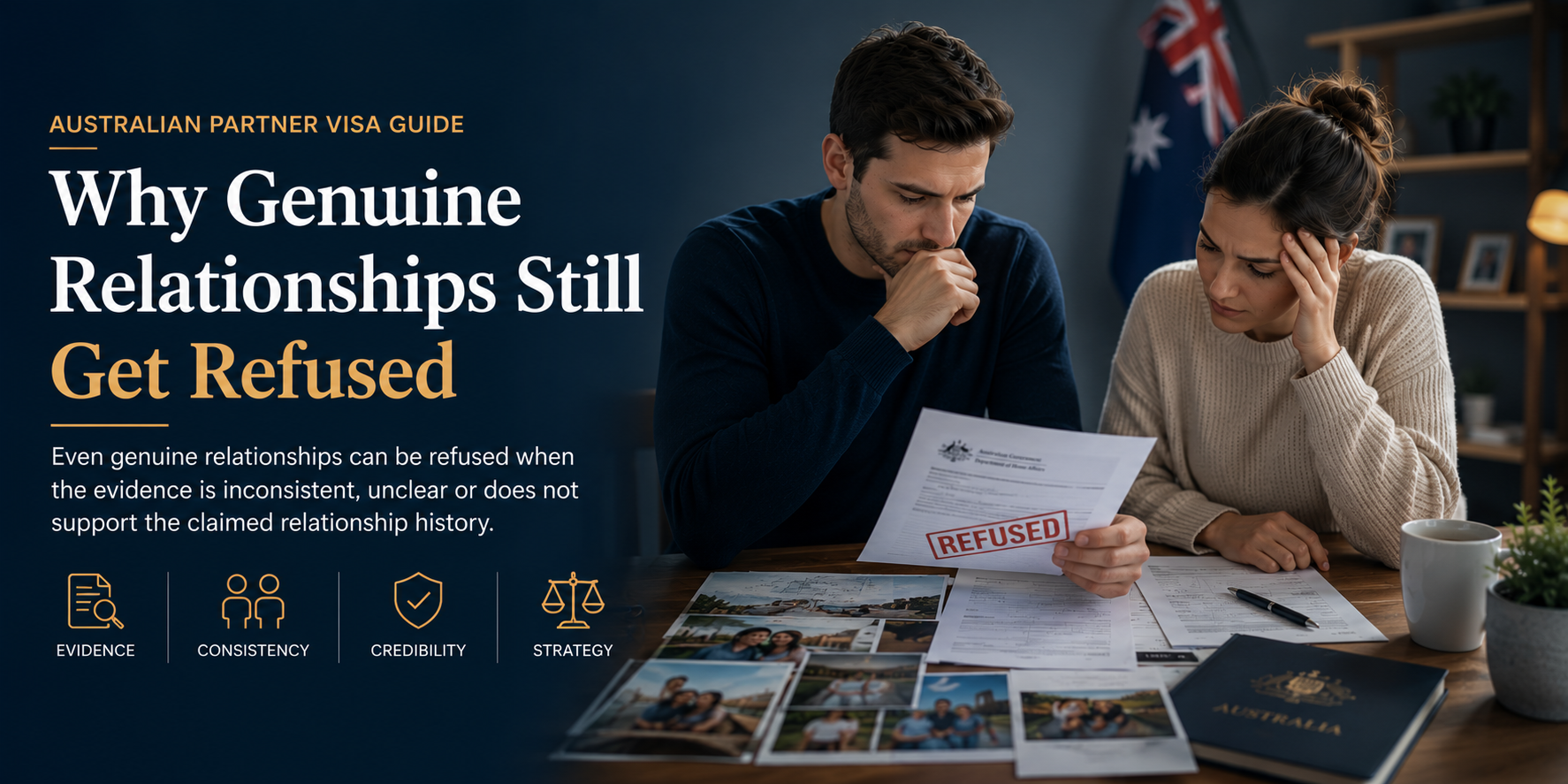
Why Genuine Relationships Still Get Refused
A genuine relationship does not automatically produce a successful Partner visa application. The Department must be satisfied that the evidence consistently supports the relationship history being claimed. Where documents, statements, dates or living arrangements do not align, a genuine couple can still face delay, further assessment or refusal.
Executive Summary
Partner visa decisions are not based only on whether two people genuinely love one another. They are based on whether the legal criteria are met and whether the evidence presents a credible, consistent and persuasive account of the relationship.
A genuine relationship can become difficult to assess where there are weak timelines, unexplained addresses, contradictory statements, limited evidence of shared life, poorly prepared witness evidence or documents that appear to have been assembled only for the application.
This guide explains why genuine relationships can still be refused, how credibility concerns develop, why evidence quality matters more than volume and how strategic preparation can reduce avoidable risk.
What You’ll Learn
- Why a genuine relationship is not automatically an approvable application
- How the Department assesses relationship evidence
- Why inconsistencies can damage credibility
- Why more evidence is not always stronger evidence
- How living apart and unusual circumstances should be explained
- Why timing can affect Partner visa strategy
- What may happen after a Partner visa refusal
The Partner Visa Refusal Framework
A Partner visa refusal risk often develops through five connected stages:
- Relationship History — the events and circumstances being claimed
- Evidence — the documents and statements supporting that history
- Consistency — whether dates, addresses and explanations align
- Credibility — whether the overall account appears reliable
- Decision — whether the Department is satisfied the legal criteria are met
A relationship can be genuine at the first stage but still encounter problems at the later stages if the evidence does not consistently support the story being presented.
How Genuine Relationships Become Successful Applications
A genuine relationship is the foundation of every successful Partner visa application, but it is only the beginning of the assessment process.
A genuine relationship is essential, but every later stage also needs to be satisfied before a Partner visa can be granted.
At a Glance
| Topic | Summary |
|---|---|
| Core issue | A genuine relationship must still be supported by persuasive evidence |
| Primary decision focus | Whether the relationship is genuine and continuing under the legal criteria |
| Common risk | Inconsistencies between forms, statements and documents |
| Evidence standard | Relevant, dated, credible and consistent evidence |
| Major misconception | That genuine relationships are automatically approved |
| Simon Principle | Genuine Relationships Do Not Refuse Themselves. Applications Do. |
A Genuine Relationship Is Not the Same as a Persuasive Application
One of the most important distinctions in Partner visa strategy is the difference between the reality of the relationship and the quality of the application.
A couple may know that their relationship is genuine. Their families and friends may also know that it is genuine. However, the decision-maker does not assess the relationship through personal familiarity.
The decision-maker assesses the application through:
- the information provided in visa forms
- the partners’ relationship statements
- financial and household records
- social and commitment evidence
- travel and address histories
- Form 888 witness statements
- responses to requests for further information
The application must therefore make the relationship understandable and credible to someone who has never met the couple.
A genuine relationship still needs a strong evidentiary case.
Why Genuine Relationships Still Get Refused
A genuine relationship can still be refused where the application is poorly evidenced, internally inconsistent or difficult to assess.
Genuine Relationship vs Application Problems
| Relationship Reality | Application Problem |
|---|---|
| Genuine relationship | Weak or inconsistent evidence |
| Genuine relationship | Contradictory partner statements |
| Genuine relationship | Periods of separation left unexplained |
| Genuine relationship | Poorly organised documentation |
| Genuine relationship | One or more legal criteria not satisfied |
The refusal is often not because the relationship is false. It is because the application does not allow the Department to be satisfied that all relevant legal requirements have been met.
Common problems include:
- weak or unclear relationship timelines
- different relationship dates in different documents
- inconsistent residential addresses
- unexplained periods of separation
- generic or unpersuasive statutory declarations
- limited financial or household evidence
- contradictions between forms and partner statements
- witness evidence that does not match the couple’s account
- documents that appear rushed or artificially assembled
- unusual circumstances that have not been explained
In many cases, the problem is not the relationship itself. The problem is how the relationship has been documented, organised and explained.
Credibility Problems Can Damage Genuine Cases
Credibility is one of the most important issues in Partner visa applications.
A case can become difficult where the Department identifies unexplained inconsistencies, unclear evidence or statements that do not match the documents.
Examples may include:
- one partner giving a different relationship history from the other
- forms containing different relationship commencement dates
- documents showing different addresses without explanation
- conflicting accounts of living arrangements
- claims of cohabitation unsupported by household evidence
- financial claims not reflected in financial records
- witness statements that conflict with the couple’s statements
- evidence appearing to have been created only for the visa application
A missing document can sometimes be explained. A contradiction may be more damaging because it can cause the decision-maker to question the reliability of the broader application.
Simon’s Perspective
Many couples assume that if the relationship is genuine, the Department will somehow recognise that automatically. It cannot.
The Department sees forms, documents, statements and dates. It does not see the private reality of the couple’s daily life unless that reality has been explained and supported through evidence.
When I review a Partner visa application, I am not only asking whether the relationship is genuine. I am asking whether a decision-maker who has never met the couple would understand the relationship, believe the account being presented and feel confident that the evidence supports it.
In my experience, many refusal files involve genuine couples. The issue is rarely whether the relationship existed. The issue is whether the application enabled the decision-maker to be satisfied that all of the legal requirements had been met.
.
Living Apart Does Not Automatically Mean Refusal
Living apart does not automatically destroy a Partner visa application or de facto claim.
Unexplained separation can create risk. Properly explained separation may be entirely manageable.
See Living Apart Does Not Automatically Destroy a De Facto Claim.
Why Timing Matters
Timing can become critical in Partner visa strategy.
This is especially true where:
- the applicant’s current visa is close to expiry
- the applicant has become unlawful
- Schedule 3 criteria may apply
- the couple has limited cohabitation evidence
- the relationship has developed quickly
- important documents are not yet available
- there has already been a refusal or visa cancellation
A rushed application may create gaps that later become credibility problems.
Waiting is not always the correct strategy either. The right decision depends on the visa position, the relationship evidence, legal timing issues and the risks created by delay.
See Why Partner Visa Timelines Often Become Complicated.
Other Reasons a Partner Visa May Be Refused
Relationship evidence is only one part of the legal assessment. Even where a relationship is genuine and well documented, every other legislative requirement applicable to the application must still be satisfied. A refusal on one of the grounds below can defeat an application that would otherwise have succeeded on relationship grounds alone.
Schedule 3
Where an onshore applicant does not hold a substantive visa when the application is made, Schedule 3 criteria may apply. These require compelling reasons for waiving the requirement, and a genuine relationship is not automatically a compelling reason. Schedule 3 cases turn on why the applicant became unlawful, how long that continued and what the consequences of leaving Australia would be.
Sponsor Eligibility
Sponsorship is a separate approval, not a formality attached to the applicant’s case. Limitations apply where the sponsor has previously sponsored a partner, has been sponsored as a partner themselves, or has certain criminal convictions requiring disclosure. Sponsor history should be checked before lodgement rather than discovered during processing.
Health Criteria and Health Waivers
An applicant who does not meet the health requirement may still be granted a Partner visa where a health waiver is available and exercised. This is not automatic. The decision considers the likely cost to Australian health and community services and any prejudice to access for Australians, weighed against the applicant’s and sponsor’s circumstances. Health waiver submissions need to be prepared deliberately.
Character
Character concerns can arise from criminal history, association, past conduct or matters disclosed in earlier applications. Both applicant and sponsor may be affected. A conviction does not automatically produce refusal, but undisclosed history is far more damaging than disclosed history that has been addressed properly.
Identity and Documentation
Name variations across passports and civil documents, unavailable or unreliable civil registries, and poor quality translations can all delay or defeat an application. Where documents from a particular country are known to be difficult to obtain or verify, that should be anticipated and explained rather than left for the Department to raise.
Incorrect Information
Providing incorrect information or bogus documents engages the public interest criteria and can have consequences well beyond the current application, including exclusion periods affecting future visas. Information given in an earlier visa application that conflicts with the Partner visa claims is a common source of difficulty.
Failure to Respond to Department Requests
Requests for further information carry deadlines. A decision can be made on the material available if the deadline passes. Contact details and ImmiAccount access should be kept current throughout processing, and correspondence should be checked regularly rather than only when a decision seems imminent.
Procedural and Legal Eligibility
Some applications fail because a valid application was never made. A no-further-stay condition, an application made at the wrong time, or a pathway the applicant was never eligible for can all defeat a case before the relationship is ever assessed.
This is why Partner visa strategy requires more than assembling relationship documents. The whole application must be considered.
What Happens if a Partner Visa Is Refused?
A Partner visa refusal can be emotionally and financially devastating, but it is not necessarily the end of the matter. What follows depends on the reasons for refusal, whether review rights exist and how quickly the situation is assessed.
Check the Review Deadline First
Before analysing anything else, find the review deadline in the refusal notice. Time limits for applying to the Administrative Review Tribunal are strict and short, and they generally cannot be extended. A missed deadline can close a pathway that was otherwise available, regardless of how strong the underlying case is. This is the single most time-critical step after a refusal.
Establish Whether Review Rights Exist
Not every Partner visa refusal carries review rights, and where they exist it is not always the applicant who may apply. For most onshore refusals the applicant may seek review. For offshore refusals, the right generally rests with the Australian sponsor rather than the applicant. The refusal notice should state whether review is available and who may apply, and that statement should be read carefully rather than assumed.
Understand What Was Actually Refused
A refusal decision is a reasoned document, and the reasons matter more than the outcome. A refusal based on insufficient relationship evidence is a different problem from a refusal based on adverse credibility findings, and both differ again from a refusal on Schedule 3, health, character or sponsorship grounds. The remedy depends entirely on which of these applies.
Refusal reasons commonly involve:
- relationship evidence assessed as insufficient
- adverse credibility findings
- Schedule 3 criteria not satisfied or not waived
- health or character requirements
- sponsorship eligibility or limitations
- a legal or procedural requirement not met
Adverse Credibility Findings Need Particular Care
Where a decision-maker has made findings about credibility, those findings follow the case. Simply providing more of the same evidence at review rarely addresses them. The findings themselves need to be identified, understood and answered directly, which usually means explaining the inconsistency that caused them rather than adding volume around it.
Review Is Not Reapplication
An ART review is a fresh consideration of whether the criteria are met, not an opportunity to lodge the same application again and hope for a different reader. The Tribunal will have the Department’s file, including the refusal reasons. A review that does not address why the application was refused is unlikely to succeed on repetition alone.
Consider Status and Timing
For onshore applicants, a refusal affects visa status and any bridging visa position. Whether the applicant remains lawful, and for how long, depends on the circumstances and on whether review is sought. Decisions about travel, work and future applications should not be made until that position is clear.
A Refusal Enters the Migration Record
A refusal becomes part of the applicant’s immigration history and must be disclosed in future visa applications. That is not fatal, but it means any subsequent application needs to be consistent with what was said before and should address the earlier refusal rather than ignore it.
See Visa Appeals Australia and ART Reviews.
The Real Strategic Issue
Partner visa strategy is not simply about collecting documents.
It is about presenting the relationship history clearly, consistently and credibly while also addressing the legal requirements and any risks specific to the couple’s circumstances.
Strong applications usually explain:
- how the relationship began
- when the relationship became committed
- how the couple built a shared life
- how financial and household arrangements developed
- how periods of separation were managed
- why unusual circumstances occurred
- how the evidence supports the relationship over time
A genuine relationship is the starting point.
The application is the vehicle through which that genuine relationship is demonstrated. The clearer, more consistent and better organised the application is, the easier it becomes for the Department to understand the relationship being claimed.
A strategically prepared evidentiary case is what allows the Department to recognise that relationship with confidence.
Strategic Question
If a decision-maker knew nothing about your relationship except what appears in the application, would the evidence give them confidence that the relationship is genuine, continuing and credible?
Simon Principle: Genuine Relationships Do Not Refuse Themselves. Applications Do.
A genuine relationship is the foundation of every successful Partner visa application, but it is not the final legal question.
The application must demonstrate that relationship through clear evidence, credible explanations and compliance with every relevant legislative requirement.
The stronger the application, the easier it becomes for the Department to recognise the relationship that already exists.
Related Partner Visa Guides
Building Relationship Evidence
- How to Prove a De Facto Relationship
- Why Relationship Evidence Is About Consistency, Not Volume
- Living Apart Does Not Automatically Destroy a De Facto Claim
Managing Partner Visa Risk
- Common Partner Visa Mistakes
- Why Partner Visa Cases Develop Credibility Problems
- How Schedule 3 for Partner Visas Actually Works
Partner Visa Strategy
- Partner Visa Strategy Australia
- Why Partner Visa Timelines Often Become Complicated
- Visa Appeals Australia and ART Reviews
Partner Visa Refusal FAQs
Can a genuine relationship still be refused?
Yes. A genuine relationship can still be refused if the evidence is inconsistent, weak, poorly explained or does not satisfy the legal criteria.
Is relationship evidence about quantity?
No. More evidence is not always better. Strong evidence is relevant, dated, consistent and connected to the relationship history.
Can living apart cause a Partner visa refusal?
Living apart does not automatically cause refusal. However, unexplained separation can create evidentiary and credibility concerns.
Do photographs prove a genuine relationship?
Photographs can support an application, but they are rarely enough by themselves. Strong applications usually include financial, household, social and commitment evidence.
What should I do if my Partner visa is refused?
Read the refusal decision carefully and check any review deadline immediately. Time limits can be strict, and the refusal reasons should be assessed before deciding what to do next.
About Simon Mander
Simon Mander is a Registered Migration Agent (MARN 0318058) with more than 23 years of experience in Australian migration law.
He has assisted hundreds of couples with Partner visa applications, including de facto relationships, offshore Partner visas, Schedule 3 matters, health waiver issues, refusals and Administrative Review Tribunal matters.
His approach focuses on helping couples understand how Partner visa decisions are made in practice, with particular attention to evidence, credibility, consistency and strategic preparation.
Concerned About Partner Visa Refusal Risk?
The Partner Visa Strategy Assessment is a paid $750 service designed to identify evidentiary weaknesses, credibility issues and legal risks before you lodge your application.
The service includes a 40-minute consultation with Simon Mander and a detailed written strategic assessment tailored to your circumstances.