
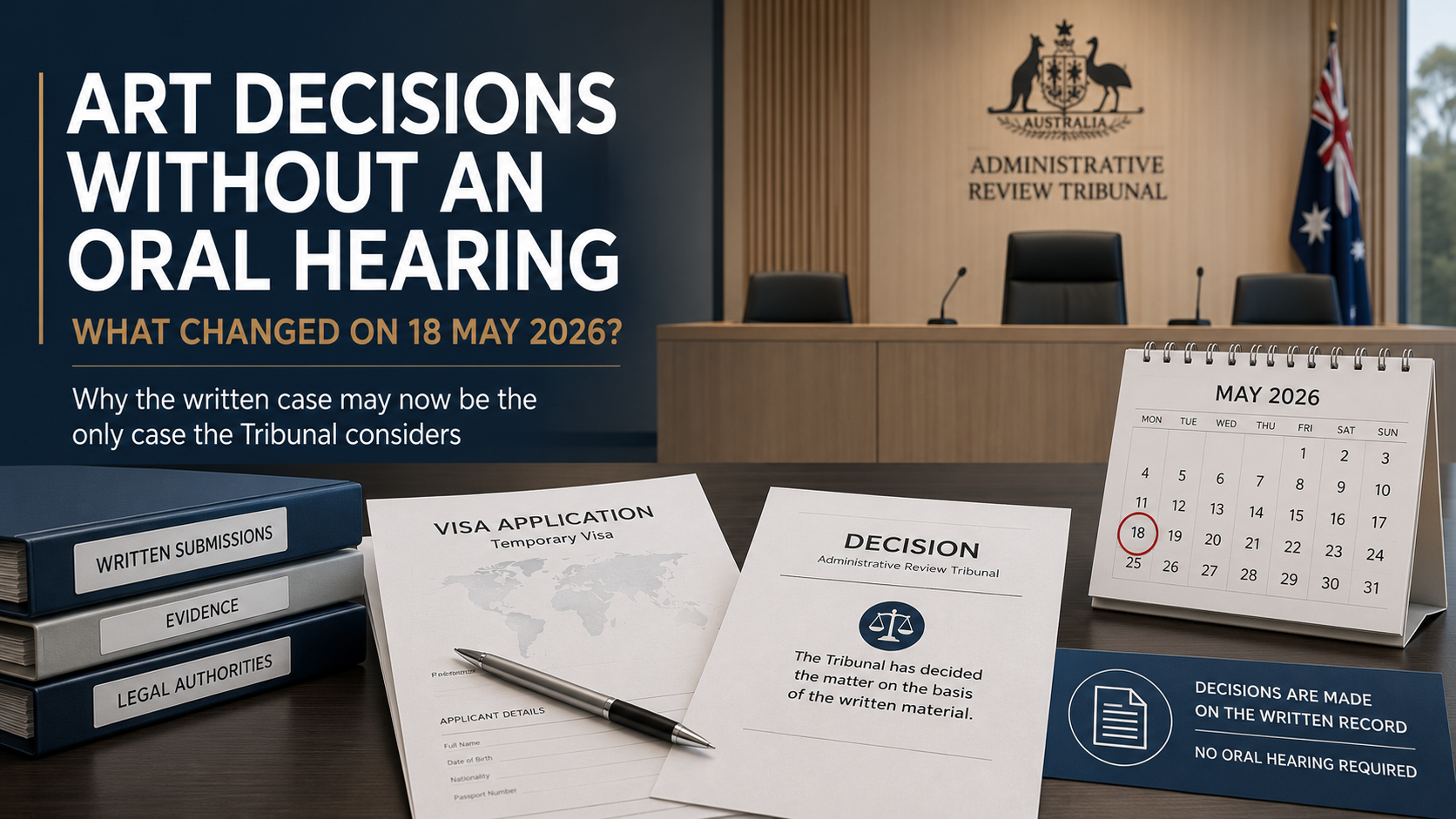
ART Decisions Without an Oral Hearing: What Changed in 2026?
ART decisions without an oral hearing became more important after legislative amendments commenced on 18 May 2026. The ART states that the new written process began applying to affected student visa refusal reviews from 1 June 2026.
For most affected student visa refusal reviews, the Tribunal member will decide the case from the written material without holding an oral hearing. That makes the application record, written evidence and submissions more important—but it does not justify assuming that every student review follows exactly the same procedure.
The first task is to identify whether the change applies to the particular review, read every notice issued by the ART and respond to the actual questions and time limits stated in that correspondence.
The Two Dates Perform Different Functions
The dates should not be collapsed into one:
- 18 May 2026 — commencement of the legislative amendments.
- 1 June 2026 — the date from which the ART says the new no-hearing process began applying to affected student visa refusal reviews.
The ART states that, except in very limited circumstances, the no-hearing process applies where:
- a new student visa refusal review application is lodged on or after 1 June 2026; or
- an existing student visa refusal review had not been constituted to a Tribunal member before 1 June 2026.
Where the ART had already notified the applicant of a hearing or case event, the ART says that event will proceed.
The individual ART correspondence remains the practical source for what will happen next in a particular review.
Official ART guidance:
Frequently Asked Questions About Changes to Hearings
.
The Simon Principle
The Written Case May Now Be the Only Case the Tribunal Considers.
Where the no-hearing provisions apply, an applicant cannot prepare on the assumption that unclear evidence, inconsistent dates or an incomplete explanation can later be repaired through oral evidence. The written record must stand on its own.
The Notice–Record–Response–Decision Framework
An affected review should be managed through four stages:
- Notice — identify what the ART has communicated, whether the no-hearing process applies and when a response is required.
- Record — reconstruct the original visa application, refusal findings, Home Affairs correspondence and material already before the Tribunal.
- Response — provide the evidence and written submissions needed to answer the refusal and any questions raised by the ART.
- Decision — understand that, where the legislation requires it, the Tribunal may decide the review from the written material without an oral hearing.
These stages must occur in that order.
An applicant who starts by writing a general personal statement may fail to address:
- the precise refusal finding;
- an inconsistency already contained in the application record;
- the question asked in the ART notice;
- the relevant visa criterion;
- the evidentiary weakness that caused the refusal; or
- the period stated for providing the response.
The written case should be built from the notice and the existing record—not from a generic template describing why the applicant wishes to study in Australia.
Contents
- What Genuinely Changed in 2026?
- Could the ART Already Decide Matters Without a Hearing?
- Step 1 — Read the ART Notice
- Which Student Visa Reviews Are Affected?
- When Might a Hearing Still Occur?
- Step 2 — Reconstruct the Written Record
- Step 3 — Prepare the Written Response
- Step 4 — Understand the Decision Process
- Frequently Asked Questions
What Genuinely Changed in 2026?
The 2026 amendments created two related but distinct changes.
1. A New General ART Power
The Administrative Review Tribunal Act 2024 now permits the Tribunal to decide some reviews without a hearing where:
- the issues can be adequately determined without the parties attending; and
- it is reasonable in the circumstances to decide the matter that way.
Before using that general power, the Tribunal must give the participating parties a reasonable opportunity to make submissions about whether the matter should be decided without a hearing and must consider any submissions received.
2. A Separate Mandatory Process for Prescribed Migration Reviews
The Migration Act 1958 now contains a separate Division for applications required to be reviewed on the papers.
Where that Division applies:
- the Tribunal must invite the applicant to provide written submissions and evidence about the relevant issues;
- the applicant may be given adverse information and an opportunity to comment;
- the Tribunal considers the written material before it; and
- the Tribunal must decide the review without holding an oral hearing.
The ART states that this process began applying to most affected student visa refusal reviews from 1 June 2026.
The Important Distinction
The general ART power and the prescribed migration process are not the same.
Under the general power, the Tribunal considers whether deciding without a hearing is reasonable in the particular proceeding.
For an application prescribed to be reviewed on the papers under the Migration Act, the legislation requires the Tribunal to use the written process and decide without an oral hearing, subject to the exceptions applying to that review.
Could the ART Already Decide Matters Without a Hearing?
Yes.
It would be inaccurate to suggest that every review before the 2026 changes necessarily included an oral hearing.
The ART Act already permitted decisions without a hearing in specified circumstances, including where:
- all parties consented and the issues could be adequately determined without them;
- the only parties were the applicant and a non-participating decision-maker, and the decision was wholly favourable or the applicant requested a decision without a hearing;
- a party failed to comply with the Act or a Tribunal order and the issues could still be determined;
- a party failed to appear after receiving appropriate notice; or
- the parties reached an agreement capable of being reflected in the Tribunal’s decision.
Each of those routes depended on consent, a request, agreement, non-compliance, non-appearance or another identified procedural event.
The new general provision is broader.
It allows the Tribunal to decide without a hearing where the issues can be adequately determined in the parties’ absence and doing so is reasonable, even though the applicant:
- did not consent;
- did not request an on-the-papers decision;
- did not fail to comply with an order; and
- did not fail to appear at a listed event.
The applicant must still be given a reasonable opportunity to make submissions about the proposed no-hearing course.
For prescribed student visa refusal reviews, however, the separate Migration Act process applies instead of that general ART Act provision.
What Actually Became Less Safe
The unsafe assumption was never simply:
“The Tribunal can never decide without a hearing.”
The more common assumption was:
“Unless I agree, fail to comply or fail to attend, I will eventually have an oral opportunity to explain the case.”
That assumption is no longer safe. The written response may be the applicant’s only substantive opportunity to address the review issues.
Step 1 — Read the ART Notice
Do not begin with a generic student visa statement.
Begin with the correspondence issued for the particular ART review.
The notice may identify:
- whether the review is being decided without an oral hearing;
- the visa refusal decision under review;
- the criterion or issue the applicant must address;
- the written submissions and evidence invited;
- the final date for responding;
- how the response must be provided;
- any adverse information requiring comment;
- whether access to further review material is available; and
- the consequence of failing to respond.
Read the complete notice and every attachment.
Do not rely only on:
- the email subject line;
- an automated notification;
- the date the applicant happened to open the email;
- a standard response period found on another website; or
- the procedure followed in another student visa review.
Create a Notice Register
| Question | What to record |
|---|---|
| What was received? | The email, notice, invitation, adverse information and every attachment |
| What issue must be addressed? | The criterion, statutory bar, refusal finding or other issue identified |
| What is invited? | Written submissions, evidence, comments or a combination of them |
| When is it due? | The exact final calendar date stated or calculated from the notice |
| How must it be supplied? | Online services, email, post or another specified method |
| What happens if there is no response? | The procedural consequence described in the notice and legislation |
Which Student Visa Reviews Are Affected?
The ART’s current guidance states that, except in very limited circumstances, a student visa refusal review will be decided without a hearing where:
- the application for review is lodged on or after 1 June 2026; or
- the review was already lodged but had not been constituted to a Tribunal member before 1 June 2026.
“Constituted” means that a Tribunal member has been assigned to decide the review.
The applicant should not attempt to determine constitution merely from:
- how long the review has been pending;
- whether T documents have arrived;
- whether a representative has been appointed;
- whether submissions have already been provided; or
- whether the online case status has changed.
The ART says it will contact affected applicants about the next steps.
Where a hearing or case event has already been notified, the ART says that event will proceed.
See the ART’s current announcement:
Changes to the Conduct of Student Visa Reviews
.
When Might a Hearing Still Occur?
The ART identifies a limited exception for student visa refusals based on:
- public interest criteria; or
- special return criteria.
Those reviews may still involve a hearing.
A hearing may also remain relevant where:
- the review had been constituted to a Tribunal member before 1 June 2026;
- the ART had already notified the applicant of a hearing or case event;
- the matter ceases to be an application required to be reviewed on the papers under the applicable legislation; or
- another procedural route applies to the particular case.
Do not assume that a reference to integrity, credibility or document concerns automatically creates a hearing exception.
The relevant question is the legal basis on which the student visa was refused and the procedure communicated by the ART.
Do Not Wait for a Hearing Merely Because No Notice Has Arrived Yet
Silence from the ART does not confirm that an oral hearing will occur.
Continue preparing the written record, preserve current evidence and monitor all ART correspondence. The applicant should be ready to respond when the Tribunal communicates the procedure applying to the review.
Step 2 — Reconstruct the Written Record
A review decided without an oral hearing cannot safely be prepared from the refusal letter alone.
The written record may include:
- the final visa application form;
- every supporting document supplied with the application;
- Home Affairs requests for information;
- the applicant’s responses to those requests;
- procedural-fairness correspondence;
- interview or telephone records;
- the refusal notification and decision record;
- the documents provided by Home Affairs to the ART;
- earlier submissions or evidence already given to the Tribunal;
- related visa, sponsorship or nomination records; and
- new evidence prepared for the review.
The applicant should know:
- what the original application said;
- which documents were actually lodged;
- which facts Home Affairs accepted;
- which facts or criteria caused the refusal;
- whether dates, figures or explanations conflict across the record;
- what has changed since the original application; and
- what the ART’s written invitation now requires the applicant to address.
The ART Invitation May Be Wider Than the Refusal Reasons
For an application required to be reviewed on the papers, the Migration Act requires the ART to invite written submissions and evidence about the relevant issue.
Where the refusal was based on the applicant not satisfying a visa criterion, the issue is whether the applicant satisfies that criterion generally.
It is not necessarily limited to:
- the particular aspect of the criterion discussed by the Home Affairs decision-maker;
- the wording used in the refusal decision;
- the evidence gap the applicant personally considers most important; or
- the argument made by the former representative.
This means an applicant should not merely prepare a rebuttal to individual sentences in the refusal decision.
The response should establish that the relevant criterion is satisfied on the complete written record.
A Narrow Refusal Can Require a Wider Written Case
A student visa may have been refused because one aspect of the applicant’s circumstances was not accepted.
The ART invitation may nevertheless require evidence and submissions addressing the criterion as a whole.
For example, an applicant should not assume that answering one financial transaction, one course change or one unexplained inconsistency is necessarily enough.
The review response must follow the issue identified in the ART notice and the legal criterion applying to the review—not only the applicant’s summary of why the visa was refused.
Create a Written-Record Map
| Record | What it says | Problem to address | Evidence required |
|---|---|---|---|
| Visa application | The original answers, chronology and claims | Any incomplete, inaccurate or inconsistent information | Correction, explanation and independent records |
| Refusal decision | The findings and criterion relied upon | The factual or legal conclusion that produced refusal | Evidence capable of satisfying the criterion |
| ART invitation | The issue, response requirements and final date | Every question or issue requiring a written answer | Submissions and evidence responsive to the notice |
| Current circumstances | What has changed since the original application | Whether the changes are relevant to the criterion | Current documents and a clear chronology |
The record map should be completed before the applicant begins drafting the final written submission.
Step 3 — Prepare the Written Response
The response period is not safely described by a universal statement that every applicant receives 28 days or 14 days.
The written notice must specify:
- that the response must be in writing;
- the period within which the applicant must respond;
- the issue or information requiring a response; and
- any prescribed requirements applying to the invitation.
The response period is:
- the prescribed period, where one applies; or
- otherwise, a reasonable period specified in the notice.
The ART Cannot Extend the Response Period
The Migration Act expressly states that the ART does not have power to extend the response period for these invitations.
Do not assume that extra time will be granted because:
- documents are difficult to obtain;
- an employer or education provider has not responded;
- the applicant has changed representatives;
- the applicant did not immediately understand the notice;
- the evidence requires translation;
- the applicant is waiting for an access request; or
- the applicant intends to provide a stronger response later.
The exact final date should be recorded as soon as the notice is received, and preparation should begin immediately.
The Initial Invitation and Adverse Information Are Different
The legislation provides for two important written processes.
Invitation to Address the Relevant Issue
The ART must invite the applicant to provide written submissions and evidence about the relevant issue.
This is the central opportunity to establish that:
- the relevant visa criterion is satisfied; or
- the legal provision relied upon does not prevent the visa from being granted.
Subject to its separate obligations concerning adverse information, the ART is not required to:
- give another warning about the same relevant issue;
- identify every weakness in the applicant’s response;
- request documents that the applicant should have supplied;
- invite a second round of submissions; or
- provide an oral opportunity to repair the written case.
Invitation to Comment on Adverse Information
Where the legislation requires it, the ART must give the applicant clear particulars of information it considers may be a reason, or part of a reason, for affirming the refusal and invite written comment.
The applicant should identify:
- the precise information supplied;
- why the ART says it is relevant;
- what conclusion may be drawn from it;
- whether the information is accurate;
- whether context is missing;
- what evidence contradicts or explains it; and
- what written response is required before the stated deadline.
The obligation to provide particulars is subject to statutory exceptions. Applicants should not assume that every concern based on information already contained in their own application or the refusal decision will produce a separate warning.
What Happens If the Applicant Does Not Respond?
The consequence depends on the invitation.
No Response to the Initial Written Invitation
If the applicant does not respond within the specified response period to the initial invitation for submissions and evidence about the relevant issue, the ART must dismiss the review application.
The applicant may be able to apply for reinstatement within the period stated by law after receiving the dismissal notice. Reinstatement is a separate process and should not be treated as a substitute for responding on time.
No Response to an Adverse-Information Invitation
The mandatory-dismissal rule described above is directed at failure to respond to the initial invitation under section 367F.
Where the applicant does not comment on adverse information within the stated response period, the ART may proceed after that period and decide the review on the material before it.
The practical consequence is that the Tribunal considers no written explanation or rebuttal from the applicant about that information.
The Email You Overlook Can Decide the Case
The applicant should confirm:
- the email address recorded with the ART;
- whether a representative or authorised recipient is receiving correspondence;
- whether a former representative remains recorded;
- that spam and junk folders are checked;
- that attachments can be opened;
- that contact details are updated promptly; and
- that every notice is saved with its original email and timestamp.
Non-response does not preserve an opportunity for the applicant to explain the case later at a hearing.
How to Structure the Written Submission
A useful submission should connect:
- The criterion — what the applicant must establish.
- The refusal finding — why Home Affairs was not satisfied.
- The ART invitation — what the Tribunal has asked the applicant to address.
- The evidence — which documents establish the relevant facts.
- The reliability — why the evidence should be accepted when compared with the original application record.
- The conclusion — why the criterion is now satisfied or the statutory bar does not apply.
The submission should not merely:
- repeat the applicant’s desire to study in Australia;
- describe the refusal as unfair;
- attach documents without explaining what they prove;
- copy the original personal statement;
- avoid inconsistencies in the earlier application;
- quote legislation without applying it to the evidence; or
- assume the Tribunal member will ask follow-up questions.
Use an Evidence Schedule
| Document | Fact established | Connection to criterion | Reliability issue |
|---|---|---|---|
| Bank or financial record | Source, movement or availability of funds | Explains how the relevant financial requirement is met | Large deposits, third-party control or unexplained transfers |
| Education record | Enrolment, progress, attendance or course history | Supports the applicant’s current study circumstances | Gaps, cancellations, inconsistent dates or changed course plans |
| Witness statement | Facts personally observed by the witness | Explains circumstances relevant to the disputed issue | Basis of knowledge, retrospective preparation or conflict with records |
Translations Must Be Prepared Properly
The ART states that documents and evidence must be supplied in English.
Where the original is in another language:
- provide the original document;
- provide an English translation;
- use an appropriately accredited translator;
- ensure names, dates and amounts are translated consistently; and
- allow sufficient time before the response deadline.
Do not assume that the Tribunal will accept an untranslated document or wait for a translation after the response period expires.
Step 4 — Understand How the ART Makes the Decision
For an application required to be reviewed on the papers, the ART must decide the review:
- after considering the submissions, evidence and comments supplied by the applicant;
- after considering other documents and material given to the Tribunal in the proceeding; and
- without holding an oral hearing.
The applicant is not entitled to appear before the Tribunal for that review.
The ART must not make the decision before the relevant response periods have ended.
Once those periods have ended, the Tribunal does not need to wait for:
- evidence the applicant hoped to obtain later;
- a further personal statement;
- a representative who was appointed after the deadline;
- a document-access request that remains outstanding; or
- an oral hearing that the legislation does not permit.
No Hearing Does Not Mean No Reasons
When the ART makes its decision, it must produce a written statement setting out:
- the Tribunal’s decision;
- the reasons for that decision; and
- the day and time the written statement was made.
The decision should be read carefully to identify:
- whether the refusal was affirmed;
- whether the decision was varied;
- whether another decision was substituted;
- whether the matter was remitted to Home Affairs;
- what factual findings were made;
- how the Tribunal treated the written evidence; and
- what practical or legal step follows.
The Written Submission Is Not Merely Preparation for the Hearing
In an affected student visa review, the written material is not a preliminary outline to be developed orally later.
It may be the complete evidentiary and argumentative case on which the Tribunal decides:
- what facts it accepts;
- what weight it gives the documents;
- whether inconsistencies have been explained;
- whether the relevant criterion is satisfied; and
- what review outcome should follow.
The applicant should write for a decision-maker who may never ask a clarifying question.
For the ART’s explanation of the decisions it may make, see:
Possible ART Review Outcomes
.
Fictional Worked Example: The Applicant Waited for a Hearing That Never Came
The following example is fictional and is included to demonstrate the Notice–Record–Response–Decision Framework.
Ravi’s student visa application is refused.
He applies for ART review and receives confirmation that the review application has been lodged.
Ravi has read older information online stating that he will eventually attend a Tribunal hearing. He assumes:
- the initial ART application only preserves his place in the queue;
- the detailed evidence can be prepared closer to the hearing;
- the Tribunal member will explain any concerns orally;
- he will be able to clarify inconsistencies during questioning; and
- his personal circumstances can be explained more effectively in person.
Several months later, the ART sends Ravi a written invitation concerning the issue in his student visa review.
The invitation requires a written response by the date stated in the notice.
Ravi reads the email quickly. He assumes it is an optional request for preliminary documents and decides to wait until a hearing is scheduled.
Notice
The complete ART notice explains:
- that Ravi’s review will be decided without an oral hearing;
- the issue he must address;
- the written submissions and evidence invited;
- the final date for responding;
- how the response must be supplied; and
- the consequence of failing to respond.
Ravi had focused on the email subject line and had not read the notice carefully.
Record
The original application contains several matters requiring explanation:
- different descriptions of why Ravi chose the course;
- an unexplained change of education provider;
- a large recent deposit in the supporting bank account;
- a period of limited academic progress; and
- differences between the visa form and the personal statement.
Those issues cannot safely be addressed from memory.
The response should have been prepared from:
- the final visa application form;
- the refused application documents;
- the refusal decision;
- the Home Affairs correspondence;
- Ravi’s study records;
- the financial evidence;
- the ART invitation; and
- current evidence relevant to the criterion under review.
Response
A proper response would have:
- identified the criterion Ravi had to satisfy;
- addressed each adverse finding;
- explained the course and provider changes;
- established the source and availability of the funds;
- reconciled the inconsistent statements;
- provided current study evidence; and
- explained why the complete record supported the requested outcome.
Instead, Ravi provided no response within the period stated in the initial invitation.
Decision
Because Ravi did not respond to the initial written invitation within the applicable period, the legislation requires the ART to dismiss the review application.
Ravi may need urgent advice about whether a reinstatement process remains available. That process should not be treated as an extension of the original response period or as a reliable way to repair a missed invitation.
The Lesson
Ravi did not lose the opportunity because the Tribunal rejected a carefully prepared written case.
He lost it because he prepared for a hearing that the ART notice said would not occur.
The correct strategy began with reading the notice, reconstructing the record and responding in full before the date stated—not waiting for a Tribunal member to ask the questions orally.
ART Written Case Checklist
When the ART communicates that a review will be decided without an oral hearing:
- Save the original email, notice and every attachment.
- Confirm whether the correspondence relates to the no-hearing process.
- Record the exact final date for responding.
- Check how the response must be submitted.
- Identify the visa criterion or statutory issue specified in the notice.
- Obtain the final visa application form and supporting documents.
- Read the complete refusal decision.
- Review Home Affairs requests, interviews and earlier responses.
- Compare the original application with the applicant’s current account.
- Identify dates, figures and explanations that require reconciliation.
- Match every proposed document to a fact that must be established.
- Provide current evidence where current circumstances are relevant.
- Address adverse information directly where comment has been invited.
- Explain why the evidence is reliable.
- Use an evidence schedule rather than supplying an unexplained bundle.
- Arrange translations before the response deadline.
- Do not assume the ART will request missing documents later.
- Do not assume there will be an oral opportunity to correct the written case.
- Keep proof showing when and how the response was submitted.
- Continue monitoring all ART correspondence after submission.
Simon’s Perspective
For many years, applicants approached Tribunal review with one powerful assumption:
“I will have the opportunity to explain this properly at the hearing.”
Even before the 2026 amendments, an oral hearing was never guaranteed in every review. The legislation already allowed matters to be decided without a hearing in particular circumstances.
What changed is that applicants can no longer safely assume that an oral opportunity will follow merely because they:
- did not consent to a decision on the papers;
- complied with the Tribunal process;
- remained available to attend;
- wanted to give oral evidence; or
- believed their credibility could be demonstrated in person.
For prescribed student visa refusal reviews, the written process is not simply a preliminary stage before the hearing.
It is the review process.
That changes the order in which the case must be prepared.
The old practical approach was often:
- lodge the review;
- wait for the matter to progress;
- prepare closer to the hearing;
- submit some documents; and
- explain the difficult parts orally.
That approach is now dangerous in an affected review.
The written case has to do the work that applicants expected the hearing to do.
It must:
- identify the legal issue;
- explain the chronology;
- address the refusal findings;
- confront inconsistent information;
- connect each document with the relevant fact;
- explain why the evidence should be accepted;
- deal with the applicant’s current circumstances; and
- state clearly why the required criterion is satisfied.
This is more than collecting new documents.
A student may provide another personal statement, new bank statements, a new Confirmation of Enrolment and letters from family members. That does not necessarily answer the review issue.
The Tribunal may still need to understand:
- why the original application said something different;
- where a large deposit came from;
- why the applicant changed courses or providers;
- what happened during an earlier period of poor academic progress;
- how the proposed course fits the applicant’s background; and
- why the present evidence should be accepted when read with the original record.
Those questions must be answered before the Tribunal decides—not saved for an oral appearance that may never occur.
The other major risk is correspondence.
An applicant can prepare an excellent case and still lose the opportunity to have it considered if the relevant ART invitation is overlooked or answered late.
A stale email address, a former representative remaining recorded, an unmonitored inbox or an attachment that was never opened can become decisive.
The Tribunal considers the written material it receives.
Where nothing is received in response to a notice, there may be nothing from the applicant for the Tribunal to consider—or the review may be dismissed where the legislation requires that result.
The central discipline is therefore simple: read the notice, know the record, answer the issue and submit the complete written case within the period stated.
Strategic Question
Would your written submissions allow a Tribunal member who never speaks to you to understand the application history, resolve every material inconsistency and find that the relevant visa criterion is satisfied?
Official ART and Legislative Resources
About Simon Mander
Simon Mander is a Registered Migration Agent (MARN 0318058) with more than 23 years of experience in Australian migration law.
His work includes student visa refusals, written ART submissions, credibility issues and complex review matters.
For reviews decided without an oral hearing, Simon begins with the ART notice and the complete original application record. The written case is then structured around the relevant criterion, the refusal findings, the available evidence and any inconsistencies that must be resolved before the Tribunal decides the matter.
ART Decisions Without an Oral Hearing: Frequently Asked Questions
When did the legislative changes commence?
The legislative amendments commenced on 18 May 2026. The ART states that the new no-hearing process began applying to affected student visa refusal reviews from 1 June 2026.
Will every student visa refusal review be decided without a hearing?
Most affected student visa refusal reviews are decided without an oral hearing, but limited exceptions apply. The position also depends on matters such as when the review was lodged, whether it had already been constituted to a Tribunal member and whether a hearing or case event had already been notified.
What does it mean if my review has been constituted?
The ART uses “constituted” to mean that a Tribunal member has been assigned to decide the review. The ART states that a student visa review constituted before 1 June 2026 might still involve a hearing.
How long do I have to respond to the ART’s written invitation?
Use the period stated in the actual ART notice. The applicable period may be prescribed or may be a reasonable period specified by the Tribunal. Do not assume that a universal 28-day or 14-day period applies to every invitation.
Can the ART extend the response period?
For invitations issued under the prescribed no-hearing process, the Migration Act states that the ART does not have power to extend the response period.
What happens if I do not respond to the initial invitation?
If the applicant does not respond within the applicable period to the initial invitation for written submissions and evidence about the relevant issue, the ART must dismiss the review application. A separate reinstatement process may be available, but it should not be treated as an extension or substitute for responding on time.
What happens if I do not comment on adverse information?
After the stated response period ends, the ART may proceed on the material before it without receiving an explanation or rebuttal from the applicant. This is different from the mandatory-dismissal consequence applying to non-response to the initial written invitation.
Can I submit evidence after lodging the ART review?
Yes, but the evidence must be supplied in accordance with the ART process and within any applicable response period. An applicant should not assume that the Tribunal will accept late material or issue another invitation before deciding the review.
Will the ART still provide written reasons?
Yes. A decision without an oral hearing is still a Tribunal decision. The ART must provide a written statement setting out the decision and the reasons for it.
Get a Visa Refusal Strategy Assessment
An affected ART review may be decided entirely from the written material. The refusal decision, original application record and ART correspondence should therefore be assessed before the written response is prepared.
The paid Visa Refusal Strategy Assessment examines the decision notification, the available review position and the key application material. You receive written strategic advice identifying the refusal problem, the urgent procedural issues and the evidence needed to address the case.
The assessment does not lodge the ART review, extend an ART response period or prepare the complete written Tribunal submission.
This information is general in nature and does not constitute migration advice for your individual circumstances. Australian migration law and policy can change, and eligibility should be assessed based on the circumstances existing at the time of application.