
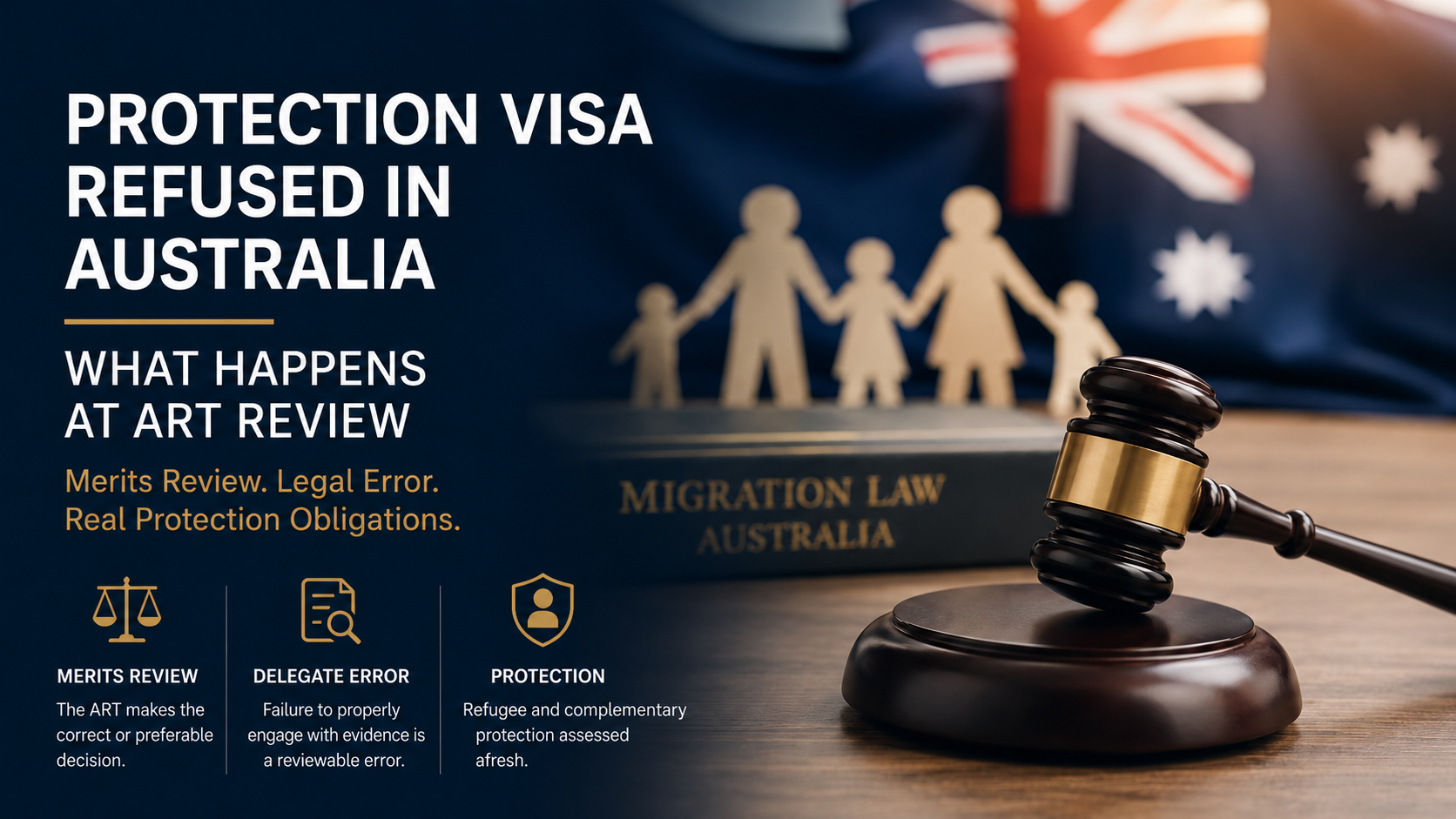
Protection Visa Refused in Australia: What Happens at ART Review?
Protection visa refused in Australia: the Administrative Review Tribunal does not simply decide whether the Department was unfair or whether the delegate made a legal error. The ART reconsiders the reviewable decision under the protection criteria, assesses the evidence and decides whether Australia’s protection obligations are engaged.
That requires more than repeating the original account, submitting general country reports or making the claim sound more serious.
The review must identify:
- what findings caused the application to be refused;
- which parts of the applicant’s account were accepted or rejected;
- whether the claim satisfies the refugee or complementary-protection criteria;
- what current country information establishes about the individual risk;
- whether later evidence is reliable and consistent with the earlier record; and
- what the applicant may need to explain at an ART hearing or in writing.
Simon’s Principle
A protection review is not won by making the story more dramatic.
It is won by making the claim legally coherent, evidentially reliable and consistent with the applicant’s actual history.
What the ART Actually Reviews
The ART conducts merits review of reviewable protection decisions.
This is different from judicial review.
Judicial review asks whether a legally significant error affected the decision-making process. ART merits review instead requires the Tribunal to reconsider the reviewable decision within the jurisdiction given to it by the Migration Act.
The ART may examine:
- the original protection visa application;
- statements and statutory declarations;
- Departmental interview records;
- documents submitted before refusal;
- the Department’s decision record;
- new evidence submitted during review;
- current country information;
- changes in the applicant’s personal circumstances;
- oral evidence given at a hearing; and
- the applicant’s responses to credibility or evidentiary concerns.
You Do Not Have to Prove “Delegate Error”
Errors or weaknesses in the Department’s reasoning may be relevant, but they are not the legal foundation of ordinary merits review.
The central question is whether the Tribunal can be satisfied that the applicable protection visa requirements are met—not whether the applicant can prove that the delegate committed a reviewable legal error.
A submission that spends most of its time accusing the delegate of failing to consider evidence can therefore miss the real task.
The ART still needs a coherent case showing:
- what the applicant fears;
- who may cause the harm;
- why the applicant may be targeted;
- why the risk is real rather than remote;
- whether effective protection is available;
- whether relocation is legally and practically relevant; and
- how the evidence supports the statutory criteria.
The Refugee and Complementary-Protection Criteria
A protection visa application may involve more than one possible basis for protection.
The Refugee Criterion
Broadly, the refugee criterion requires an assessment of whether the applicant has a well-founded fear of persecution for reasons connected with:
- race;
- religion;
- nationality;
- membership of a particular social group; or
- political opinion.
The assessment is not complete merely because the applicant has experienced something frightening or unfair.
Issues may include:
- whether the feared conduct amounts to serious harm;
- whether it involves systematic and discriminatory conduct;
- whether a Convention reason is an essential and significant reason for the persecution;
- whether the fear is well-founded;
- whether effective protection is available from authorities; and
- whether the applicant can safely and reasonably relocate within the receiving country.
Complementary Protection
Complementary protection may apply where the applicant is not accepted as a refugee but there are substantial grounds for believing that removal would expose the person to a real risk of significant harm.
Significant harm is defined by the Migration Act and includes particular forms of harm such as:
- arbitrary deprivation of life;
- the death penalty;
- torture;
- cruel or inhuman treatment or punishment; and
- degrading treatment or punishment.
Complementary protection is not simply a fallback assertion that the applicant will have a difficult life if returned.
The claimed harm must satisfy the statutory requirements, including the nature of the harm, the likelihood of it occurring and the connection between removal and the predicted consequence.
It should be relied upon where the facts and evidence support it—not automatically inserted into every protection review.
The Tribunal must also consider any other applicable visa criteria, exclusions and statutory restrictions.
Step 1 — Identify the Actual Refusal Findings
A protection refusal frequently contains several findings, not one.
For example, the decision-maker may have accepted that:
- the applicant belongs to a particular religious or ethnic group;
- an incident occurred;
- the applicant attended a political event;
- conditions in the country are difficult; or
- the applicant genuinely fears returning.
But the decision-maker may still have found that:
- the applicant would not personally be targeted;
- the feared harm was not sufficiently serious;
- the claim was not connected with a Convention reason;
- state protection was available;
- relocation was possible;
- important parts of the account were not credible;
- the sur place activity would not come to the attention of authorities; or
- complementary protection was not established.
A safe review strategy maps every material finding.
| Refusal issue | Question for ART review |
|---|---|
| Credibility | What precisely was rejected, what caused the concern and can it be explained through reliable evidence? |
| Serious harm | Does the feared treatment meet the statutory threshold rather than amounting only to discrimination, inconvenience or general hardship? |
| Convention reason | Why would the persecutor target the applicant, and is a protected reason essential and significant? |
| State protection | Is effective protection practically available to this applicant? |
| Internal relocation | Is relocation legally relevant, safe and reasonable in the applicant’s actual circumstances? |
| Sur place activity | Is the activity attributable to the applicant, likely to become known and capable of creating a real risk? |
| Complementary protection | Does the predicted treatment satisfy the statutory definition of significant harm? |
The review should respond to the findings that were actually made. It should not substitute a more convenient refusal reason.
Step 2 — Reconstruct the Credibility Record
Credibility is often central to protection review, but “the Tribunal did not believe me” is not a sufficiently precise analysis.
The record may include:
- the protection visa form;
- the original written statement;
- Departmental interview answers;
- earlier Australian visa applications;
- visa applications made to other countries;
- arrival and travel history;
- identity and civil documents;
- social-media activity;
- statements from family or witnesses; and
- documents submitted after concerns were raised.
What Applicants See as Small Differences
Applicants often regard differences in dates, locations or sequences as minor because the central event remains the same in their mind.
A Tribunal member may see those differences differently.
For example:
- Was the applicant detained before or after the political meeting?
- Was the threat made by police, party members or relatives?
- Did the applicant leave the region immediately or remain there for six months?
- Was the political activity longstanding or begun after the visa application?
- Did an earlier visa form say the applicant had no reason to fear returning?
These are not always fatal contradictions. Memory, trauma, interpretation, cultural communication and the way questions were asked may all require consideration.
But an inconsistency should not be ignored merely because the applicant considers it unimportant.
Late Claims and Omissions
A claim raised late is not automatically false.
There may be genuine reasons for an omission, including:
- fear of authorities;
- shame;
- trauma;
- poor interpretation;
- unsafe or inadequate previous assistance;
- misunderstanding the relevance of an event;
- fear of family or community members; or
- an event that occurred only after the original application.
The explanation must nevertheless fit the record.
A carefully drafted explanation created years later may be less persuasive than a short, ordinary and verifiable explanation that accounts for:
- what was omitted;
- when it was first disclosed;
- why it was not disclosed earlier;
- what evidence supports the explanation; and
- whether the omission changes other parts of the claim.
The Explanation Can Cause More Damage Than the Inconsistency
An applicant may survive a genuine mistake in a date. It is much harder to recover when a polished explanation is later produced that does not fit the documents, travel history or earlier answers.
For a broader credibility framework, see:
Why Credibility Problems Become Difficult to Reverse
.
Step 3 — Connect Country Evidence with the Individual Risk
Country information is essential in many protection matters, but volume is not the same as relevance.
A collection of reports showing that a country has:
- political repression;
- religious conflict;
- gender-based violence;
- poor prison conditions;
- corruption;
- armed conflict; or
- human-rights abuses
does not automatically establish that the particular applicant faces the legally required risk.
The evidence should be connected to:
- the applicant’s location;
- ethnicity, religion, gender or social group;
- political profile;
- past treatment;
- family and community connections;
- visibility to authorities or non-state actors;
- ability to obtain protection;
- possibility of internal relocation; and
- likely treatment as a returnee.
General Conditions Versus Personal Risk
A useful submission does not merely say:
“The country is dangerous.”
It explains:
“This evidence shows why a person with this applicant’s characteristics, history and visibility faces the claimed risk.”
The source also matters.
Country material should be:
- reliable;
- current enough for the issue being assessed;
- specific to the claimed risk;
- accurately represented;
- read in context; and
- connected with the individual evidence.
A single paragraph from a report should not be presented as proving more than the source actually says.
State Protection and Internal Relocation
Where the refusal relies on state protection, the review may need to address:
- whether the authorities are willing to protect the applicant;
- whether they are practically able to do so;
- whether the persecutor is connected with authorities;
- what happened when assistance was previously requested;
- whether reporting the harm would itself create risk; and
- whether protection exists in practice rather than only in legislation.
Where relocation is raised, relevant considerations may include:
- whether the feared actor has national reach;
- identity and registration systems;
- family or community networks;
- gender and social constraints;
- health and disability;
- employment and accommodation;
- the applicant’s ability to live safely without concealing a protected characteristic; and
- whether relocation is reasonable in the individual circumstances.
Step 4 — Assess Current Risk and Changed Circumstances
Protection review is not necessarily confined to circumstances that existed when the Department made its decision.
Relevant developments may include:
- changes in government or security conditions;
- new conflict or unrest;
- new threats against the applicant or family;
- religious conversion;
- political activity in Australia;
- public advocacy or media activity;
- sexual-orientation or gender-identity claims disclosed later;
- changes in family or social circumstances;
- new criminal allegations or warrants overseas; and
- new information about the treatment of returnees.
Sur Place Claims
A sur place claim arises from circumstances or conduct occurring after the applicant left the receiving country.
Examples may include:
- political activity in Australia;
- participation in demonstrations;
- online criticism of a government;
- religious conversion or practice;
- association with opposition groups; or
- public disclosure of a protected characteristic.
The fact that an activity occurred in Australia does not by itself establish protection obligations.
The review may need to examine:
- whether the activity genuinely occurred;
- whether it is attributable to the applicant;
- whether the applicant’s identity is visible;
- whether authorities or other actors monitor that activity;
- whether the applicant has come to their attention;
- how a person with that profile is treated on return; and
- whether the conduct reflects a genuine characteristic or is nevertheless likely to cause an imputed characteristic.
Digital Evidence
Screenshots alone may not establish the full history or ownership of an account.
Depending on the claim, useful evidence may include:
- account creation and profile history;
- original posts rather than selected screenshots;
- public visibility settings;
- dates and engagement records;
- links between the account and the applicant’s identity;
- photographs or recordings of public activity;
- witness evidence;
- translations of non-English content; and
- evidence about monitoring and treatment of similar activists.
Changed Circumstances Are Not Permission to Change the Story
New events should be identified as new events. They should not be blended into the earlier account in a way that makes it appear they existed before the original decision.
Step 5 — Build the ART Review Strategy
Confirm Review Rights and the Deadline
Not every decision is reviewable by the ART, and the person entitled to apply must be identified.
The Department’s decision notification should state:
- whether ART review is available;
- who may apply;
- the applicable review period;
- how to apply; and
- other procedural information.
Do not rely on a general 28-day assumption.
Strict statutory time limits apply, and the actual decision notification must be checked immediately.
See:
How Long Do You Have to Apply for ART Review?
.
Reconstruct the Departmental Record
The review should begin with the material that already exists.
That may require obtaining:
- the complete application;
- all statements and attachments;
- interview records;
- natural-justice correspondence;
- documents submitted in response;
- the complete refusal record;
- material held by a former representative; and
- relevant Departmental or Tribunal documents.
An applicant who prepares for review from memory may unknowingly repeat or deepen the inconsistency that caused the refusal.
See:
FOI Requests After a Visa Refusal
.
Prepare Written Evidence and Submissions
Written submissions should help the Tribunal understand:
- the legal basis of the claim;
- the facts relied upon;
- which refusal findings are disputed;
- what evidence answers each finding;
- how inconsistencies are explained;
- how country information connects with the applicant;
- what has changed since the refusal; and
- why the statutory criteria are now satisfied.
They should not merely:
- repeat the applicant’s statement;
- accuse the delegate of unfairness;
- attach hundreds of pages without explanation;
- quote legal tests without applying them;
- ignore evidence that appears adverse; or
- assume the Tribunal will identify and repair the case unaided.
Prepare for a Hearing Without Assuming One Is Guaranteed
Protection reviews are not part of the specific mandatory written-only process introduced for most affected student visa refusal reviews.
The ART may invite an applicant to a hearing, where the member can ask questions and receive oral evidence. The Tribunal’s powers and procedures also allow some matters to be resolved without an oral hearing in appropriate circumstances.
The applicant should therefore prepare both:
- a complete written case; and
- for the possibility of detailed oral questioning.
Where a hearing occurs, preparation should include:
- reviewing all earlier statements and interview answers;
- understanding the findings in dispute;
- identifying dates or details that may require explanation;
- preparing to discuss country and personal circumstances;
- arranging any necessary witnesses;
- requesting an interpreter where required; and
- answering questions honestly rather than attempting to reproduce a memorised script.
Check Current Visa Status
Lodging ART review does not, by itself, explain the applicant’s bridging-visa position, conditions, work rights or travel rights.
The applicant should check:
- the visa currently in effect;
- all bridging-visa grant notices;
- VEVO;
- work and study conditions;
- travel restrictions; and
- the consequences of departure from Australia.
See:
Bridging Visa After a Visa Refusal
.
Understand the Possible Outcome
A favourable ART outcome does not always result in the immediate grant of a visa.
Depending on the decision and legal framework, the Tribunal may affirm the refusal, set the decision aside or return the matter to Home Affairs for further action.
Health, character, identity, security or other visa requirements may still require consideration.
See:
Winning ART Review Does Not Always Mean You Can Stay in Australia
.
Fictional Worked Example: A Genuine Fear with a Weak Record
This example is fictional and is included to demonstrate the review framework.
Darius claims that he fears persecution because of his political opinion.
He tells Home Affairs that:
- he attended opposition meetings before leaving his country;
- police questioned him after one meeting;
- he later attended demonstrations in Australia; and
- his social-media activity now criticises the government.
The Department accepts that political opponents are sometimes detained but refuses the application.
The decision identifies several problems:
- Darius’s original visitor visa application did not mention political involvement;
- his protection statement placed the police questioning in March;
- his interview placed it in June;
- the opposition letter was created after the interview;
- his social-media account was largely inactive until after concerns were raised; and
- the country information did not show that low-profile overseas demonstrators were routinely identified.
Finding
The Department did not deny that political repression exists. It rejected important parts of Darius’s personal account and was not satisfied that his Australian activity created a real chance of persecution.
Credibility
The review needs to reconstruct:
- what Darius said in every earlier application;
- the actual date and sequence of the political events;
- why political involvement was not disclosed in the visitor application;
- how and when the opposition letter was obtained; and
- whether the social-media account history supports his explanation.
Country Evidence
Reports about general repression are not enough.
The evidence must address:
- monitoring of overseas demonstrators;
- how individuals are identified;
- the treatment of returnees;
- whether low-profile activists are targeted; and
- whether Darius’s actual activity is likely to attract attention.
Current Risk
Darius’s Australian political activity may be relevant, but the review must establish what he did, whether it is genuinely attributable to him and why it creates risk now.
Review Strategy
The strongest review is not achieved by adding a more dramatic incident to the story.
It requires:
- a reliable chronology;
- a candid explanation of the omissions and changing dates;
- authenticated evidence of Australian activities;
- targeted country information;
- evidence about attribution and monitoring; and
- careful preparation for questioning.
Darius may genuinely fear return. The ART must still be given a legally coherent and evidentially reliable basis on which to accept that fear as well-founded.
Simon’s Perspective
Protection applicants often assume the strength of the case depends on how serious the country situation is.
That is only part of it.
The Tribunal may accept that:
- the government represses dissent;
- a minority group experiences discrimination;
- domestic violence is widespread;
- security forces use excessive force; or
- particular detainees face mistreatment.
The case can still fail because the evidence does not establish why this applicant faces the relevant risk.
The gap is often between the general country situation and the applicant’s personal profile.
I also see applicants attempt to repair credibility problems by making the account more detailed.
More detail is not always more credible.
A new statement may create additional dates, conversations, locations and events that must now remain consistent with:
- the original form;
- the Departmental interview;
- travel records;
- earlier visa applications;
- witness accounts; and
- the documentary evidence.
The strongest protection submissions are often disciplined rather than dramatic.
They distinguish:
- what is known from what is assumed;
- past events from later developments;
- general country conditions from personal risk;
- an innocent mistake from an unexplained contradiction; and
- a genuine new claim from a changed version of an old claim.
The objective is not to create the most persuasive-sounding story. It is to present the most accurate case that the law and evidence can support.
Official Protection Visa and ART Resources
About Simon Mander
Simon Mander is a Registered Migration Agent (MARN 0318058) with more than 23 years of experience in Australian migration law.
His work includes visa-refusal strategy, ART review assessment, credibility analysis, written submissions and complex protection matters.
Get a Protection Visa Refusal Strategy Assessment
A protection visa refusal should be assessed against the complete decision, the original application record, current country information and the applicant’s present circumstances.
The paid Visa Refusal Strategy Assessment provides written advice identifying the refusal issues, urgent procedural risks and the realistic next steps.
The assessment does not lodge an ART review, prepare the complete protection submission or guarantee that the protection criteria can be satisfied.
Protection Visa Refusal: Frequently Asked Questions
Can every protection visa refusal be reviewed by the ART?
No universal assumption should be made. The Department’s decision notification should identify whether ART review is available, who may apply and the applicable review period.
Do I have to prove that the Department made a legal error?
Not for ordinary ART merits review. The ART reconsiders the reviewable decision under the applicable law and evidence. Legal error is the central concept in judicial review, which is a different process.
Will I receive an ART hearing?
The ART may invite an applicant to a hearing and receive oral evidence, but an oral hearing should not be assumed in every matter. Prepare the written evidence fully and follow every procedural notice issued by the Tribunal.
Can I provide new evidence during ART review?
New evidence may be relevant, including evidence about changed circumstances or current country conditions. It must be reliable, properly explained and consistent with the earlier application record.
What is a sur place protection claim?
A sur place claim concerns circumstances or activities arising after the applicant left the receiving country, such as political activity, religious conversion or public advocacy undertaken in Australia.
Does political activity in Australia automatically establish a protection claim?
No. The review may need to establish that the activity is genuinely attributable to the applicant, likely to become known and capable of creating the required personal risk on return.
Can general country reports prove my protection claim?
General reports may establish relevant conditions, but they must be connected with the applicant’s personal circumstances, characteristics, location, visibility and claimed risk.
What if I left important information out of the original application?
An omission is not automatically fatal, but it must be identified and explained honestly. The explanation should address why the information was not provided earlier and how it fits with the existing record.
How long does protection visa ART review take?
Processing times vary considerably. The ART publishes recent processing-time data, but historical figures do not predict the time required for an individual review.
This information is general in nature and does not constitute migration advice for your individual circumstances. Australian migration law and policy can change, and eligibility should be assessed based on the circumstances existing at the time of application.