
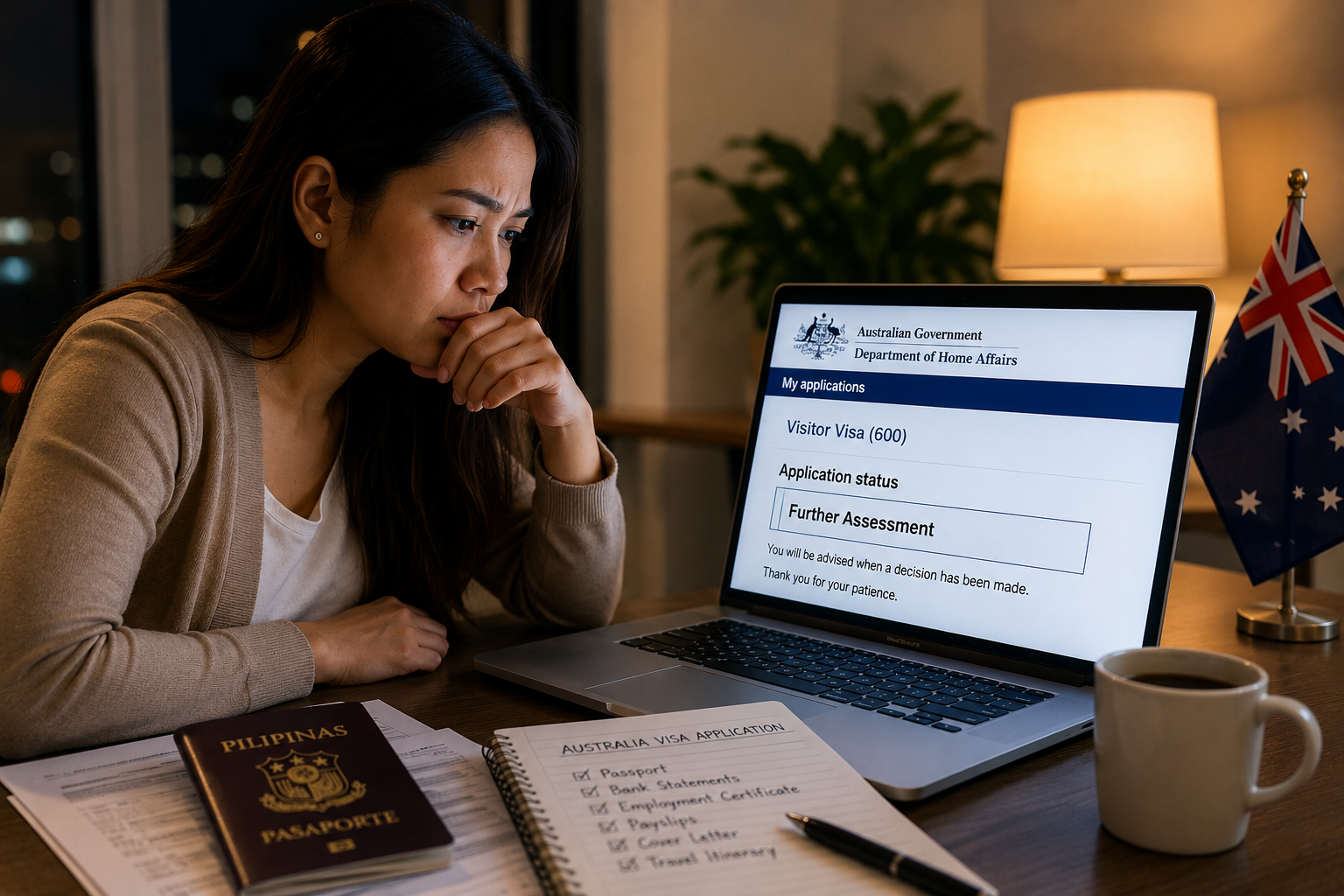
Further Assessment Philippines
When an Australian visa application changes to Further Assessment in ImmiAccount, Filipino applicants often assume that the status reveals what the Department thinks about the case.
It does not.
Further Assessment shows that the application remains under consideration. The status alone does not identify what is being assessed, explain why the application is taking longer or predict whether the visa will be granted or refused.
The useful information comes from the application itself, any outstanding requirements and actual correspondence from the Department.
The Immediate Answer
Further Assessment does not mean approval is close. It does not mean refusal is coming.
It is an ImmiAccount processing status, not an explanation of the Department’s view of the application.
What Further Assessment Means in ImmiAccount
ImmiAccount uses broad status labels to show where an application sits in the processing system.
Further Assessment generally indicates that the application has not yet been finalised and remains under consideration. It may involve ordinary processing, an outstanding requirement, verification, assessment of evidence or another administrative step.
The status does not tell the applicant:
- which document is being considered
- whether the Department has a concern
- whether external checks are underway
- how long the application will remain at that stage
- whether the final decision will be favourable
For the broader explanation applying across Australian visa subclasses, see:
Further Assessment Australia Visa.
Simon’s Principle: The Status Is Not the Evidence
The status label does not decide the application and does not explain the Department’s reasoning.
The important record is the application, the documents, any outstanding requirement and any actual communication from the Department.
Does Further Assessment Mean the Visa Will Be Refused?
No.
Applications can be granted or refused after showing Further Assessment. The status itself does not distinguish between those outcomes.
It is therefore unsafe to assume:
- that a refusal is imminent because the application has remained pending
- that approval is close because the status changed
- that somebody else’s timeline predicts your outcome
- that the Department is concerned about a particular document
- that uploading more documents will make the application move faster
The absence of a decision is not itself evidence about the likely decision. For more on this distinction, see Can Further Assessment Lead to Visa Refusal?.
Why Filipino Applicants Often Become Concerned
Many applications from the Philippines involve important travel, employment, relationship and family plans.
A pending application may affect:
- a planned family visit
- time with an Australian partner
- a wedding or important family event
- employment leave
- school or university arrangements
- airfares and accommodation
- future Partner visa or migration planning
This makes uncertainty difficult, particularly where an applicant reads online reports claiming that Further Assessment has a fixed meaning.
Those reports usually compare applications with different visa streams, evidence, histories and Departmental requirements. They are not a reliable guide to an individual case.
What to Check First
The first response should be practical rather than speculative.
1. Check ImmiAccount Messages
Review the messages and correspondence attached to the application, including any Actions required or Health assessment information shown in ImmiAccount. Do not rely only on the status displayed on the application summary screen.
Look for:
- a request for further information
- a health examination request
- a biometric request
- an interview notice
- a request for identity or civil-status documents
- a request concerning the sponsor or inviter
- an invitation to comment on adverse information
2. Check the Nominated Email Address
Applicants sometimes monitor ImmiAccount but overlook the email address nominated in the application.
Check:
- the inbox
- spam and junk folders
- whether the email address remains active
- whether an agent or authorised recipient was nominated
- whether contact details changed after lodgement
3. Check Outstanding Requirements
Confirm whether anything remains incomplete, including:
- biometrics
- health examinations
- police clearances
- translations
- passport updates
- sponsor documents
- requested forms or declarations
An outstanding requirement may explain why the application cannot yet be finalised, but Further Assessment itself will not necessarily identify that requirement.
4. Check Whether Circumstances Have Changed
Material changes may need to be notified where relevant.
These may include:
- a new passport
- a change of address or email
- a marriage, separation or change in relationship status
- the birth of a child
- a change in employment
- a change in family composition
- a criminal charge or other character matter
- discovery of incorrect information in the original application
When Is Professional Advice Worthwhile?
Further Assessment alone is not a reason to pay for migration advice. Many applications simply remain pending without any action being required from the applicant.
A professional review may be useful if the Department has issued a request you do not understand, raised a concern about information provided, or if you have identified inconsistent documents, an error in the application or a previous refusal that may affect the present case.
For Filipino applicants, these issues can involve employment records, civil-status documents, relationship evidence or earlier Visitor visa applications. The question is whether there is a specific problem to assess or a response to prepare—not whether the ImmiAccount label has changed.
Book a paid application review if there is an identifiable concern →
A consultation cannot reveal undisclosed Department concerns or guarantee faster processing.
Should You Upload More Documents?
Not simply because the status says Further Assessment.
Additional evidence should have a clear purpose. It may be appropriate where the document:
- responds to a Department request
- corrects an error or omission
- updates a material change
- provides a document that should have been included initially
- records a significant development relevant to the visa criteria
Uploading large volumes of unrelated evidence can make the record harder to understand. It can also create inconsistencies where later documents describe events differently from the original application.
Do Not Upload Evidence Merely to Show Activity
A new bank statement, photograph or chat archive should be uploaded because it proves something material—not because the applicant is anxious that the account has been quiet.
Further Assessment in Visitor Visa Applications
For Filipino Visitor visa applicants, the Department may be assessing whether the applicant satisfies the relevant Visitor visa requirements, including whether the proposed stay is genuinely temporary and financially supported.
The application may involve:
- Philippine employment
- approved leave
- family circumstances
- the source of travel funds
- an Australian inviter or sponsor
- an Australian partner
- previous travel and immigration history
- identity or document verification
The presence of one of these issues does not prove that it is causing the delay. The status does not identify the particular matter being considered.
For the substantive Visitor visa requirements, see:
Australia Tourist Visa for Filipinos.
Further Assessment in Australian–Filipino Partner Visa Cases
Partner visa applicants sometimes respond to a delay by uploading hundreds of additional chat messages, photographs and remittance records.
That may not assist unless the material updates or strengthens an identifiable part of the relationship record.
A Partner visa may involve ongoing assessment of:
- relationship evidence
- identity and civil status
- previous marriages
- sponsor eligibility
- health and character requirements
- information supplied in earlier visa applications
- changes occurring after lodgement
A meaningful relationship development may justify an update. Re-uploading the entire relationship history usually does not.
See:
Partner Visa Australia for Filipinos.
Filipino Documents That May Require Careful Review
Where a request is issued, the required evidence may involve records from several Philippine agencies or organisations.
Depending on the visa and circumstances, these may include:
- PSA birth and marriage records
- Certificates of No Marriage Record
- annulment, nullity or foreign-divorce recognition records
- Certificates of Employment
- BIR, SSS and Pag-IBIG records
- DMW or former POEA deployment records
- bank statements and remittance records
- school, professional registration or licensing records
The important issue is not merely whether a document has been provided. Names, dates, employers, civil status and family details must remain consistent across the application record.
How Long Does Further Assessment Take?
There is no fixed period attached to the status.
The time required may vary because of:
- the visa subclass
- application volumes
- case allocation
- health or character processing
- identity or document verification
- responses from third parties
- additional information requested from the applicant
- the overall complexity of the application
Published visa processing times are general guides based on recently finalised applications. They do not predict the completion date of an individual application.
For Filipino Visitor visa timing issues, see:
Australia Visitor Visa Processing Time Philippines.
When Should You Follow Up?
A follow-up may be appropriate where:
- the application is materially outside the published processing range
- all requested requirements have been completed
- there is no outstanding Department request
- contact details are current
- a significant factual or compassionate circumstance has arisen
A follow-up does not guarantee priority or a faster decision. Ordinary waiting, without an outstanding request or another identifiable issue, does not by itself mean that professional intervention is needed. Any enquiry should provide accurate information and use the appropriate Department channel rather than repeated general enquiries.
What I See in Practice
The most common mistake is treating the status label as though it were a message from the decision-maker.
It is not.
I see applicants who:
- upload the same bank evidence several times
- send hundreds of new relationship screenshots without context
- compare a Partner visa timeline with a Visitor visa timeline
- assume silence means a refusal concern
- miss an email request while repeatedly checking the ImmiAccount status
- provide new explanations that conflict with the original application
- focus on elapsed days while an outstanding requirement remains incomplete
The better approach is to separate what is known from what is assumed.
The applicant may know that the application is pending. They may know that the status says Further Assessment. They may know whether the Department has sent a request.
They do not know, from the status alone, what conclusion the Department will reach.
Fictional Worked Example
This is a fictional example created to explain migration strategy. It is not a real client matter.
Maria lodged a Partner visa application from the Philippines. Several months later, ImmiAccount showed Further Assessment.
Maria and her Australian sponsor assumed the Department wanted more relationship evidence. They prepared hundreds of additional chat screenshots, remittance receipts and photographs.
Before uploading them, they reviewed the application record. They discovered that the sponsor’s email address had changed and that a Department request concerning a previous marriage had been sent to the old address.
The important action was not to upload another archive of relationship evidence. It was to update the contact details, respond to the actual request and provide the civil-status documents required.
The Further Assessment status did not explain the issue. The Department’s correspondence did.
Common Mistakes During Further Assessment
- assuming that the status predicts approval or refusal
- relying on social-media timelines
- uploading documents without identifying what they prove
- missing an email or ImmiAccount message
- failing to complete biometrics, health or another requested step
- changing the explanation of important events after lodgement
- failing to notify a material change
- contacting the Department repeatedly without new information
For official guidance on monitoring an application and responding to requests, see the
Department of Home Affairs ImmiAccount information.
Related Guides for Filipino Applicants
General Further Assessment Guide
The broader explanation applying across Australian visa subclasses.
Visitor Visa Processing Time
Published timeframes, delay and when a follow-up may be appropriate.
Visitor Visa Refusal
How to analyse the decision and decide whether a new application is viable.
Partner Visas
Long-distance evidence, previous marriages and Australian–Filipino relationship cases.
Tourist and Family Visits
Visitor visa purpose, finances, invitations and temporary-stay evidence.
Filipino Visa Gateway
The main Australian visa pathways and documentary issues for Filipino applicants.
Frequently Asked Questions
What does Further Assessment mean in ImmiAccount?
It means the visa application remains under consideration and has not yet been finalised. The status does not identify what is being assessed or predict the outcome.
Does Further Assessment mean my Australian visa will be refused?
No. Applications may be granted or refused after showing Further Assessment. The status alone does not indicate which outcome is likely.
How long does Further Assessment take?
There is no fixed timeframe. Processing can vary according to the visa subclass, application volumes, outstanding requirements, verification, health or character processing and individual circumstances.
Should I upload more documents during Further Assessment?
Only where the documents respond to a request, correct an error, update a material change or provide relevant evidence that was missing. Documents should not be uploaded merely because the status has changed.
Can I contact the Department about Further Assessment?
A follow-up may be appropriate where the application is materially outside published processing times and all outstanding requirements have been completed. An enquiry does not guarantee faster processing.
Does Further Assessment mean the Department has concerns?
Not necessarily. The status may reflect ordinary processing, verification, an outstanding requirement or closer consideration. The label itself does not explain why the application remains pending.
About Simon Mander
Simon Mander is a Registered Migration Agent with more than 23 years of experience in Australian migration.
He advises Filipino applicants and Australian sponsors on pending visa applications, Further Assessment, Department requests, Visitor visa issues, Partner visa evidence and previous immigration history.
His approach focuses on identifying what is actually known from the application record before recommending whether any action is required.
MARN 0318058
Get Clear Advice About a Pending Visa Application
If you have received a substantive Department request, discovered inconsistent or incorrect information, or have a previous refusal that may affect the current application, a paid consultation can examine the available application record, identify the issue and advise whether a response or other action is appropriate.
The consultation cannot disclose internal Department assessments or guarantee that the application will be decided sooner.
This information is general in nature and does not constitute migration advice for your individual circumstances. Australian migration law and policy can change, and eligibility should be assessed based on the circumstances existing at the time of application.