
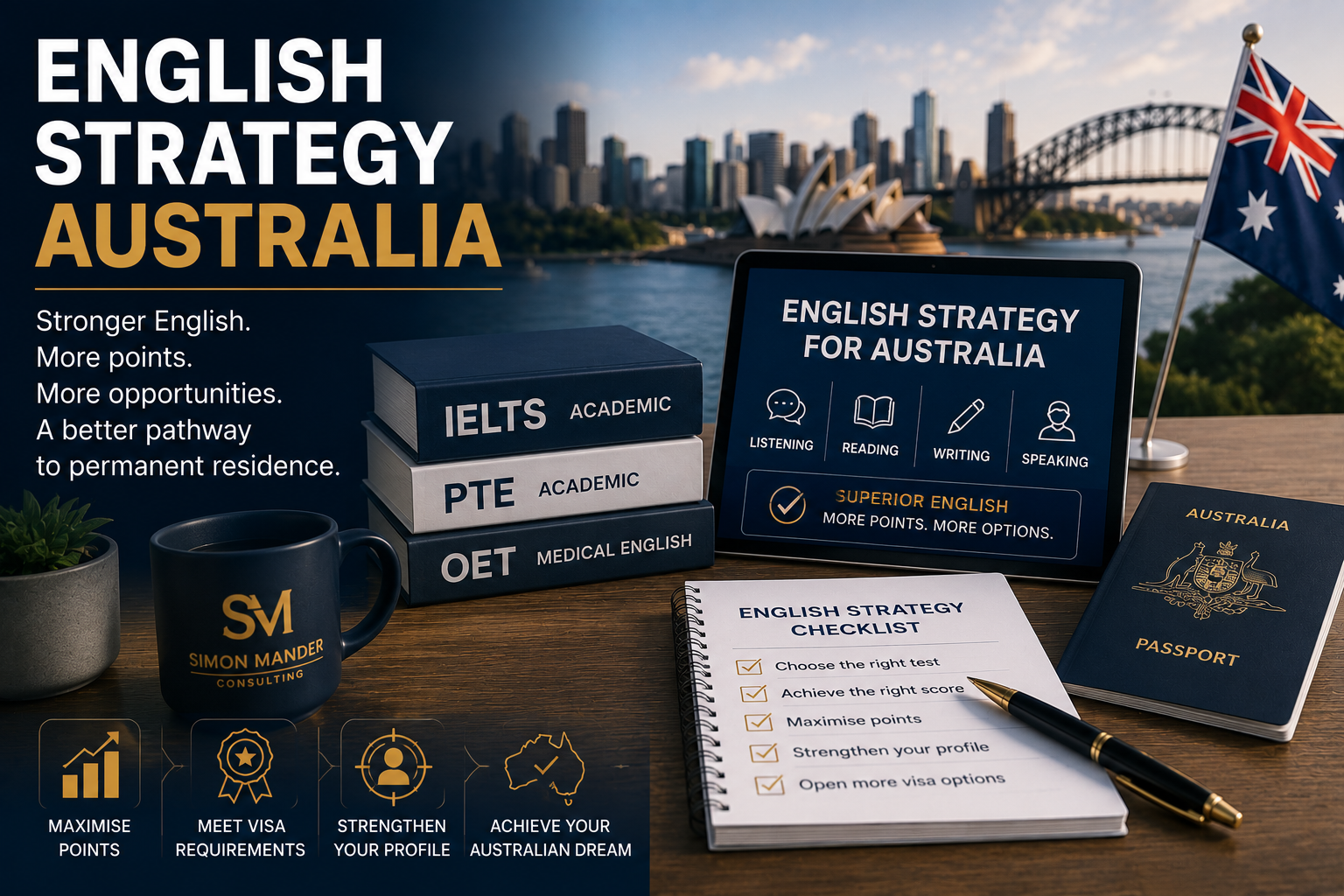
English Requirements for Australian Skilled Migration
English can determine whether you satisfy the basic requirements for an Australian skilled visa, whether you receive 0, 10 or 20 migration points, and whether your Expression of Interest is realistically competitive. The correct strategy is not simply to pass IELTS, PTE or another approved test. It is to identify the English result that materially strengthens your 189, 190 or 491 pathway.
Simon’s Principle
The right English target is not the highest score you might achieve. It is the score that changes the migration pathway enough to justify the time, cost and effort required.
English for Australian Skilled Migration: Executive Summary
| Issue | What it can affect | Common risk |
|---|---|---|
| Competent English | Basic visa eligibility for many skilled pathways | Applicant qualifies technically but receives no English points |
| Proficient English | Adds 10 skilled migration points | One component falls below the required benchmark |
| Superior English | Adds 20 skilled migration points | Applicant assumes a high overall score is enough |
| Partner English | May contribute five partner points or form part of a 10-point skilled-partner claim | Only the primary applicant’s English is considered |
| State nomination | Eligibility, ranking, employability and selection prospects | Meeting the federal minimum is assumed to satisfy every state pathway |
| Test timing | EOI readiness, invitation and visa evidence | The result expires or becomes unusable while the EOI is waiting |
| Assessment or registration | Professional recognition in some occupations | Visa English is confused with a profession’s separate English standard |
For the main points-tested skilled visas, English commonly affects:
- subclass 189 invitation competitiveness;
- subclass 190 points and state nomination;
- subclass 491 points and regional pathways;
- the score entered into SkillSelect;
- partner points;
- occupation-specific skills assessment or professional registration;
- employability and employer confidence.
The central strategic question is:
If you obtained a higher English result, what would actually change?
A useful answer should identify:
- the points gained;
- the state pathways opened;
- the ranking improvement;
- the invitation prospects affected;
- the cost and time required;
- whether another issue remains the true constraint.
Why English matters for Australian skilled migration
English has several separate functions within migration strategy.
English can be a basic visa requirement
Many skilled visa applicants must establish at least competent English unless another accepted form of evidence applies.
Meeting that requirement may allow the applicant to satisfy a threshold criterion without adding any English points.
English can add 10 or 20 points
Proficient English contributes 10 points.
Superior English contributes 20 points.
For many applicants, English is one of the largest remaining parts of the score that can be changed without waiting years.
English can affect state nomination
A state or territory may:
- require a higher level than the federal minimum;
- award ranking preference for stronger English;
- consider English as part of employability;
- apply occupation-specific English requirements;
- select candidates with stronger English from an otherwise similar pool.
English can affect professional assessment
Some assessing authorities, registration bodies and professions apply English requirements separate from the federal points test.
The applicant may therefore need to satisfy:
- a skills-assessment standard;
- a professional-registration standard;
- a visa English requirement;
- a points benchmark;
- a state nomination benchmark.
These should be checked separately.
Competent, proficient and superior English
Competent English
Competent English is commonly the base level required for points-tested skilled migration.
It contributes:
0 migration points
That does not mean competent English is unimportant.
It may still be essential to:
- satisfy the visa requirement;
- submit a valid EOI profile;
- support partner points;
- meet a state nomination pathway;
- avoid additional English-related costs for family members in some visa settings.
Proficient English
Proficient English contributes:
10 migration points
Moving from competent to proficient English can materially improve:
- the total EOI score;
- subclass 189 ranking;
- subclass 190 and 491 eligibility;
- state nomination competitiveness;
- the choice of primary applicant within a couple.
Superior English
Superior English contributes:
20 migration points
Moving from competent to superior English creates a 20-point difference.
Moving from proficient to superior English creates a further 10 points.
Superior English can be strategically powerful, but it should not be pursued without first identifying whether those additional points improve a realistic pathway.
English points for skilled migration
| English level | Skilled migration points | Strategic significance |
|---|---|---|
| Competent English | 0 | May satisfy the base English criterion but adds no points |
| Proficient English | 10 | Can move an applicant from technical eligibility toward a more credible score |
| Superior English | 20 | May materially change federal invitation or state nomination prospects |
The English score should be considered with:
- age;
- qualifications;
- skilled employment;
- partner points;
- occupation;
- state nomination;
- the relevant subclass.
Read more about Australian Migration Points.
Why each English-test component matters
Australian migration English categories generally require the relevant benchmark in each component:
- listening;
- reading;
- writing;
- speaking.
A high overall score may not be enough
An applicant may achieve:
- superior-level listening;
- superior-level reading;
- superior-level speaking;
- proficient-level writing.
The applicant cannot ordinarily average those results into superior English.
The weakest component may determine the available English category.
One component can cost 10 points
This is why the difference between:
- proficient English; and
- superior English
may come down to one component rather than the applicant’s overall fluency.
The test plan should target the weakest component
Preparation should consider:
- which component is below the required threshold;
- whether the weakness is language-based or test-format based;
- whether an eligible single-component retake exists;
- whether another approved test better suits the applicant;
- how much preparation time is realistic.
Approved English tests for Australian visas
For tests taken on or after 7 August 2025, approved secure-centre tests include:
- Cambridge C1 Advanced;
- CELPIP General;
- IELTS Academic;
- IELTS General Training;
- LANGUAGECERT Academic;
- Michigan English Test;
- Occupational English Test;
- PTE Academic;
- TOEFL iBT under the required Australian registration pathway.
Not every test is suitable for every applicant
The decision may depend on:
- test availability;
- the applicant’s location;
- computer-based versus paper-based preference;
- typing speed;
- speaking format;
- profession-specific requirements;
- result timing;
- retake options;
- the exact score target.
Check the visa and professional requirements separately
A test accepted by Home Affairs may not automatically satisfy:
- the assessing authority;
- professional registration;
- a state nomination program;
- an employer’s own communication requirements.
English tests taken before and after 7 August 2025
Home Affairs changed the approved test framework from 7 August 2025.
Tests taken on or after 7 August 2025
The current test and score tables apply.
For some tests, including PTE Academic, the component thresholds are no longer uniform.
Tests taken on or before 6 August 2025
Earlier test results may remain usable under transitional arrangements.
Home Affairs states that qualifying results from tests taken on or before 6 August 2025 may be used for visa purposes until 6 August 2028, depending on:
- the visa subclass;
- the test result;
- the applicable validity requirements;
- the date on which the evidence is required.
The same test name can use different score tables
PTE Academic retained the same name, but Home Affairs distinguishes between:
- the test and score framework used before 7 August 2025; and
- the test and score framework used from 7 August 2025.
The test date must therefore be checked before the result is interpreted.
IELTS requirements for Australian skilled migration
For both IELTS Academic and IELTS General Training, the common points-tested benchmarks are:
| English level | IELTS requirement | Points |
|---|---|---|
| Competent | At least 6 in each component | 0 |
| Proficient | At least 7 in each component | 10 |
| Superior | At least 8 in each component | 20 |
IELTS Academic versus General Training
Home Affairs accepts both IELTS Academic and IELTS General Training for the competent, proficient and superior English categories.
However, an assessing authority or professional-registration body may require a particular version.
IELTS One Skill Retake
Home Affairs accepts IELTS results incorporating One Skill Retake for eligible visas.
The relevant visa and other professional requirements should be checked before relying on this option.
PTE Academic requirements for Australian skilled migration
For PTE Academic tests taken on or after 7 August 2025, the component thresholds are:
| English level | Listening | Reading | Writing | Speaking | Points |
|---|---|---|---|---|---|
| Competent | 47 | 48 | 51 | 54 | 0 |
| Proficient | 58 | 59 | 69 | 76 | 10 |
| Superior | 69 | 70 | 85 | 88 | 20 |
Older PTE Academic results
For qualifying PTE Academic tests taken on or before 6 August 2025, the former uniform thresholds may remain applicable during the transitional period:
- 50 in each component for competent English;
- 65 in each component for proficient English;
- 79 in each component for superior English.
The test date and visa-specific validity requirements must be checked before relying on an older result.
Do not rely on an overall PTE score
The current PTE framework uses separate listening, reading, writing and speaking thresholds.
An overall score does not replace the component requirements.
Is IELTS or PTE easier for Australian migration?
Neither test is universally easier.
Applicants have different strengths, and the test formats reward different skills.
| Factor | IELTS may suit applicants who | PTE may suit applicants who |
|---|---|---|
| Speaking | Prefer speaking with a person | Prefer speaking into a computer microphone |
| Writing | Prefer familiar essay and task formats | Type quickly and respond well to computer-scored tasks |
| Test environment | Prefer a more traditional examination structure | Prefer a fully computer-based test-centre format |
| Target profile | Can consistently reach the same band in all four components | Can meet the differing component thresholds under the current PTE framework |
Choose the test from evidence, not online opinion
A sensible test choice may involve:
- taking practice assessments in both formats;
- identifying the weakest component;
- reviewing previous official results;
- considering test availability and result timing;
- checking whether the assessing authority accepts the same test;
- comparing the actual target component scores.
The easiest test is the one that produces the required result
A test is not strategically easier merely because:
- a friend preferred it;
- a coaching provider promotes it;
- social media describes it as easier;
- its overall score appears lower.
Other approved English tests
Applicants are not limited to IELTS and PTE Academic.
Depending on the test date and visa, accepted options may include:
- Cambridge C1 Advanced;
- CELPIP General;
- LANGUAGECERT Academic;
- Michigan English Test;
- Occupational English Test;
- TOEFL iBT.
Occupational English Test
OET is developed for health professionals and may suit applicants working in eligible health occupations.
Professional registration requirements must still be checked separately.
TOEFL iBT
For tests taken under the current framework, applicants must select the required “Taking TOEFL for Australia” pathway when registering.
A result obtained outside that pathway may not be accepted for Australian visa purposes.
More choice does not remove the need for strategy
The applicant should still identify:
- the required English category;
- the target component scores;
- professional-body acceptance;
- test-centre access;
- the realistic preparation period.
Are online English tests accepted for Australian visas?
Home Affairs does not accept English tests delivered completely online or as remote-proctored at-home tests.
Examples of tests that are not accepted when taken fully online include:
- CELPIP Online;
- IELTS Online;
- LANGUAGECERT Academic Online;
- MET Digital taken at home;
- OET@Home;
- TOEFL iBT Home Edition.
Computer-based does not necessarily mean online
A computer-based test taken in an approved secure test centre can be accepted.
That is different from taking the test remotely at home.
Can a passport prove competent English?
A valid passport may establish competent English where the applicant is a citizen of and holds a valid passport issued by:
- Canada;
- New Zealand;
- the Republic of Ireland;
- the United Kingdom;
- the United States of America.
Passport evidence does not provide proficient or superior points
An eligible passport may establish competent English.
It does not itself provide:
- 10 points for proficient English; or
- 20 points for superior English.
An applicant seeking those points generally needs an accepted test result meeting the relevant component thresholds.
Native language and citizenship are different questions
Speaking English as a first language does not automatically establish the passport-based concession unless the formal citizenship and passport requirements are satisfied.
English for visa eligibility versus English for points
Applicants often confuse the minimum English requirement with the score needed for a viable points strategy.
Eligibility question
Do you meet the minimum English standard required for the visa?
Points question
Do you have proficient or superior English for an additional 10 or 20 points?
Competitiveness question
Would the additional points materially improve your invitation or nomination prospects?
These are three different questions.
An applicant may have competent English and therefore satisfy the visa requirement but remain uncompetitive because:
- the occupation requires a higher score in practice;
- subclass 189 invitation levels are stronger;
- a state requires or prioritises higher English;
- the applicant lacks enough points elsewhere.
English requirements for skills assessment and professional registration
Migration English and professional English should not be assumed to be the same.
Depending on the occupation, an applicant may face English requirements imposed by:
- the assessing authority;
- a professional-registration body;
- a licensing authority;
- Home Affairs;
- a state or territory nomination program.
Teaching
Teacher assessment may apply English requirements linked to:
- the applicant’s education history;
- approved test results;
- the type and duration of study undertaken in English;
- the assessing authority’s own standards.
Health professions
Nursing and other regulated health professions may involve separate:
- skills assessment requirements;
- registration requirements;
- English tests or exemptions;
- test-combination rules.
Accounting and other professional occupations
The assessing authority may accept or require evidence differently from the visa points test.
The strongest English result is not automatically portable
Before choosing a test, check whether the result will serve:
- the skills assessment;
- registration;
- the EOI;
- state nomination;
- the visa application.
Read more about Skills Assessment Australia.
English and state nomination
States and territories apply their own nomination criteria and selection priorities.
English can influence nomination in several ways.
Formal eligibility
A state may require:
- competent English;
- proficient English;
- superior English;
- a higher level for specified occupations.
Candidate ranking
Even where competent English satisfies the published minimum, stronger English may improve selection prospects.
Employability
A jurisdiction may consider English as part of the applicant’s ability to:
- obtain skilled employment;
- work in regulated or client-facing occupations;
- settle successfully;
- contribute to a priority sector.
Ten more points do not create nomination automatically
Improved English cannot overcome:
- an occupation unavailable to offshore applicants;
- a local-employment requirement;
- insufficient experience;
- an ineligible state pathway;
- weak or contradictory employment evidence;
- limited nomination allocation.
Read more about State Nomination Strategy Australia.
Partner English and migration points
The partner’s English can affect the family’s total points position.
Five partner-English points
A partner with competent English may contribute five points where the relevant partner requirements are satisfied.
Ten skilled-partner points
A partner may contribute 10 points where the full skilled-partner criteria are met, which may include:
- being under the relevant age threshold;
- having competent English;
- holding a suitable skills assessment;
- having an eligible occupation;
- being included in the same application.
Partner English should be tested strategically
The partner may need only competent English to add five points.
Spending months pursuing a much higher partner score may not improve the points position further.
The partner may be the stronger primary applicant
The English review should also ask:
- who has the stronger occupation;
- who can achieve more English points;
- who has the better skills assessment;
- who has more defensible employment;
- who has the stronger state pathway.
English-test validity and timing
English evidence must satisfy the time requirements applying to the visa and English category.
Home Affairs commonly refers to results achieved within the three years before the relevant visa application, depending on the subclass and form of English evidence.
EOI submission does not preserve the result indefinitely
An EOI can remain active while:
- the English result approaches the end of its usable period;
- the applicant waits for state selection;
- invitation rounds are delayed;
- another document expires.
Timing should account for the whole pathway
The test strategy should consider:
- skills assessment timing;
- EOI submission;
- state registration;
- nomination processing;
- invitation timing;
- visa application timing;
- possible retesting.
Do not test so early that the result may expire before it is needed
An early test may be sensible where:
- the result is needed for a skills assessment;
- an age deadline is approaching;
- the EOI will be lodged promptly;
- the state pathway is open now.
It may be premature where:
- the occupation remains unresolved;
- the skills assessment is years away;
- the applicant will not migrate for a long period;
- the pathway is not yet viable.
When should you retake IELTS, PTE or another English test?
Retesting may be worthwhile where the improved result has a clear strategic consequence.
Competent to proficient English
Moving from competent to proficient English adds 10 points.
Retesting may be valuable where those points:
- bring the applicant to the legal threshold;
- open a state nomination pathway;
- improve subclass 189 competitiveness;
- make the applicant a stronger primary applicant;
- reduce dependence on another conditional claim.
Proficient to superior English
Moving from proficient to superior English adds a further 10 points.
This may be worthwhile where:
- the applicant is one component short;
- the occupation is competitive but viable at the higher score;
- a state ranks stronger English more favourably;
- the age timeline allows another attempt;
- the cost is proportionate to the potential benefit.
Partner retesting
Retesting may be sensible where:
- the partner needs competent English for five points;
- the partner needs competent English as part of a skilled-partner claim;
- the partner may become the primary applicant.
Test preparation should have a stopping rule
Before booking repeated attempts, decide:
- the exact target;
- how many points it adds;
- which pathway it changes;
- how many attempts are reasonable;
- what alternative strategy applies if the target is not achieved.
When a higher English score will not solve the migration problem
English is powerful, but it cannot repair every weak pathway.
The occupation is not available
Twenty English points do not make an occupation available for a visa or state pathway where it is not listed.
The skills assessment is not viable
A superior English result does not replace:
- the required qualification;
- relevant employment;
- professional registration;
- proper evidence.
The employment points are overstated
Ten additional English points may only replace points that were never legally available.
The state pathway is closed
A higher score does not overcome:
- an onshore-only criterion;
- a local-employment requirement;
- an excluded occupation;
- a regional-residence requirement.
The applicant is approaching an age deadline
Repeated testing may consume time while the applicant:
- loses age points;
- approaches the age limit;
- ignores employer sponsorship;
- misses an available subclass 491 pathway.
The occupation remains uncompetitive
An extra 10 points may not produce an invitation where:
- the occupation receives few invitations;
- the competing pool remains much stronger;
- the state does not prioritise the occupation;
- another pathway is structurally stronger.
How to build an English-test strategy
| Step | Question to answer |
|---|---|
| 1. Establish the minimum | What English level is required for the visa, assessment, registration and state pathway? |
| 2. Calculate the points effect | Does the target produce 0, 10 or 20 points? |
| 3. Test the pathway effect | Which 189, 190 or 491 opportunity improves if the score is achieved? |
| 4. Choose the test | Which approved format best suits the applicant and all required authorities? |
| 5. Identify the weakest component | Which component prevents the target category? |
| 6. Plan timing | When will the result be needed, and how long may the invitation process take? |
| 7. Set a stopping rule | When should the applicant stop testing and pursue an alternative strategy? |
English testing should sit inside the broader Skilled Migration Strategy.
What I see in English-strategy matters
The applicant believes the overall score controls
An applicant shows a strong overall PTE or IELTS result.
One component falls below the required threshold.
The applicant has proficient rather than superior English, or competent rather than proficient English.
The test was taken under the old scoring framework
The applicant or adviser applies the current PTE thresholds to a test taken before 7 August 2025, or applies the former uniform thresholds to a newer test.
The test date must be considered before the result is classified.
The applicant keeps repeating the same test without changing preparation
The applicant sits the same test several times with:
- the same weakest component;
- the same preparation approach;
- no diagnostic analysis;
- no alternative test considered.
Paying for another test is not a strategy by itself.
The applicant chases superior English without calculating its value
The applicant already has proficient English and spends months pursuing another 10 points.
The occupation remains unavailable for state nomination, and subclass 189 invitations remain unrealistic.
The additional points do not solve the actual pathway problem.
The applicant accepts competent English too quickly
The applicant reaches the minimum, stops testing and submits an EOI.
The profile remains 10 or 20 points below realistic competition in the occupation.
The primary applicant and partner are never compared
One partner may have:
- a stronger occupation;
- more work experience;
- a more favourable age;
- a better English result;
- a more accessible state pathway.
The couple assumes the first person who enquired must remain the primary applicant.
The partner’s English is ignored
The primary applicant repeatedly tests for superior English while the partner could obtain competent English and add five points more easily.
Visa English and assessing-authority English are confused
The applicant achieves a result sufficient for SkillSelect but not for:
- teacher assessment;
- health registration;
- another profession-specific process.
The result approaches expiry while the EOI waits
The applicant submits an EOI and assumes the result is permanently protected.
The invitation process takes longer than expected, and no retesting plan exists.
An at-home test is purchased
The applicant chooses a test marketed as convenient and online, without checking whether Home Affairs accepts remote-proctored results.
Fictional worked example: When superior English changes the pathway—and when it does not
This is a fictional example created to explain English strategy. It is not a real client matter.
Ravi is a 34-year-old engineering professional living outside Australia.
His defensible score before nomination is:
- 25 points for age;
- 15 points for his qualification;
- 10 points for overseas skilled employment;
- 10 points because he is single;
- 0 English points because he currently has competent English.
His current score is 60 points before nomination.
Competent to proficient English
If Ravi achieves proficient English, he gains 10 points.
His score becomes:
70 points before nomination
This may allow him to:
- meet the general points threshold;
- submit a viable EOI;
- reach 75 points with subclass 190 nomination;
- reach 85 points with subclass 491 nomination.
The move from competent to proficient English materially changes his legal and strategic position.
Proficient to superior English
If Ravi later achieves superior English, he gains another 10 points.
His score becomes:
80 points before nomination
That appears stronger, but the further analysis shows:
- subclass 189 invitations in his occupation remain highly competitive;
- one state accepts his occupation only for applicants already working locally;
- another state offers an offshore subclass 491 pathway;
- his engineering evidence does not yet clearly establish the state’s priority specialisation.
The strategic conclusion
Achieving proficient English is essential because it creates a workable points score.
Achieving superior English may still help, but it does not remove the need to:
- strengthen the occupation evidence;
- target the correct state pathway;
- consider subclass 491;
- maintain employer sponsorship as an alternative.
Partner comparison
If Ravi had a partner with competent English, that partner might add five points.
If the partner also held a suitable assessment and satisfied the other skilled-partner criteria, the partner could potentially support 10 points.
The correct English target is therefore found by testing the whole migration pathway—not by assuming the highest available English category automatically creates the best outcome.
Common English mistakes in Australian skilled migration
Using the overall score instead of each component
Every required component must meet the applicable benchmark.
Using the wrong PTE score table
The test date determines whether the pre-7 August 2025 or current framework may apply.
Claiming a future English result
An EOI should contain the result already achieved, not the result expected after another test.
Assuming an eligible passport gives English points
Passport evidence may establish competent English but does not itself create proficient or superior English points.
Choosing a test from social-media advice
The test should be chosen from the applicant’s strengths and the requirements of the visa, assessment and profession.
Taking an at-home test
Completely online or remote-proctored English tests are not accepted for Australian visa purposes.
Checking Home Affairs but not the assessing authority
The profession may apply a different or additional English requirement.
Checking the assessing authority but not state nomination
A jurisdiction may require or prioritise a stronger English level.
Ignoring partner English
The partner may support five or 10 points depending on the full criteria.
Testing too early
The result may approach the end of its usable period before invitation or visa lodgement.
Testing too late
The applicant may face an age deadline or miss an open state nomination opportunity.
Repeatedly testing without a stopping rule
The cost and time should be linked to a clear migration benefit.
Assuming superior English cures every weakness
English cannot replace an eligible occupation, suitable assessment, defensible employment or available pathway.
English Requirements for Australian Skilled Migration: Frequently Asked Questions
What English level do I need for Australian skilled migration?
Applicants commonly need at least competent English for the subclass 189, 190 and 491 points-tested pathways, although the exact visa, state nomination, skills assessment and professional requirements must be checked.
How many points do I receive for competent English?
Competent English contributes no skilled migration points, although it may satisfy the minimum English requirement for the visa.
How many points do I receive for proficient English?
Proficient English contributes 10 skilled migration points.
How many points do I receive for superior English?
Superior English contributes 20 skilled migration points.
What IELTS score is competent English?
Competent English generally requires at least IELTS 6 in each of listening, reading, writing and speaking.
What IELTS score is proficient English?
Proficient English generally requires at least IELTS 7 in each of listening, reading, writing and speaking.
What IELTS score is superior English?
Superior English generally requires at least IELTS 8 in each of listening, reading, writing and speaking.
What PTE score is competent English after 7 August 2025?
For a PTE Academic test taken on or after 7 August 2025, competent English requires at least 47 in listening, 48 in reading, 51 in writing and 54 in speaking.
What PTE score is proficient English after 7 August 2025?
For a PTE Academic test taken on or after 7 August 2025, proficient English requires at least 58 in listening, 59 in reading, 69 in writing and 76 in speaking.
What PTE score is superior English after 7 August 2025?
For a PTE Academic test taken on or after 7 August 2025, superior English requires at least 69 in listening, 70 in reading, 85 in writing and 88 in speaking.
Do the old PTE scores still apply?
Qualifying PTE Academic results from tests taken on or before 6 August 2025 may remain usable under transitional arrangements. The former thresholds were 50 in each component for competent English, 65 for proficient English and 79 for superior English. The visa and validity period must be checked.
Can I combine scores from two English tests?
The competent, proficient or superior English category generally needs to be established through an accepted result under the applicable test rules. Do not assume that components from separate tests can be combined unless the relevant visa or professional framework expressly permits it.
Can I use IELTS One Skill Retake?
Home Affairs accepts IELTS results incorporating One Skill Retake for eligible visas. The particular visa and any assessing-authority or professional-registration requirements should be checked.
Is IELTS General Training accepted for skilled migration?
Yes. Home Affairs accepts both IELTS Academic and IELTS General Training for the competent, proficient and superior English categories, although a professional body may require a particular test.
Is PTE or IELTS easier?
Neither test is universally easier. The better option depends on the applicant’s strengths, preferred format, weakest component, score target and the requirements of the visa and profession.
Are online English tests accepted?
No. Home Affairs does not accept completely online or remote-proctored at-home English tests for Australian visa purposes. The test must be undertaken at an approved secure test centre.
Can my passport prove competent English?
Potentially. A valid passport may establish competent English where the applicant is a citizen of and holds a valid passport from Canada, New Zealand, Ireland, the United Kingdom or the United States.
Does an eligible passport give me 10 or 20 English points?
No. Passport evidence may establish competent English, which contributes no points. Proficient or superior English points generally require an accepted test result.
How long is an English result valid?
The answer depends on the English category, test date and visa subclass. Home Affairs commonly requires relevant test results within the specified period before the visa application. Tests taken before 7 August 2025 may also be subject to transitional arrangements.
Can my English result expire while my EOI is active?
Yes. Submitting an EOI does not permanently preserve an English result. Its validity and usability should be monitored while waiting for invitation or state nomination.
Can I claim superior English before I receive the result?
No. The EOI should reflect the result already achieved and available, not a score expected from a future test.
Does my partner need an English test?
It depends on the strategy. Competent English may allow the partner to support five points or form part of a 10-point skilled-partner claim where all other requirements are met.
Does superior English guarantee a skilled visa invitation?
No. It adds 20 points but does not guarantee subclass 189 invitation, state nomination or visa approval. Occupation, evidence, state criteria and competition still matter.
Should I keep retaking the test until I achieve superior English?
Only where the additional 10 points materially improve a realistic pathway and the cost, timing and preparation burden are justified. Repeated testing should have a defined strategic purpose and stopping point.
Can stronger English help with employer sponsorship?
Potentially. English requirements vary between employer-sponsored visas, but stronger communication may also improve employability, interviews and an employer’s confidence in the proposed appointment.
Official English-language resources
Department of Home Affairs — English language visa requirements
Department of Home Affairs — Competent English
Department of Home Affairs — Proficient English
Department of Home Affairs — Superior English
Department of Home Affairs — Expression of Interest
Department of Home Affairs — Skilled migration points table
About Simon Mander
Simon Mander is a Registered Migration Agent (MARN 0318058) with more than 23 years of experience in Australian migration.
His skilled migration work includes English strategy, migration points, skills assessment, Expressions of Interest, partner points, state nomination and subclass 189, 190 and 491 pathway analysis.
The objective is not to send every applicant back to IELTS or PTE indefinitely. It is to identify the English target that meaningfully improves the pathway, the test most likely to achieve it and the point at which another migration strategy should be considered.
Assess your English strategy
A paid consultation can assess your current English result, points, nominated occupation, skills-assessment requirements, partner English, state nomination options and subclass 189, 190 and 491 pathways.
The purpose is to determine whether you need competent, proficient or superior English, whether retesting is worthwhile, which test may best suit your circumstances and what should happen if the target is not achieved.
This information is general in nature and does not constitute migration advice for your individual circumstances. Australian migration law and policy can change, and eligibility should be assessed based on the circumstances existing at the time of application.