
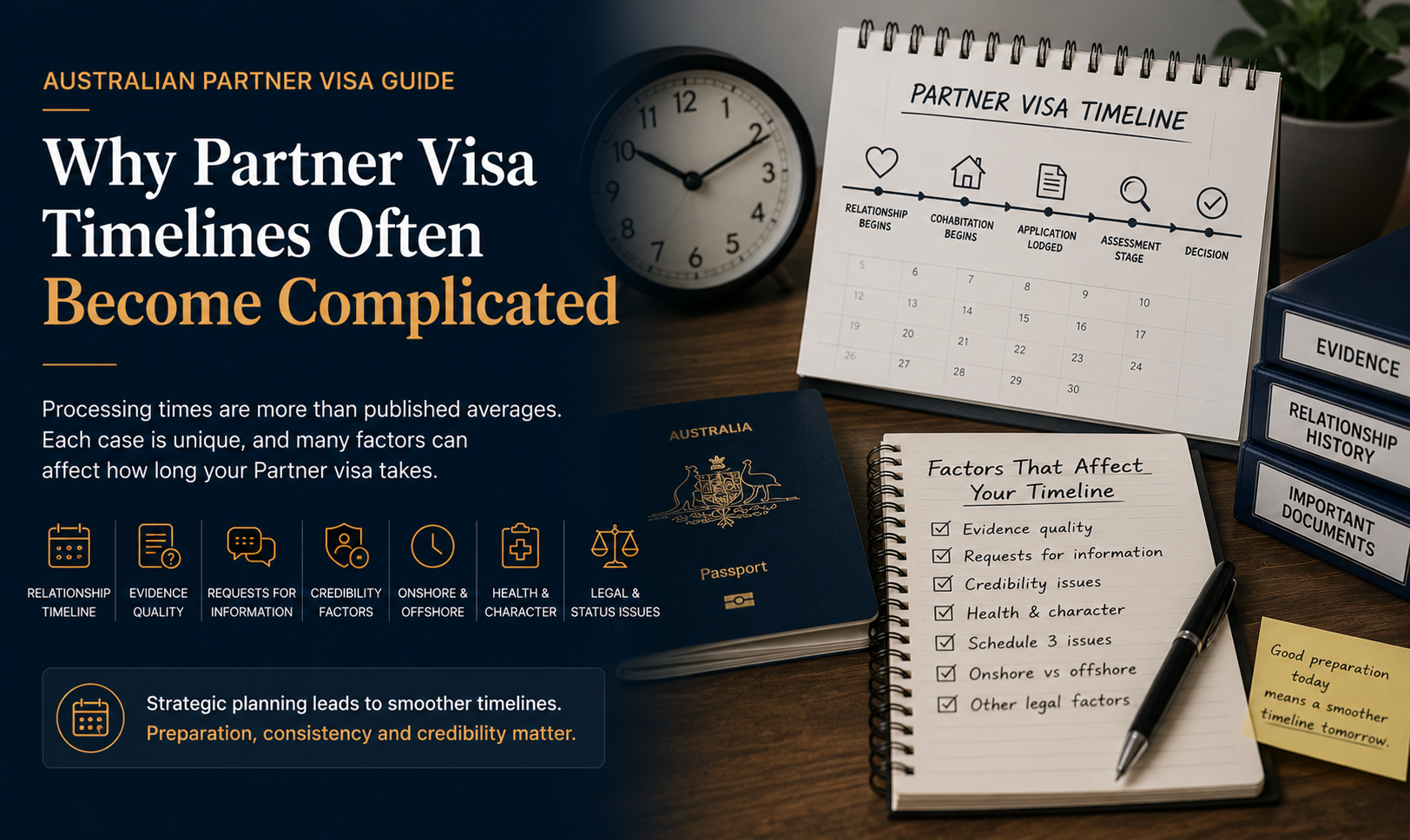
Why Partner Visa Timelines Often Become Complicated
Partner visa timing involves much more than published processing averages. The relationship history, evidence available at lodgement, current visa status, onshore or offshore pathway, health and character requirements, Department requests and credibility issues can all affect how a case progresses. The important question is not simply how long a Partner visa may take, but whether the application has been prepared to avoid unnecessary complexity.
Executive Summary
Published Partner visa processing times are broad indicators rather than guarantees. Two applications lodged at the same time can progress very differently because the relationships, evidence and legal circumstances are different.
A Partner visa pathway may also involve more than one assessment timeline. The temporary or provisional subclass 820 or 309 stage and the later permanent subclass 801 or 100 stage are connected, but they are not necessarily assessed or decided at the same time.
A case may become slower or more complicated because of inconsistent relationship evidence, requests for further information, health or character concerns, previous visa history, Schedule 3 issues, periods of separation or difficulty verifying particular documents.
Applicants cannot control every part of Department processing. They can, however, reduce avoidable complexity by preparing consistent evidence, identifying legal risks early and responding carefully when further information is requested.
What You’ll Learn
- Why a Partner visa pathway may involve separate temporary or provisional and permanent-stage timelines
- How relationship, immigration, Department and permanent-stage clocks operate at the same time
- Why published Partner visa processing times are not guarantees
- How relationship evidence can affect the assessment process
- Why requests for further information can extend a timeline
- How credibility issues can make a case more difficult
- Why onshore and offshore pathways involve different practical issues
- How health, character and Schedule 3 concerns may affect strategy
- Why comparing your application with another couple can be misleading
At a Glance
| Topic | Summary |
|---|---|
| Published processing times | Broad indicators rather than guaranteed decision dates |
| Major variables | Evidence, pathway, legal status, health, character and case complexity |
| Common cause of delay | Requests for further information or unresolved inconsistencies |
| Applicant control | Preparation, consistency, disclosure and timely responses |
| Common mistake | Comparing one application directly with another couple’s case |
| Simon Principle | Time Does Not Simply Pass. It Changes the Case. |
Why Partner Visa Timelines Are Difficult to Predict
No two Partner visa applications are exactly the same.
Two couples may lodge applications on the same day but receive decisions at very different times. This does not necessarily mean that one application has been forgotten or mishandled.
Timing can be affected by:
- the quality and consistency of relationship evidence
- the length and history of the relationship
- periods of separation or limited cohabitation
- whether the application is onshore or offshore
- the applicant’s immigration history
- health or character issues
- previous visa refusals or cancellations
- Schedule 3 considerations
- sponsor eligibility concerns
- requests for further information
- the need to verify documents or claims
- changes in the couple’s circumstances after lodgement
This is why published averages should be treated as general information rather than a promise about an individual case.
Published Processing Times Are Not Guarantees
Published processing times describe how applications have been processed across a broader group of cases. They do not provide a guaranteed decision date for a particular couple.
An application may move faster where it is straightforward and easy to assess. Another may take longer because the Department needs to:
- request additional documents
- clarify inconsistent information
- verify relationship or identity evidence
- consider health or character matters
- analyse immigration history
- assess unusual relationship circumstances
- consider additional legal requirements
Processing ranges can also change over time. Applicants should therefore avoid making irreversible plans on the assumption that a decision will be made by a particular date.
See also Why Australian Visa Processing Times Can Be Misleading.
The Timeline Begins Before Lodgement
Many couples think the Partner visa timeline begins on the date the application is lodged.
Strategically, it often begins much earlier.
Important events may include:
- when the relationship began
- when the couple became committed partners
- when cohabitation began
- when the de facto period was established
- when the relationship was registered
- when the couple married
- when the applicant’s current visa expires
- when key relationship evidence becomes available
- when police or health documents are obtained
- when the couple becomes ready to lodge a credible application
The correct lodgement date is therefore not always simply the earliest possible date.
It should be considered against the couple’s eligibility, evidence, immigration status and strategic risks.
The Decision Date Is Not the Only Deadline
The Department’s eventual decision date may be uncertain, but other dates can have immediate legal or practical consequences.
Important dates may include:
- the expiry date of the applicant’s current substantive visa
- the intended Partner visa lodgement date
- a deadline for responding to a Department request
- the validity period of police certificates, health examinations or other documents
- planned travel and any need for an appropriate bridging visa
- the permanent-stage eligibility point
- a deadline arising from a refusal or reviewable decision
An uncertain decision date does not mean that every other part of the case is flexible.
A sound timeline strategy identifies the dates that can be controlled, the dates that cannot be controlled and the consequences of missing either.
Evidence Quality Can Affect Timing
Evidence quality can affect how easily an application is assessed.
A strong evidence package usually provides a clear and consistent account of:
- how the relationship began
- how it developed
- when commitment became serious
- how the couple shared financial and household arrangements
- how the relationship was recognised socially
- how periods of separation were managed
- what future plans the couple developed
A weak or disorganised application may create questions that need to be resolved before a decision can be made.
An application that looks simple to the couple may still become complicated if the evidence is inconsistent or difficult to follow.
See How to Prove a De Facto Relationship and Why Relationship Evidence Is About Consistency, Not Volume.
Simon’s Perspective
Applicants often ask me how long their Partner visa will take. The honest answer is that nobody can promise an exact decision date.
The more useful question is whether anything in the application is likely to make the case slower, harder to assess or more vulnerable to further questioning.
Good preparation does not guarantee faster processing. It can, however, reduce the risk that avoidable evidence gaps, contradictions or legal issues will make an already lengthy process more complicated.
Not Every Department Request Means the Same Thing
Department communications should be read carefully before a response is prepared. Different requests can serve different purposes and may involve different levels of concern.
| Type of Communication | Possible Purpose |
|---|---|
| Additional document request | To obtain missing, current or more complete documents |
| Further-information request | To obtain information considered relevant to the assessment of the application |
| Invitation to comment | To allow the applicant to address information that may be adverse to the application |
| Health or character request | To complete a separate health, character or public-interest assessment |
| Verification enquiry | To confirm the authenticity, accuracy or reliability of documents or claims |
A routine request for an updated police certificate or additional document does not necessarily mean that refusal is being considered.
An invitation involving inconsistent, adverse or potentially damaging information may be more serious. The response should identify the actual concern, answer it directly and avoid creating new contradictions.
Response deadlines matter. If the requested information or comments are not provided within the permitted period, the Department may be able to decide the application using the information already available.
The objective is not merely to upload more documents. It is to understand what the Department is asking and why.
Evidence Gaps and Credibility Problems Are Not the Same
An incomplete application and an application affected by credibility concerns are not necessarily the same problem.
| Evidence Gap | Credibility Problem |
|---|---|
| A period, event or claim is insufficiently documented | The available information appears contradictory, unreliable or difficult to accept |
| May sometimes be resolved by providing additional evidence | May require an explanation of why conflicting information exists |
| Usually concerns completeness | Concerns whether the claimed account should be accepted |
| Does not necessarily imply doubt about the relationship | May lead to closer examination of the application as a whole |
Providing more evidence may address a genuine gap. It will not necessarily resolve a credibility problem unless the contradiction or concern itself is explained.
Credibility Issues Can Create Delay
Credibility concerns can arise where the application does not clearly support the relationship history being claimed.
Examples include:
- different relationship dates in different forms
- inconsistent residential addresses
- unclear cohabitation history
- weak explanations for living apart
- generic witness statements
- financial claims unsupported by documents
- statements that conflict with independent records
- evidence that appears rushed or artificially created
Once credibility becomes an issue, the Department may need to consider the application more closely or request further material.
See Why Genuine Relationships Still Get Refused.
Onshore and Offshore Timing Can Differ
Onshore Partner Visas
Applicants lodging an onshore Partner visa may need to consider:
- the expiry date of the current visa
- whether a valid onshore application can be lodged
- bridging visa arrangements
- travel while the application is pending
- work rights
- Schedule 3 issues
- previous refusal or cancellation history
The timing of lodgement can therefore have important legal and practical consequences.
For a detailed explanation of visa expiry, bridging visas, travel and onshore lodgement strategy, see Onshore Partner Visa Australia: Subclasses 820 and 801.
Offshore Partner Visas
Offshore applicants may need to manage:
- extended physical separation
- visitor visa travel while waiting
- continued relationship evidence
- communication and visit records
- relocation planning
- employment or family commitments overseas
Both pathways can be appropriate, but the timing strategy and practical consequences are different.
For the complete offshore pathway, see Australia Partner Visa Offshore: Subclasses 309 and 100.
Health Issues Can Affect the Timeline
Health requirements can add complexity where:
- further medical examinations are requested
- specialist reports are needed
- medical information is incomplete
- a significant health condition is identified
- health waiver considerations arise
A health concern does not automatically mean refusal, but it may require additional assessment and evidence.
Character Issues Can Affect the Timeline
Character assessment can become more complex where the applicant:
- has lived in several countries
- has difficulty obtaining police certificates
- has criminal charges or convictions
- has unresolved court proceedings
- has provided incomplete character information
- has previous immigration compliance concerns
Full and accurate disclosure is essential. Attempting to minimise or conceal a character issue can create a more serious problem than the underlying event.
Schedule 3 and Unlawful Status
Partner visa timing can become particularly complex where Schedule 3 or unlawful status issues arise.
These matters may involve questions about:
- when the applicant’s substantive visa expired
- when the applicant became unlawful
- why a further visa was not lodged earlier
- when the relationship began
- whether compelling circumstances exist
- whether the application can satisfy additional legal requirements
The timing of advice and lodgement can be critical.
See How Schedule 3 for Partner Visas Actually Works.
Living Apart While Waiting
Some couples remain in different countries or locations while the application is being assessed.
Where separation continues after lodgement, applicants should continue preserving evidence of:
- regular communication
- visits and travel
- financial or practical support
- shared decision-making
- involvement with family and friends
- future relocation plans
The relationship must generally remain genuine and continuing at the relevant assessment stages.
Limited provisions may allow a Partner visa application to continue after the relationship ends in circumstances involving domestic and family violence, the death of the sponsor, or a child of the relationship where the former partners share access and parental responsibility.
See Living Apart Does Not Automatically Destroy a De Facto Claim.
Changes After Lodgement
A couple’s circumstances may change while the application is pending.
Changes may include:
- marriage
- birth of a child
- change of address
- new employment
- international travel
- new health information
- new criminal or legal matters
- changes in the sponsor’s circumstances
- relationship separation or breakdown
Relevant changes should be considered carefully and disclosed where required. Waiting for a decision does not mean the application remains frozen in time.
The Permanent Partner Visa Stage Has Its Own Timeline
The subclass 820 and 801 pathway and the subclass 309 and 100 pathway generally involve combined applications covering two connected stages:
- the temporary subclass 820 or provisional subclass 309 stage
- the permanent subclass 801 or subclass 100 stage
Most applicants become eligible for consideration of the permanent stage two years after they first applied for the temporary or provisional and permanent Partner visas.
Reaching the eligibility point does not mean that the permanent visa is granted automatically or immediately. The Department may still need to assess:
- whether the relationship remains genuine and continuing
- updated financial, household, social and commitment evidence
- changes in the couple’s circumstances
- updated applicant or sponsor information
- health or character requirements where relevant
- whether any relationship-cessation provisions apply
Some applicants who were already in a long-term relationship when they applied may be considered for the permanent stage sooner.
The permanent-stage timeline should therefore be treated as part of the original strategy rather than an unrelated process that begins after the temporary visa is granted.
See Onshore Partner Visa Australia: Subclasses 820 and 801 and Australia Partner Visa Offshore: Subclasses 309 and 100.
Why Comparing Timelines Can Mislead Couples
Many applicants compare their case with friends, online forums or social media groups.
Another couple may appear similar but have a very different:
- relationship history
- evidence package
- country of residence
- onshore or offshore pathway
- immigration history
- health position
- character history
- sponsor circumstances
- case allocation and assessment requirements
Another person’s timeline is not a reliable prediction of your own outcome.
Similar visa subclasses do not mean identical applications.
Can Applicants Speed Up a Partner Visa?
There is no general method that guarantees faster Partner visa processing or a decision by a particular date.
Applicants should be cautious of anyone promising a guaranteed expedition or suggesting that simply uploading a larger volume of documents will produce a faster decision.
Priority Processing in Limited Circumstances
The Department may consider a request for priority processing where compelling reasons and circumstances of a compassionate nature can be demonstrated.
Priority processing is not an entitlement. A request may be declined, and even an accepted request does not guarantee that the application will be decided by a particular date or produce a favourable outcome.
Applicants should distinguish between requesting priority processing and preparing an application so that it does not create avoidable complications.
Reducing Avoidable Complexity
Applicants can reduce avoidable complexity by:
- lodging a complete and accurate application
- providing relevant and consistent relationship evidence
- explaining unusual circumstances clearly
- disclosing health, character and immigration issues honestly
- checking that forms, statements and documents align
- responding carefully and promptly to Department requests
- keeping contact details and important documents current
- continuing to preserve relationship evidence while the application is pending
Good preparation cannot control the Department’s workload or guarantee faster processing. It can make the application easier to understand and reduce the risk of unnecessary questions caused by gaps or contradictions.
What Applicants Should Focus On
Applicants should focus less on predicting the exact decision date and more on preparing for the process strategically.
That means:
- understanding the legal pathway
- choosing the correct time to lodge
- preparing consistent relationship evidence
- identifying complex issues early
- planning for travel, work and bridging visa consequences
- continuing to preserve evidence while waiting
- responding properly to requests
- avoiding contradictions across the application
Processing time matters, but application quality and legal strategy matter first.
Simon Principle
Time Does Not Simply Pass. It Changes the Case.
In a Partner visa matter, time can change the applicant’s immigration status, the relationship evidence available, the validity of documents, the practical consequences of travel and the circumstances that must be disclosed to the Department.
Waiting is therefore not a neutral period. The strategic question is not merely how much time has passed, but what has changed while it was passing.
Strategic Question
Are you focused only on how long the Department may take, or have you identified what could make your own application slower, harder to assess or more legally complicated?
Related Partner Visa Guides
Partner Visa Pathways
- Partner Visa Strategy Australia
- Onshore Partner Visa Australia: Subclasses 820 and 801
- Australia Partner Visa Offshore: Subclasses 309 and 100
- Partner Visa Strategy Assessment
Relationship Evidence and Credibility
- How to Prove a De Facto Relationship
- Why Relationship Evidence Is About Consistency, Not Volume
- Living Apart Does Not Automatically Destroy a De Facto Claim
- Why Partner Visa Cases Develop Credibility Problems
Delay, Risk and Complex Cases
- Why Genuine Relationships Still Get Refused
- How Schedule 3 for Partner Visas Actually Works
- Partner Visa Further Assessment: Why Your File Is Different
- Common Partner Visa Mistakes
- Visa Appeals Australia and ART Reviews
Partner Visa Timeline FAQs
Are Partner visa processing times guaranteed?
No. Published processing times are broad indicators and do not guarantee when an individual application will be decided.
Why is my Partner visa taking longer than another application?
Your case may involve different relationship evidence, legal issues, health or character requirements, pathway, immigration history or Department assessment needs.
Does a request for further information mean refusal?
Not necessarily. Some requests seek routine or missing information. Other communications may raise more serious concerns. The request should be read carefully and answered completely, accurately and consistently.
Can weak evidence delay a Partner visa?
Weak or inconsistent evidence may lead to further questions, document requests, verification or closer assessment, which can make the application more complicated.
Does a Partner visa have more than one processing stage?
Usually. The onshore subclass 820 and 801 pathway and the offshore subclass 309 and 100 pathway generally involve a temporary or provisional stage followed by a permanent stage.
When can the permanent Partner visa stage be assessed?
Most applicants become eligible for consideration of the permanent stage two years after they first applied for the temporary or provisional and permanent Partner visas. Eligibility does not guarantee an immediate decision, and some long-term relationship cases may be considered sooner.
Can a Partner visa application receive priority processing?
The Department may consider priority processing in limited cases involving compelling reasons and circumstances of a compassionate nature. Priority processing is not guaranteed.
Can Schedule 3 affect Partner visa timing?
Yes. Schedule 3 issues can make an onshore Partner visa application significantly more complex and may affect both timing and strategy.
What happens if the relationship changes while the visa is pending?
The Department should be notified of relevant changes. Although the relationship must generally remain genuine and continuing, limited provisions may apply in circumstances involving domestic and family violence, the sponsor’s death or a child of the relationship.
Can I guarantee faster processing by lodging more documents?
No. Large volumes of documents do not guarantee faster processing. Evidence should be relevant, consistent and organised around the relationship history.
About Simon Mander
Simon Mander is a Registered Migration Agent (MARN 0318058) with more than 23 years of experience in Australian migration law.
He has assisted couples with Partner visa applications involving complex relationship evidence, long-distance relationships, Schedule 3 issues, health waiver matters, refusals and Administrative Review Tribunal proceedings.
His approach focuses on helping couples understand the strategic issues that can affect a Partner visa application before and after lodgement, including evidence quality, legal timing, immigration status and credibility.
Understand the Timeline Before It Controls the Strategy
A Partner visa timeline involves more than waiting for a Department decision. Visa expiry, evidence development, lawful status, travel, health, character and the permanent visa stage may all affect the strategy.
The $750 Partner Visa Strategy Assessment includes:
- a focused 40-minute consultation with Simon Mander
- assessment of the appropriate Partner visa pathway
- identification of timing, evidence and legal risks
- practical strategic advice about the next steps
- a comprehensive written assessment following the consultation