
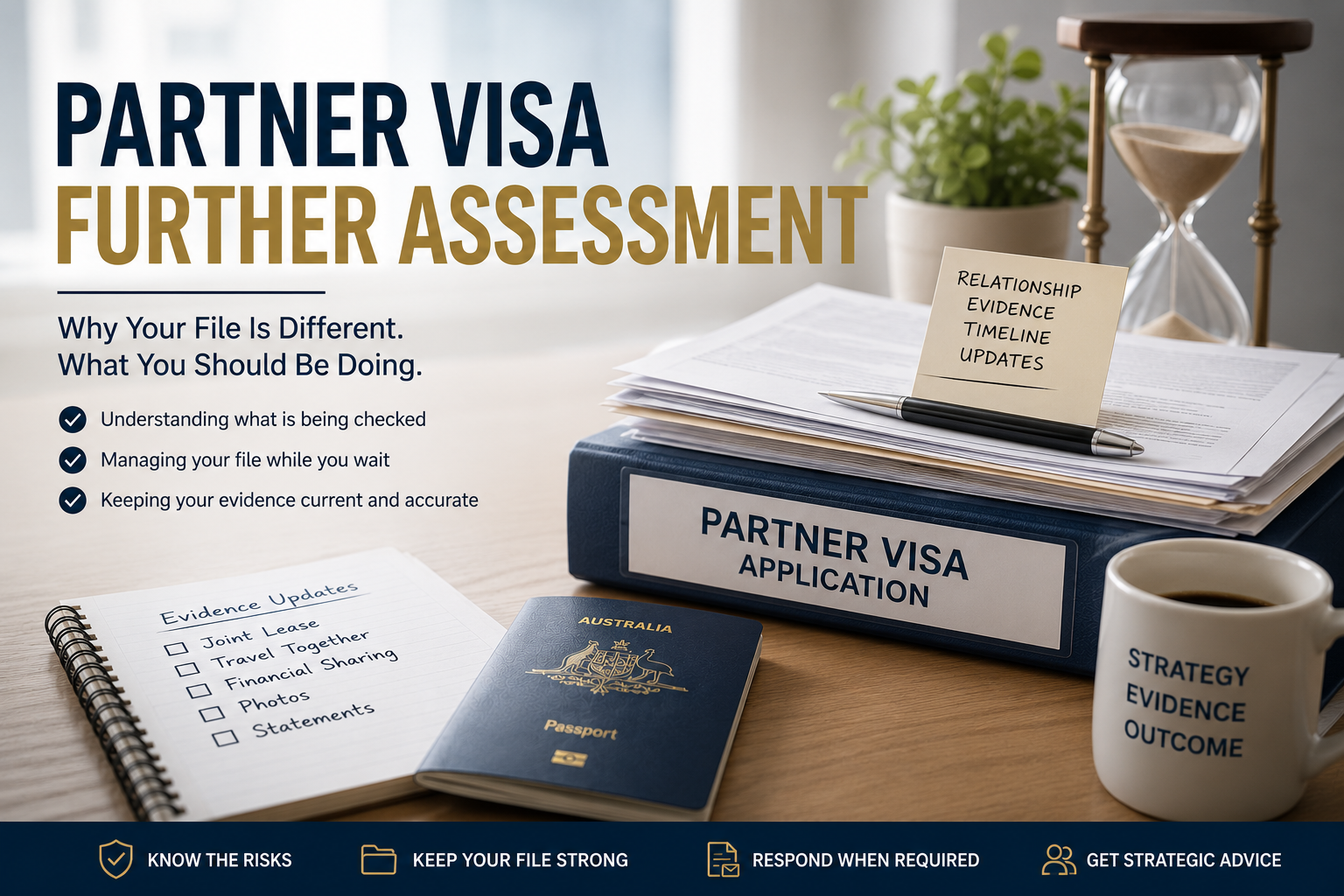
Partner Visa Further Assessment
A Partner visa application does not stop developing after lodgement. While the Department is assessing the application, the relationship continues, circumstances change and the evidence originally submitted becomes older.
This guide explains how to keep a pending Partner visa application accurate, current and coherent while it remains under assessment. It focuses on relationship updates, changed circumstances, Department requests, interviews and evidence strategy—not simply the meaning of an ImmiAccount status.
For the broader meaning of Further assessment, including processing time, general refusal risk and what the status does and does not tell you, see Further Assessment Australia Visa.
Executive Summary
The central issue in Partner visa further assessment is not the status label. It is whether the application still accurately reflects the couple’s relationship and current circumstances.
During a long assessment period, couples may marry, have children, move home, combine finances, live apart temporarily, change employment or experience other significant developments.
Some changes should be notified. Some new evidence may strengthen or update the application. Other documents add little value and may create unnecessary inconsistencies.
The correct strategy is to preserve the integrity of the original application while ensuring that significant developments, changed circumstances and Department requests are addressed carefully.
What You’ll Learn
- why a pending Partner visa application continues changing after lodgement
- which relationship developments may justify an update
- when additional evidence is useful—and when it becomes document dumping
- how to keep dates, statements and circumstances consistent
- what to do when the Department requests further information
- how Partner visa interviews should be approached
- why changed circumstances should not be hidden
- how onshore and offshore applicants face different practical risks
Managing a Pending Partner Visa Application
A pending Partner visa application should be managed through four connected tasks.
1. Preserve the Original Record
Keep copies of the forms, relationship statements, evidence and explanations originally submitted. New information should be checked against that record before it is added.
2. Keep the Application Accurate
Identify changes affecting addresses, contact details, marriage, children, living arrangements, relationship circumstances, health, character or answers already given to the Department.
3. Add Significant Evidence Deliberately
Provide evidence of meaningful developments where it updates or strengthens the relationship history. Avoid uploading large quantities of repetitive material merely because the application is taking time.
4. Respond to the Actual Issue
If the Department sends a request, interview invitation or potentially adverse information, identify the precise issue and answer it directly with targeted evidence and explanation.
The objective is not to keep adding documents. It is to keep the application true, current and easy to understand.
At a Glance
| Topic | Summary |
|---|---|
| Purpose of this guide | Keeping a pending Partner visa application accurate, current and coherent |
| General status meaning | Covered separately in the main Further Assessment Australia Visa guide |
| Possible areas of assessment | Relationship, sponsor, immigration history, identity, health or character |
| Main strategic issue | Keeping the application accurate, current and coherent while waiting |
| Common mistake | Uploading large volumes of trivial or repetitive material |
| Simon Principle | The Wait Is Part of the Application |
What Partner Visa Further Assessment Means
For a Partner visa applicant, the important issue is not simply that ImmiAccount shows Further assessment. The practical issue is that the relationship and the information supplied to the Department continue changing while the application remains undecided.
The status itself does not confirm:
- that the relationship is doubted
- that an interview will occur
- that the visa will be refused
- that additional evidence is required
- how long the application will remain pending
The more meaningful information comes from the original application, the couple’s current circumstances and any Department correspondence received.
For the general meaning of the ImmiAccount status, see Further Assessment Australia Visa.
What the Department May Be Checking
There is no single reason every Partner visa application enters or remains in further assessment.
Possible areas of consideration may include:
- the genuineness and continuing nature of the relationship
- financial aspects of the relationship
- household arrangements
- social recognition of the relationship
- the nature of the partners’ commitment
- sponsor eligibility
- previous sponsorships and applicable sponsorship limitations
- the applicant’s immigration history
- previous visa applications or refusals
- previous relationships or sponsorship information
- identity verification
- health requirements
- character checks
- external agency clearances
The relationship assessment is not a mechanical exercise based only on four document categories. The Department considers the evidence and circumstances of the relationship as a whole.
The Evidence-Aging Problem
A Partner visa application records the relationship as it existed at lodgement.
If the application remains unresolved for many months, the original evidence becomes older while the real relationship continues developing.
During that period, the couple may:
- marry
- have a child
- sign a new joint lease
- purchase property
- merge finances further
- travel together
- move to a new address
- begin living apart for work
- experience health or family changes
- change employment
Some developments strengthen the relationship evidence. Others change information already given to the Department.
The correct approach is not to upload everything that happens. It is to keep the file accurate and add significant developments that genuinely update or strengthen the relationship history.
A Partner visa application should remain true to the couple’s actual circumstances throughout the period of assessment.
Simon’s Perspective
Couples often treat the period after lodgement as dead time. It is not.
The relationship continues, circumstances change and the evidence originally submitted becomes older. The correct strategy is not to upload every message, photograph or bank statement that appears after lodgement.
The correct strategy is to keep the file accurate, notify relevant changes and add significant developments that genuinely help the Department understand the current relationship.
Keeping the Application Accurate
Applicants should consider whether information previously provided remains accurate.
Relevant changes may include:
- a new residential address
- a change in contact details
- marriage
- the birth of a child
- a change in relationship circumstances
- a new period of living apart
- a change in the sponsor’s circumstances
- new health information
- new criminal charges or character information
- changes affecting answers already given in the application
Changes should not be hidden simply because they appear inconvenient.
A current circumstance may be manageable when properly explained. A file that quietly contradicts the couple’s actual situation can create a more serious integrity or credibility concern.
What Evidence Should Be Added While Waiting?
Additional evidence is most useful when it records a significant development or meaningfully updates the relationship.
Examples may include:
- a marriage certificate
- a child’s birth certificate
- a new joint lease or mortgage
- significant new financial arrangements
- updated beneficiary nominations
- major travel or relocation evidence
- evidence of resumed cohabitation
- evidence explaining a new period of separation
- documents responding to a known Department concern
Large volumes of repetitive material are not necessarily helpful.
For example, hundreds of routine message screenshots may obscure the evidence that actually matters.
New material should ideally be:
- significant
- dated
- clearly named
- organised
- consistent with the existing application
- accompanied by explanation where needed
See Why Relationship Evidence Is About Consistency, Not Volume.
Partner Visa Interviews
Interviews may be used selectively where the Department requires clarification or wishes to test aspects of the relationship evidence.
Partners may be asked about:
- how the relationship began
- important relationship milestones
- living arrangements
- financial arrangements
- family members
- daily routines
- periods of separation
- future plans
- information already provided in forms and statements
The aim should not be to memorise identical answers.
The partners should understand their own application, be honest about genuine differences in memory and avoid creating new contradictions.
Consistency with the application is as important as consistency between the partners.
If the Department Requests Further Information
A Department letter may reveal the actual issue requiring attention.
The request may concern:
- additional relationship evidence
- missing identity documents
- police certificates
- health examinations
- sponsor character information
- relationship timeline inconsistencies
- different addresses
- previous visa information
- third-party information
- unexplained circumstances
A response should:
- identify each question or concern
- answer it directly
- provide targeted evidence
- explain inconsistencies honestly
- remain consistent with the original application
- avoid irrelevant document dumping
- be submitted within the required timeframe
See Natural Justice Letters in Australian Visa Applications.
Natural Justice and Adverse Information
In some matters, the Department may provide adverse information or raise a concern before making a decision.
This can involve:
- inconsistent relationship evidence
- information from a third party
- previous application information
- identity concerns
- sponsor history
- immigration compliance concerns
- credibility issues
These letters can be decisive.
A response should address the actual concern, not merely repeat that the relationship is genuine.
The evidence and explanation must respond to the issue the Department has identified.
Onshore Subclass 820 Applications
An onshore Partner visa applicant may remain in Australia on a bridging visa while the application is being processed, depending on the applicant’s circumstances.
Important issues may include:
- lawful status
- work rights
- travel arrangements
- the correct bridging visa for overseas travel
- Schedule 3
- previous refusals
- the consequences of an onshore refusal
An applicant intending to travel should ensure that the appropriate bridging visa arrangements are in place before departure.
An onshore refusal may carry ART review rights, but the refusal notice should be checked immediately because review eligibility and deadlines depend on the decision.
Offshore Subclass 309 Applications
An offshore Partner visa applicant may remain separated from the Australian partner while the application is processed.
During that period, the couple should continue preserving evidence of:
- regular communication
- visits
- travel planning
- financial or practical support
- shared decisions
- future relocation plans
Some offshore Partner visa refusals may carry ART review rights through the Australian sponsor, depending on the decision and statutory circumstances.
The refusal notice should always be checked immediately because review rights and deadlines are decision-specific.
If the Relationship Changes During the Wait
Relationship circumstances can change while the application is pending.
Changes may include:
- temporary separation
- living apart for work
- serious relationship difficulties
- permanent relationship breakdown
- family violence
- the death of the sponsor
These circumstances can have very different legal consequences.
Applicants should not assume that every change means the application must be withdrawn, or that the application can simply continue unchanged.
The correct response depends on the facts, visa pathway and applicable legal provisions.
Withdrawal Is Not a Clean Slate
An applicant may be able to withdraw a pending visa application before a decision is made.
Withdrawal may prevent a refusal decision on that particular pending application, but it does not erase:
- the fact that the application was lodged
- the information already provided
- the applicant’s immigration history
- bridging visa consequences
- fees already paid
- future disclosure obligations
Withdrawal should therefore be treated as a strategic decision rather than a way to make the application history disappear.
See Withdrawing an Australian Visa Application.
Further Assessment and Refusal Risk
Further assessment does not automatically mean refusal.
However, risk may be higher where:
- the Department has identified relationship inconsistencies
- there is adverse third-party information
- important evidence is missing
- the couple’s accounts conflict
- previous visa information contradicts the current application
- sponsor limitations have not been addressed
- health or character requirements remain unresolved
- Department requests are answered poorly or late
The status alone is not the warning sign.
The warning signs come from the substance of the case and any correspondence received.
See Can Further Assessment Lead to Visa Refusal?.
If the Partner Visa Is Refused
A Partner visa refusal should be read carefully and acted on immediately.
The decision may involve:
- relationship evidence concerns
- credibility findings
- sponsor eligibility issues
- Schedule 3
- health or character requirements
- identity concerns
- failure to respond adequately to a request
Some Partner visa refusal decisions may carry ART review rights. Others may not.
The refusal notice should be treated as the source of truth for:
- whether review rights exist
- who may apply for review
- the applicable deadline
- the decision under review
See Visa Appeals Australia and ART Reviews.
What Couples Should Do While Waiting
Couples should focus on keeping the application accurate, current and coherent.
That may involve:
- monitoring ImmiAccount and email
- updating contact information
- notifying relevant changes
- preserving significant new relationship evidence
- avoiding repetitive document uploads
- keeping copies of all correspondence
- reviewing the original application before responding to requests
- maintaining consistent information across both partners
- seeking advice where a legal or credibility issue emerges
The objective is not to interfere with the assessment unnecessarily.
It is to ensure that the application remains accurate and that significant developments are not ignored.
The Real Strategic Issue
The central issue in Partner visa further assessment is not simply how long the application has been waiting.
The real issue is whether:
- the original application remains accurate
- significant changes have been addressed
- new evidence strengthens or contradicts the existing case
- the couple is prepared for questions or interviews
- any Department concern has been answered properly
- the relationship continues to satisfy the relevant criteria
The strongest strategy is to keep the file true, current and easy to understand while the application remains open.
Simon Principle
The Wait Is Part of the Application
A Partner visa application is assessed over time, but the relationship does not remain frozen at the date of lodgement.
The couple’s circumstances, evidence and explanations may continue developing while the application remains pending. Significant changes can strengthen the application, require notification or create inconsistencies if they are ignored.
The waiting period should therefore be managed as part of the application itself—not treated as empty time between lodgement and decision.
Strategic Question
If the Department assessed your Partner visa application today, would the information on the file still accurately reflect your relationship and current circumstances?
Related Guides
Partner Visa Strategy
- Partner Visa Strategy Australia
- Why Partner Visa Timelines Often Become Complicated
- Common Partner Visa Mistakes
Relationship Evidence
- How to Prove a De Facto Relationship
- Why Relationship Evidence Is About Consistency, Not Volume
- Why Genuine Relationships Still Get Refused
Further Assessment and Refusal
- Further Assessment Australia Visa
- Natural Justice Letters
- Can Further Assessment Lead to Refusal?
- Visa Appeals Australia and ART Reviews
Partner Visa Further Assessment FAQs
How long does Partner visa further assessment take?
There is no fixed period. A Partner visa may remain under further assessment for months, and the length of the wait does not reliably predict the outcome.
Does further assessment mean the Partner visa will be refused?
No. Further assessment means processing is continuing. The status alone does not identify the issue or predict the result.
Should I upload more relationship evidence while waiting?
Significant new evidence may be useful, particularly where it updates or strengthens the relationship history. Large volumes of repetitive or trivial material are not necessarily helpful.
Do I need to tell the Department if circumstances change?
Relevant changes and information that affects answers already given may need to be notified. The application should remain accurate throughout the assessment period.
Will we be interviewed?
Possibly. Interviews are used selectively and may occur where the Department requires clarification or wishes to test aspects of the relationship evidence.
Can I withdraw the application?
A pending application may be withdrawn in some circumstances, but withdrawal does not erase the application history and may have consequences for visa status, fees and future strategy.
What happens if the Partner visa is refused?
The refusal notice should be checked immediately for reasons, review rights and deadlines. Some Partner visa refusals may be reviewable by the Administrative Review Tribunal.
About Simon Mander
Simon Mander is a Registered Migration Agent (MARN 0318058) with more than 23 years of experience in Australian migration law.
He has assisted couples with Partner visa applications involving further assessment, relationship evidence, interviews, Department requests, Schedule 3, health waiver issues, refusals and Administrative Review Tribunal proceedings.
His approach focuses on helping couples understand what may be happening during the assessment process, how to keep an application accurate and when a delay may involve a deeper evidentiary or legal issue.
Understand What Your Pending Partner Visa Application Needs
A Partner visa application can continue changing after lodgement. New evidence, changed circumstances, Department correspondence or inconsistencies may need to be considered as part of the complete visa strategy.
The $750 Partner Visa Strategy Assessment includes:
- a focused 40-minute consultation with Simon Mander
- review of the Partner visa pathway and application history
- assessment of relationship evidence, sponsor issues and current circumstances
- advice about whether and how the application should be updated
- review of Department requests, interview or credibility risks where relevant
- a comprehensive written assessment following the consultation
This information is general in nature and does not constitute migration advice for your individual circumstances. Australian migration law and policy can change, and eligibility should be assessed based on the circumstances existing at the time of application.