
Visa Refused After Further Assessment: What Happens Next?
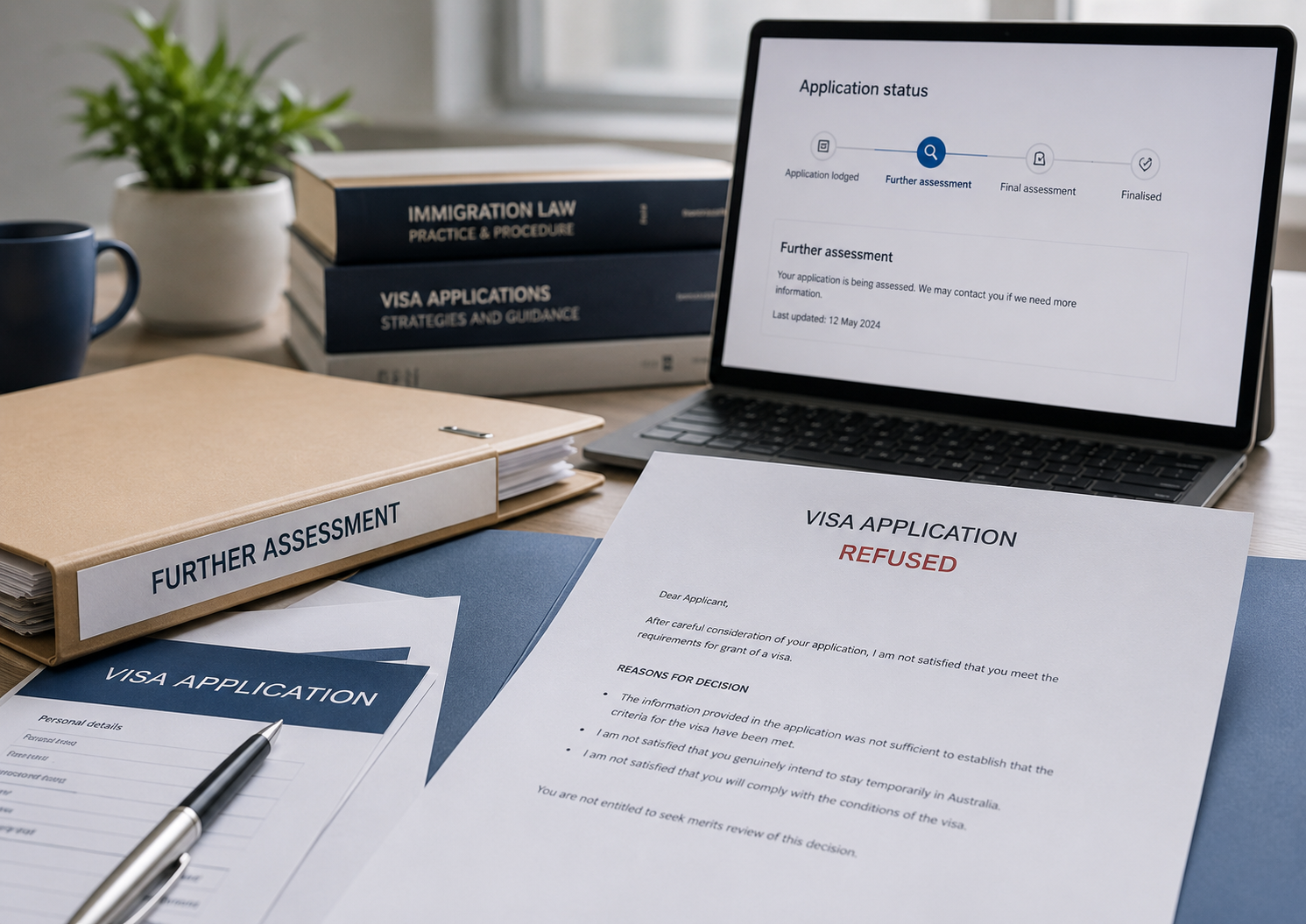
A visa refused after Further Assessment can feel particularly difficult because the applicant has often spent months waiting without knowing what was being examined. Once the refusal arrives, however, the length of the wait does not determine the legal response. The refusal decision, current visa status, review rights and realistic alternative pathways do.
If your application is still showing as Further Assessment and no decision has been made, start with:
Further Assessment in Australian Visa Applications
.
This page is for applicants who have already received a refusal decision.
Simon’s Principle
The Further Assessment history explains the delay. The refusal decision defines the problem.
Do not build the next strategy around how long the application took. Build it around the criterion that was not satisfied, the evidence considered and the legal options available after the decision.
What the Further Assessment Period Does—and Does Not—Mean
Further Assessment is an administrative status. It may mean that the application required additional consideration, checks, documents or internal processing. It does not reveal exactly what the Department was examining.
The time taken does not, by itself, prove that:
- the Department suspected fraud;
- a document was being verified;
- the application was close to approval;
- the application was always likely to be refused;
- the Department accepted every claim that was not expressly discussed; or
- the applicant now has stronger review rights.
Applicants understandably try to reconstruct the refusal from the processing history:
- “They asked for my bank statement, so finance must have been the problem.”
- “They did not request anything else, so they must have accepted the rest.”
- “The application took ten months, so they must have investigated my documents.”
Those may be reasonable questions, but they are not safe conclusions.
The starting point is the complete refusal notification, including:
- the decision record;
- the visa criterion considered;
- the findings made;
- the evidence referred to;
- any review-right information; and
- the date and method of notification.
A Long Wait Is Not a Refusal Ground
“My application was in Further Assessment for nine months” describes the history of the application. It does not identify why the legal requirements for the visa were found not to have been met.
Step 1 — Read the Refusal as a Decision Problem
A refusal should be reduced to a precise proposition.
For example:
- the decision-maker was not satisfied that the applicant met the Genuine Student requirement;
- the claimed funds were not shown to be genuinely available;
- the employment evidence did not establish the claimed work history;
- a relationship criterion was not satisfied;
- health or character requirements were not met;
- required information was not provided within the permitted period; or
- the Department considered information or a document unreliable.
The refusal should not be summarised merely as:
- “They did not believe me.”
- “They ignored my evidence.”
- “The case officer was unfair.”
- “They wanted more documents.”
Those reactions may reflect how the decision feels, but they do not yet identify what must be answered.
Separate the Finding from the Evidence
For each refusal finding, identify:
- What criterion was being assessed?
- What factual finding did the decision-maker make?
- What evidence was accepted, rejected or given limited weight?
- What evidence or explanation would be needed to answer that finding?
More evidence is not automatically better evidence.
A new bank statement does not necessarily explain the source of funds. A new employment letter does not necessarily resolve conflicting dates. A longer personal statement does not necessarily answer why the original account changed.
For the detailed evidence framework, see:
What Actually Matters in an ART Visa Review?
.
Where the Decision Mentions False or Misleading Information
Do not assume that a long Further Assessment period means that an integrity finding was made.
Equally, do not minimise the issue where the decision expressly refers to:
- false or misleading information;
- a bogus or altered document;
- identity concerns;
- information that could not be verified;
- inconsistent claims across different applications; or
- Public Interest Criterion 4020.
An integrity finding can have consequences beyond the application that was refused. The precise wording of the decision, the visa criterion involved and the available response must be examined carefully.
Home Affairs warns that false or misleading information or documents may lead to visa refusal, cancellation, restrictions on future applications and possible legal consequences.
Step 2 — Check Your Current Immigration Status
The refusal decision and the applicant’s current immigration status are separate questions.
After an onshore refusal, check:
- which visa is currently in effect;
- the expiry or cessation provisions applying to that visa;
- whether a bridging visa has been granted;
- the conditions attached to the current visa;
- work rights;
- study rights;
- travel restrictions;
- whether another application or review is already pending; and
- whether section 48 or another application limitation may apply.
VEVO can be used to check the visa currently in effect and its recorded conditions.
Do not assume that:
- the refused visa application itself allowed you to remain indefinitely;
- an ART application automatically grants a new bridging visa;
- the bridging visa connected with the original application has already commenced;
- review automatically creates work rights;
- you can travel and return on the visa currently held; or
- another onshore visa application can validly be made.
For a more detailed explanation, see:
Bridging Visa After a Visa Refusal: What Happens to Your Status?
.
Section 48
Section 48 can restrict the visa applications that some people may make while remaining in Australia.
Broadly, the issue can arise where a person:
- is in Australia;
- does not hold a substantive visa; and
- has had a visa refused or cancelled since last entering Australia.
There are specified visas and circumstances that require separate consideration. It should not be reduced to “you cannot apply for anything.”
Step 3 — Confirm Whether ART Review Is Available
Some visa refusals can be reviewed by the Administrative Review Tribunal. Others cannot.
The Department’s decision notification should identify:
- whether the decision is reviewable;
- who is entitled to apply;
- the period for lodging the review application;
- how the application must be lodged; and
- any fee or procedural requirements.
Do not rely on a general statement that every applicant has 28 days.
The applicable review period depends on the decision and the legal provisions applying to it. The actual decision notification must be checked.
The ART states that the Department’s decision letter specifies whether the decision can be reviewed and who may apply. ART guidance also directs applicants to lodge within the time stated in that notification.
For the detailed deadline guide, see:
How Long Do You Have to Apply for ART Review?
.
Legal Availability Is Not the Same as Strategic Value
A review may be legally available but still require a careful assessment of whether it is useful.
Consider:
- whether the refusal finding can be answered;
- whether the necessary evidence exists;
- whether the original visa pathway still serves the applicant’s objective;
- the applicant’s current immigration status;
- whether circumstances have materially changed;
- the likely cost and duration of review;
- whether another lawful pathway is stronger; and
- what happens after a favourable ART outcome.
A favourable ART result may set aside the refusal or result in the matter being returned to Home Affairs for further action. It does not necessarily mean that a visa is immediately granted.
See:
Winning ART Review Does Not Always Mean You Can Stay in Australia
.
Step 4 — Compare Review, Reapplication and Other Pathways
After a refusal, the realistic options may include:
- ART review;
- a fresh application, where a valid application can legally be made;
- a different visa pathway;
- departure followed by an offshore application strategy;
- obtaining the application record before deciding; or
- taking no further application step where the available options are not viable.
| Possible pathway | Question that must be answered |
|---|---|
| ART review | Is review legally available, can the refusal finding be answered and would a favourable result still be useful? |
| Fresh application | Can a valid application be made, and has the original refusal problem genuinely been corrected? |
| Different visa pathway | Is the applicant independently eligible, and how does the new application interact with current status and the refusal record? |
| Departure and offshore strategy | What are the lawful-status, travel, re-entry and future application consequences? |
| Obtain the application record | Is important material missing, or is the refusal reasoning too unclear to formulate a safe response? |
Do Not Simply Submit More Documents
The most common reapplication mistake is treating the refusal as a request for a larger document bundle.
The correct question is not:
“What else can I upload?”
It is:
“What did the decision-maker find, and what reliable evidence answers that finding?”
Where the original record is incomplete or uncertain, an FOI or other file-access process may assist. It is not automatically required in every matter.
See:
FOI Requests After a Visa Refusal
.
The Strategic Question
Which legally available process best answers the refusal, protects the applicant’s current position and still leads to a worthwhile outcome?
Fictional Worked Example: The Long Wait Was a Distraction
This example is fictional and is included to demonstrate the decision-making framework.
Mina applies for a temporary visa and the application remains in Further Assessment for eight months.
During that period, Home Affairs asks for updated financial evidence and confirmation of her employment history. Mina supplies both.
The application is eventually refused.
Mina assumes that the refusal must mean:
- the Department decided her employment documents were false;
- the long delay proves that an investigation occurred; and
- her only option is to reapply with more employment documents.
The decision record does not make a fraud finding.
Instead, it states that the decision-maker was not satisfied that Mina’s proposed visit was consistent with a temporary stay because:
- her claimed employment arrangements were unclear;
- the approved leave period did not align with the proposed travel period;
- her financial circumstances were not adequately explained; and
- the evidence did not establish sufficiently strong incentives to return.
The Further Assessment history did not identify the legal problem. The decision did.
Mina’s next strategy must therefore examine:
- whether review is legally available;
- whether her current immigration status is affected;
- whether a fresh application can validly be made;
- whether the employment and financial inconsistencies can be explained reliably; and
- whether the proposed travel circumstances remain the same.
Submitting three more employment letters without addressing the conflicting leave and travel dates would add documents without answering the refusal.
Simon’s Perspective
Applicants often attach meaning to the Further Assessment period because it was the most visible part of the process.
They remember:
- how many months they waited;
- how often they checked ImmiAccount;
- which document was requested;
- whether the status changed; and
- how little information the Department provided.
But the review or reapplication strategy cannot be built from the emotional chronology of the wait.
I have seen applicants focus heavily on the one document requested during Further Assessment while overlooking a more important inconsistency already present in the original application.
I have also seen applicants assume that a long delay means the Department rejected a document as false when the actual refusal was based on a much narrower failure to establish a visa criterion.
The distinction matters.
An integrity finding, an evidentiary gap and a failure to satisfy a discretionary assessment are not interchangeable problems. They require different evidence and different strategic responses.
The refusal letter must therefore be read as a legal and evidentiary document—not simply as the disappointing end of a long wait.
Official Resources
About Simon Mander
Simon Mander is a Registered Migration Agent (MARN 0318058) with more than 23 years of experience in Australian migration law.
His work includes visa-refusal strategy, ART review assessment, application-record analysis and advice about alternative visa pathways.
Get a Visa Refusal Strategy Assessment
A refusal after Further Assessment should be examined against the actual decision, the original application record, current immigration status and any available review or alternative pathway.
The paid Visa Refusal Strategy Assessment provides written advice identifying the refusal problem, urgent procedural risks and the realistic next options.
The assessment does not lodge an ART review, prepare complete review submissions or guarantee that another visa application can be made.
Frequently Asked Questions
Does a long Further Assessment period mean the Department suspected fraud?
No. The processing time alone does not establish what the Department was examining. Check the refusal decision for any express findings about false information, document integrity, verification or Public Interest Criterion 4020.
Can I apply for ART review after a visa refusal?
Some visa refusals are reviewable and others are not. The decision notification should state whether review is available, who may apply and the applicable deadline.
How long do I have to apply for ART review?
There is no safe universal deadline that applies to every refusal. The relevant period must be identified from the decision notification and the provisions applying to that decision.
Can I lodge another visa application after the refusal?
Possibly. The answer depends on where you are, which visa you currently hold, whether section 48 or another application limitation applies, and whether the requirements for the new visa are satisfied.
Does applying for ART review automatically give me a bridging visa?
No universal assumption should be made. The bridging-visa position depends on the visa held, the original application, whether the review is validly lodged and the circumstances of the individual case. Check VEVO and all relevant grant notices.
Should I lodge an FOI request after the refusal?
Not automatically. File access may be useful where the original application record is incomplete, important material is missing or the decision reasoning cannot be properly understood from the documents already available.
Must I disclose the refusal in future visa applications?
Answer every future application accurately according to the questions asked. Where a form asks about previous visa refusals or immigration history, the refusal must be disclosed truthfully and consistently.
This information is general in nature and does not constitute migration advice for your individual circumstances. Australian migration law and policy can change, and eligibility should be assessed based on the circumstances existing at the time of application.