
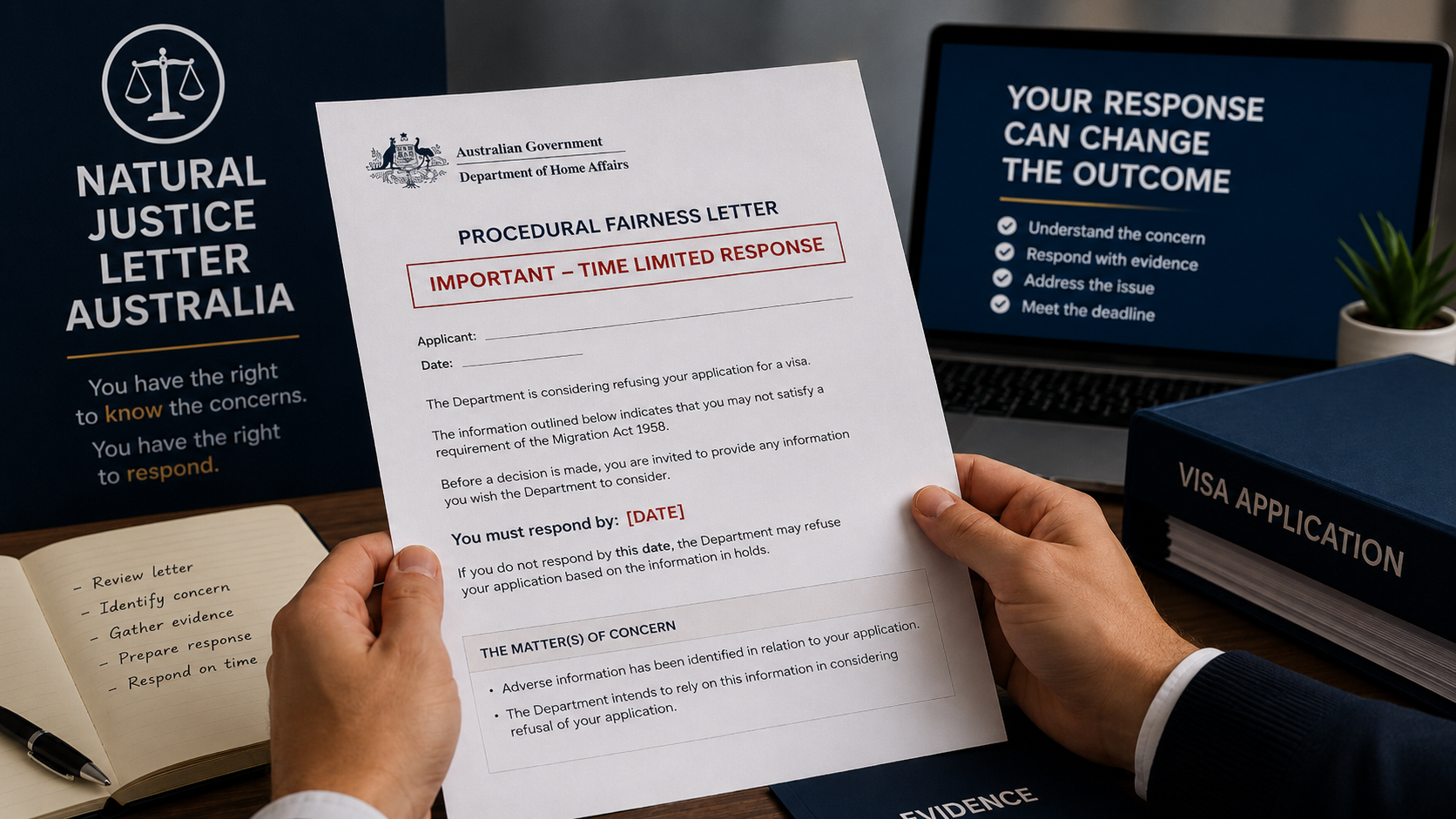
Natural Justice Letter from Home Affairs: How Should You Respond?
Natural justice letter Australia: if Home Affairs has raised potentially adverse information before deciding your visa application, the response should be built around the precise concern, its source, the relevant visa requirement and the evidence capable of answering it.
Applicants often use the expression “natural justice letter” for several different kinds of Departmental correspondence.
That can include:
- an invitation to comment on adverse information;
- a request for further information or documents;
- a procedural-fairness letter;
- a document-verification concern;
- an integrity or false-information concern;
- a character-related notice;
- a health-related invitation; or
- a notice proposing cancellation of a visa already held.
Those documents do not all operate under the same provisions or create the same consequences.
The first task is therefore not to write a response. It is to identify exactly what document has been issued and what legal and factual problem it raises.
Simon’s Principle
The letter defines the response problem.
The Department is not asking you to resubmit everything that supports the visa application. It is asking whether a particular concern can be answered before the decision is made.
What Is a Natural Justice Letter?
“Natural justice letter” is a commonly used expression rather than the title of one universal Home Affairs document.
In many visa-application matters, the expression refers to correspondence that:
- identifies information potentially adverse to the application;
- explains why that information may matter;
- invites the applicant to comment or provide further material; and
- states how and when the response must be provided.
The letter does not necessarily mean that refusal is inevitable.
It does mean that the application contains—or has attracted—an issue capable of affecting the outcome.
The opportunity to respond may be important because the decision-maker must consider relevant information and comments properly provided before the decision is made.
A Warning Is Not Yet a Decision
Treat the letter seriously, but do not write as though the application has already been refused. The purpose of the response is to engage with the unresolved concern while the application remains undecided.
Why the Exact Wording Matters
Read the letter for:
- the heading and document type;
- the statutory provision referred to;
- the visa criterion or issue identified;
- the information Home Affairs proposes to consider;
- the source of that information, if disclosed;
- the response deadline;
- the permitted response method;
- any attachments;
- whether an interview is offered or required; and
- what may happen if no response is received.
Do not rely only on the subject line in ImmiAccount.
The legal and evidentiary problem is usually found in the body of the notice and its attachments.
Section 56, Section 57 and Other Departmental Notices
A Section 56 Request for Further Information
Section 56 permits Home Affairs to seek information it considers relevant to deciding a visa application.
A section 56 request may ask for:
- updated financial information;
- identity documents;
- employment evidence;
- relationship documents;
- health or character information;
- clarification of dates or circumstances;
- missing documents; or
- evidence needed to assess a visa criterion.
A request for further information is not automatically an accusation.
But it can still reveal a significant weakness in the application.
For example, a request asking for proof that funds are genuinely available may indicate that the account balance alone has not answered the financial requirement.
A Section 57 Invitation to Comment
Section 57 deals with a narrower category of information.
Broadly, the statutory obligation concerns information that Home Affairs considers:
- would be the reason, or part of the reason, for refusing the visa;
- is specifically about the applicant or another person, rather than merely about a general class of people; and
- was not provided by the applicant for the purpose of the application.
Where section 57 applies, Home Affairs must provide particulars of the relevant information, explain its relevance as far as reasonably practicable and invite the applicant to comment.
Not Every Adverse Concern Is Necessarily a Section 57 Matter
Applicants sometimes assume that Home Affairs must separately warn them about every weakness in their own documents or statements.
That is not a safe assumption.
The statutory section 57 definition excludes information provided by the applicant for the purpose of the application.
This means a decision-maker may identify problems arising from:
- the applicant’s own form answers;
- the applicant’s statement;
- documents supplied with the application;
- conflicts between documents provided by the applicant; or
- the absence of evidence needed to establish a criterion.
Whether procedural fairness requires another invitation depends on the particular information, legislation and decision-making context.
Do not assume that silence from Home Affairs means the original evidence has been accepted.
A Notice of Intention to Consider Cancellation
A notice concerning possible visa cancellation is different again.
It concerns a visa already granted rather than an undecided visa application.
The notice may identify:
- the proposed cancellation ground;
- adverse information;
- the matters the decision-maker may consider;
- the response period; and
- the possible consequences of cancellation.
Cancellation, character and mandatory-cancellation matters can involve different procedures, deadlines and review rights. They should not be treated as an ordinary section 56 or section 57 response.
The Six-Part Natural Justice Response Framework
Notice → Concern → Source → Evidence → Response → Consequence
The framework prevents a response from becoming a general plea for approval.
Each stage answers a different question:
- Notice: What document has actually been issued?
- Concern: What factual or legal problem has been raised?
- Source: Where did the adverse information come from?
- Evidence: What reliable material answers it?
- Response: How should the explanation be presented?
- Consequence: What happens if the concern is accepted, answered or left unresolved?
Step 1 — Read the Complete Notice
Before drafting anything, preserve:
- the full letter;
- all attachments;
- the ImmiAccount message;
- the date and time it appeared;
- any email notification;
- the original application and attachments;
- previous correspondence with Home Affairs; and
- records held by any former representative.
Record the Actual Deadline
The response period should be taken from the notice itself.
Do not rely on a general statement that every applicant receives:
- seven days;
- 14 days;
- 21 days; or
- 28 days.
The legislation permits invitations to specify the period and method for giving information or comments, subject to the applicable statutory and regulatory framework.
Once the response period has expired, Home Affairs may be able to decide the application without taking further action to obtain the applicant’s information or views.
Do Not Assume an Extension Will Be Granted
Where more time is genuinely required:
- check whether an extension is legally and procedurally available;
- make the request early;
- explain exactly why additional time is needed;
- identify what evidence is being obtained;
- provide a realistic date; and
- continue preparing the response while the request is considered.
A request for more time does not itself suspend the stated deadline unless Home Affairs confirms an extension or the legislation produces that result.
Do Not Spend the Response Period Debating Whether the Letter Is Fair
The immediate task is to understand and answer the notice within the available time. Complaints about tone, delay or unfairness do not replace the evidence needed to address the concern.
Step 2 — Identify the Exact Concern
Convert the letter into an issue schedule.
| Question | What to identify |
|---|---|
| What is alleged? | The factual concern, inconsistency, verification result, omission or disputed document. |
| Why does it matter? | The visa criterion, integrity requirement, character issue or other legal consequence. |
| What is the source? | Employer verification, another application, third-party information, government records, interview answers or supplied documents. |
| What response is invited? | Comments, documents, correction, explanation, interview attendance or another specified action. |
| What may happen? | Refusal, cancellation, further checks, another request or continued assessment. |
Answer the Concern That Was Raised
A common failed response looks like this:
- Home Affairs questions whether an employment document is reliable.
- The applicant writes extensively about being a genuine student.
- The response adds bank statements, family photographs and academic certificates.
- The verification concern remains unanswered.
The response may contain a large volume of favourable material and still fail because it does not answer the identified problem.
Separate Fact, Inference and Legal Consequence
The letter may contain:
- a factual statement;
- an inference drawn from that fact; and
- a possible legal consequence.
For example:
- Fact: the organisation contacted by Home Affairs said it could not verify the employment letter;
- Inference: the document may not be genuine or reliable;
- Consequence: an integrity requirement or claimed employment criterion may not be satisfied.
A proper response may need to address all three levels.
Step 3 — Identify the Source of the Information
The same apparent inconsistency can require different responses depending on its source.
Possible sources include:
- the applicant’s visa form;
- a statement or statutory declaration;
- a previous visa application;
- a Departmental interview;
- an employer or educational institution;
- a government database;
- a former partner or family member;
- a sponsor;
- another country’s immigration records;
- social-media material;
- document verification; or
- information supplied by another agency.
Reconstruct the Original Application
Before responding, compare the concern against:
- the exact form answers;
- all uploaded documents;
- earlier statements;
- interview answers;
- emails with the representative;
- drafts approved by the applicant;
- documents submitted in earlier visa matters; and
- the applicant’s travel and immigration history.
Do not respond from memory.
Applicants commonly remember the broad story but not:
- the exact dates entered in the form;
- how an occupation was described;
- which employer name was used;
- whether an earlier refusal was disclosed;
- which address appeared in another application; or
- what a former representative actually uploaded.
Where the record cannot be reconstructed from ImmiAccount, retained documents or a former representative, a file-access process may need to be considered.
Step 4 — Gather Evidence That Answers the Concern
A response should distinguish between:
- assertion;
- explanation;
- corroboration; and
- independent verification.
“The document is genuine” is an assertion.
An explanation may identify:
- who created the document;
- when it was created;
- why a particular format was used;
- why the issuing organisation could not initially locate it; or
- why different names or dates appear.
Corroboration may include:
- contemporaneous emails;
- pay records;
- bank transactions;
- tax documents;
- contracts;
- attendance or enrolment records;
- official registers;
- medical records;
- travel evidence;
- photographs with surrounding context; or
- statements from people with direct knowledge.
Independent verification may include confirmation from:
- the issuing employer;
- the educational institution;
- a government authority;
- a regulated professional;
- a financial institution; or
- another reliable record-holder.
Evidence Must Be Connected to the Issue
Do not simply attach documents.
For each document, explain:
- what it is;
- who created it;
- when it was created;
- what fact it proves;
- how it answers the Department’s concern; and
- why it should be considered reliable.
Later-Created Documents Need Context
A letter created after Home Affairs raised a concern is not automatically unreliable.
But it should be distinguished from a contemporaneous record.
The response should explain:
- why the document was created now;
- what records the author relied upon;
- how the author knows the facts stated;
- whether the author can be independently contacted; and
- why the document differs from any earlier evidence.
More Documents Can Create More Problems
Every new document introduces names, dates, descriptions and factual claims. A rushed response can deepen the original problem where those details conflict with the existing record.
For the broader evidence framework, see:
What Actually Matters in an ART Visa Review?
.
Step 5 — Structure the Written Response
A disciplined response will usually include:
- an identification of the letter and application;
- a concise summary of the concern;
- a response to each separate issue;
- an accurate factual chronology;
- any necessary admission or correction;
- the explanation for discrepancies;
- the evidence supporting each explanation;
- an explanation of why the relevant visa requirement is satisfied; and
- an indexed list of attachments.
Use Headings That Mirror the Letter
Where the notice raises three concerns, the response should ordinarily contain three corresponding sections.
For example:
- Concern 1 — Employment dates
- Concern 2 — Authenticity of the reference
- Concern 3 — Inconsistent occupation descriptions
This helps the decision-maker see that each issue has been addressed rather than buried within a long narrative.
Correct Errors Directly
Where the original application contains an error:
- identify it clearly;
- state the correct information;
- explain how the error occurred;
- identify who prepared or supplied the incorrect answer;
- avoid shifting blame without evidence;
- explain when the error was discovered; and
- provide reliable supporting material.
Pretending an obvious error does not exist usually damages credibility more than a candid correction.
Do Not Overstate the Evidence
Avoid claiming that a document “proves” something where it only supports or is consistent with it.
A credible response should distinguish:
- what the evidence establishes;
- what it supports;
- what remains uncertain; and
- what relies on the applicant’s explanation.
Avoid Emotional Submissions That Do Not Answer the Issue
The consequences of refusal may be serious, but hardship alone may not answer:
- whether a document is genuine;
- whether employment occurred;
- whether funds are available;
- whether a relationship criterion is met;
- whether an earlier answer was false; or
- whether the visa criterion is satisfied.
Personal circumstances should be included where legally relevant, not as a substitute for answering the factual concern.
Step 6 — Understand the Possible Consequences
After receiving the response, Home Affairs may:
- accept the explanation and continue processing;
- request more information;
- conduct further verification;
- invite the applicant to an interview;
- decide that the concern remains unresolved;
- refuse the visa application; or
- in a cancellation matter, decide whether to cancel the visa.
There is no general fixed processing period after a response.
A detailed response may itself lead to further checking where it introduces new information requiring verification.
What Happens If No Response Is Provided?
Where an applicant has been invited to provide information or comments and does not respond before the applicable period ends, Home Affairs may be able to decide the application without taking further action to obtain the information or the applicant’s views.
Silence does not necessarily amount to an admission.
But it leaves the adverse information or evidentiary gap unanswered.
If the Application Is Refused
The next questions may include:
- whether ART review is available;
- who may apply for review;
- the actual review deadline;
- current visa and bridging-visa status;
- whether Section 48 applies;
- whether another application can validly be made; and
- whether the response itself created further credibility or integrity issues.
See:
Visa Refused After Further Assessment: What Happens Next?
.
For the Section 48 position, see:
Section 48 Bar After a Visa Refusal
.
Should You Withdraw Instead of Responding?
Withdrawal may be relevant in some matters, but it is not automatically a safer response.
A withdrawal made before the application is decided ordinarily prevents a refusal decision being made on that application.
It does not necessarily:
- erase the original application;
- erase documents or answers already provided;
- remove information held by Home Affairs;
- prevent the issue being considered in a future application;
- remove an earlier refusal or cancellation;
- remove Section 48 arising from another decision;
- produce a refund;
- preserve a bridging visa indefinitely; or
- make a future application valid or successful.
When Withdrawal May Need to Be Considered
Relevant questions may include:
- Can the concern be answered honestly and reliably?
- Is the disputed information true?
- Would continuing expose the applicant to a serious integrity finding?
- What happens to the applicant’s current visa or bridging visa?
- Can another application legally be made?
- Would departure be required?
- Will withdrawal affect a sponsor, family member or combined applicant?
- What must be disclosed in a future application?
- Does the applicant lose an important review opportunity?
Withdrawal Is Not a Way to Make the Problem Disappear
It ends the undecided application. It does not rewrite the information already given to Home Affairs or guarantee that the underlying concern will not arise again.
Fictional Worked Example: The Employer Could Not Verify the Letter
This example is fictional and is included to demonstrate the response framework.
Ravi submits a skilled visa application supported by an employment reference stating that he worked for Zenith Technologies from January 2018 to December 2022.
Home Affairs later issues a letter stating that:
- the employer was contacted;
- the person who responded could not verify Ravi’s employment;
- the reference used a letterhead different from the company’s current format; and
- the Department is considering whether the employment claim and document can be accepted.
Notice
Ravi records:
- the response deadline;
- the required response method;
- the exact wording of the concern;
- the referenced document; and
- the potential visa and integrity consequences.
Concern
The issue is not simply whether Ravi says he worked there.
The Department has raised:
- non-verification by the company;
- the reliability of the reference;
- the claimed employment period; and
- the weight that can be given to the work-experience evidence.
Source
Ravi discovers that:
- Home Affairs contacted the company’s current head office;
- he had worked through a regional subsidiary;
- the regional office had since closed;
- older personnel records were stored separately; and
- the reference had been issued by his former regional manager.
Evidence
Ravi gathers:
- the original employment contract;
- contemporaneous salary deposits;
- tax and retirement-contribution records;
- emails sent from the company domain during employment;
- the subsidiary’s corporate records;
- evidence linking the regional manager to the company; and
- a new confirmation from the company’s records department after it locates the archived file.
Response
The response:
- acknowledges the initial verification failure;
- explains the company structure and closure of the regional office;
- does not accuse Home Affairs of making a mistake;
- connects each document with the employment claim;
- explains the historic letterhead; and
- provides direct contact details for independent verification.
Consequence
The response does not guarantee a favourable decision.
It gives the decision-maker a coherent explanation and independent material capable of answering the actual concern.
A response consisting only of Ravi’s declaration that the letter was genuine would not have answered why the employer initially could not verify it.
Simon’s Perspective
The greatest danger in these matters is not always the original inconsistency.
It is the explanation produced after the inconsistency is identified.
Applicants under pressure frequently:
- guess dates they cannot remember;
- ask someone to create a new letter urgently;
- add details that were never previously mentioned;
- blame a former representative without checking the record;
- describe ordinary mistakes as translation errors;
- claim a document proves more than it does; or
- send an emotional response before reconstructing the application.
That can turn one disputed document into a broader credibility problem.
I also see applicants assume that the safest response is always to deny the allegation completely.
Sometimes the accurate response is more nuanced:
- the document is genuine but contains an error;
- the employment occurred but the dates were overstated;
- the applicant misunderstood a question;
- the organisation used different names;
- the information changed after lodgement;
- the document was prepared by another person without adequate checking; or
- part of the original claim cannot be maintained.
A candid, documented correction may be stronger than an absolute denial that cannot survive verification.
The best responses are usually disciplined.
They distinguish:
- what the Department says;
- what the applicant accepts;
- what the applicant disputes;
- what requires correction;
- what the evidence independently establishes; and
- what legal conclusion should follow.
The objective is not to produce the longest response. It is to give the decision-maker a reliable basis for resolving the precise concern in the applicant’s favour.
Strategic Question
What precise fact or visa requirement is at risk, and what reliable evidence gives Home Affairs a lawful basis to resolve that issue in your favour?
Official Resources
About Simon Mander
Simon Mander is a Registered Migration Agent (MARN 0318058) with more than 23 years of experience in Australian migration law.
His work includes natural justice and procedural-fairness responses, visa-refusal strategy, document and credibility analysis, Further Assessment matters and ART review assessment.
Get a Written Strategy Assessment
A natural justice or procedural-fairness letter should be assessed against the complete notice, the original visa application, the source of the concern and the available supporting evidence.
The paid strategy assessment provides written advice identifying the issue raised, the immediate deadline risk and the evidence and response structure that should be considered.
The assessment does not lodge a response, prepare complete submissions or guarantee that Home Affairs will accept the explanation.
Natural Justice Letter Australia: Frequently Asked Questions
What is a natural justice letter from Home Affairs?
The expression commonly refers to correspondence giving an applicant an opportunity to respond to potentially adverse information or a concern before a decision is made. The actual statutory basis and requirements depend on the particular letter.
Is a section 56 request the same as a natural justice letter?
Not necessarily. Section 56 permits Home Affairs to seek additional information considered relevant. Section 57 concerns particular adverse information that may be a reason for refusal and was not provided by the applicant for the purpose of the application.
Does receiving the letter mean my visa will be refused?
No. It means an unresolved issue may affect the decision. A properly supported response may resolve the concern, although no response can guarantee a favourable outcome.
How long do I have to respond?
Use the date and response instructions stated in the actual notice. Do not assume that a universal response period applies to every letter.
Can I request an extension?
An extension may be available in some circumstances, depending on the applicable legislation and notice. Request it early, explain why it is required and do not assume the deadline has changed unless the extension is confirmed or legally effective.
What happens if I ignore the letter?
Once the permitted response period ends, Home Affairs may be able to decide the application without taking further action to obtain the requested information or the applicant’s comments.
Should I send every favourable document I have?
No. The response should prioritise reliable evidence that answers the specific concern. Irrelevant documents can obscure the issue, while inconsistent new documents may create additional problems.
What if the adverse information is partly true?
Respond accurately. Identify what is accepted, what is disputed, what requires correction and what surrounding context affects the legal significance of the information.
Can I withdraw the visa application instead?
A visa application can ordinarily be withdrawn before it is decided, but withdrawal does not erase information already supplied or guarantee that the issue will not affect a future application. Visa status, bridging-visa consequences and future pathways should be checked first.
Can a good response change the outcome?
It can. A focused response supported by reliable evidence may resolve the concern or establish that the relevant visa requirement is satisfied. The result depends on the facts, the legislation and the quality of the available evidence.
This information is general in nature and does not constitute migration advice for your individual circumstances. Australian migration law and policy can change, and eligibility should be assessed based on the circumstances existing at the time of application.