
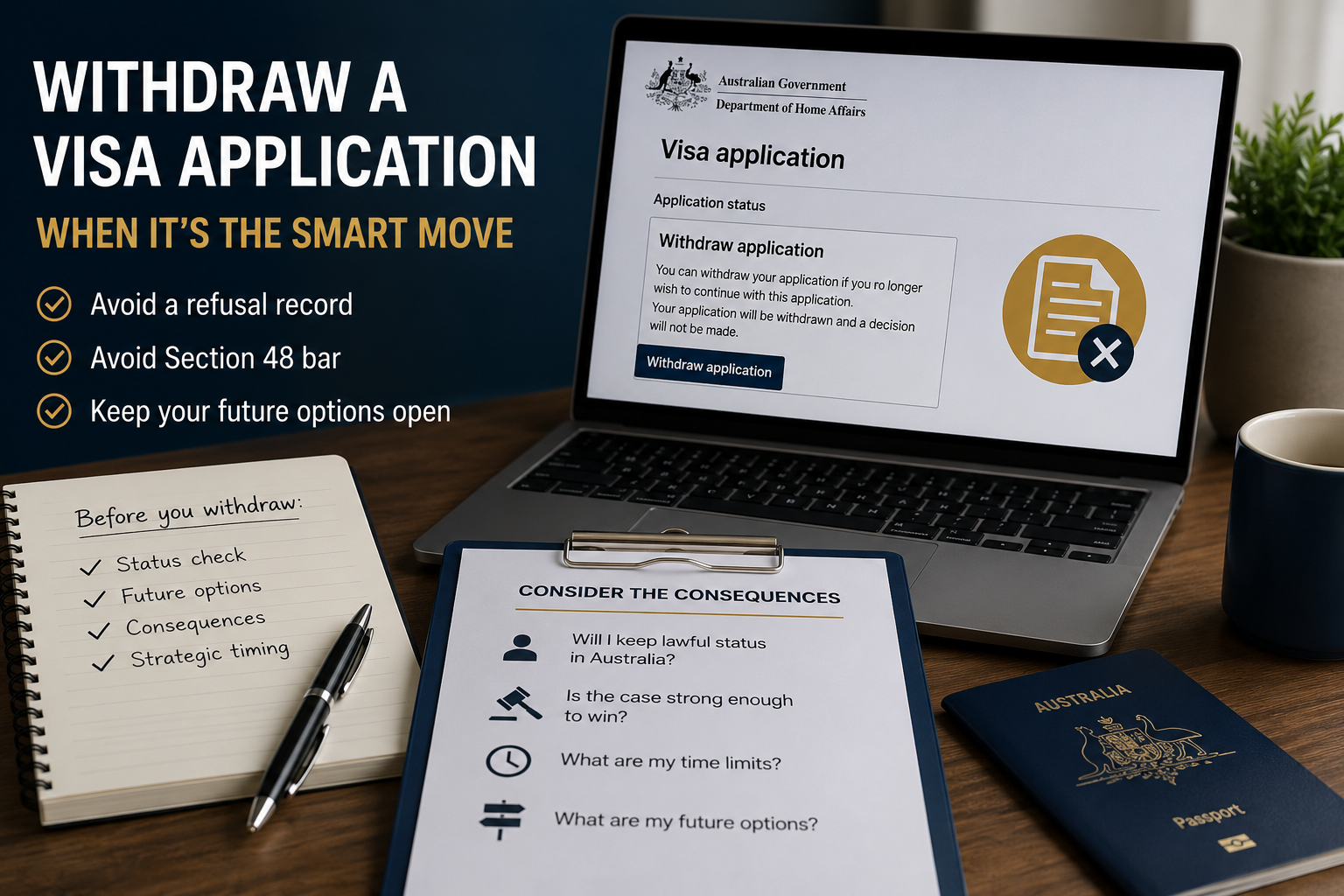
Withdraw a Visa Application in Australia: When Is It Smart?
You can generally withdraw an Australian visa application before Home Affairs makes a decision. But withdrawing is not simply an administrative step. It can affect your bridging visa, your ability to lodge another application, your visa application charge and the consequences of a possible refusal.
If you are considering withdrawing a visa application in Australia, there are two separate questions:
- How do you withdraw the application?
- Should you withdraw it, given what happens afterwards?
The first question is usually straightforward. The second can have serious consequences, particularly if you are in Australia, have received a natural justice letter, or are concerned that your application may be refused.
This guide explains both the withdrawal procedure and the strategic considerations. If your application is undergoing additional checks, also see Further Assessment in Australian Visa Applications.
The Immediate Answer
To withdraw a pending Australian visa application, you can generally use the withdrawal function in ImmiAccount or the withdrawal procedure specified by Home Affairs for your application.
Once a valid withdrawal takes effect, the application ends without a grant or refusal decision. The visa application charge is generally not refunded.
If you hold a bridging visa connected with the application, withdrawal can also cause that bridging visa to cease after the period prescribed by law.
The important distinction: being able to withdraw does not mean withdrawing is your best option.
What Happens When You Withdraw an Australian Visa Application?
| Question | General position |
|---|---|
| Can I withdraw before a decision? | Generally yes, while the application remains undecided. |
| How do I withdraw? | Usually through ImmiAccount or another Home Affairs withdrawal procedure. |
| How long does withdrawal take? | A valid withdrawal generally takes effect when Home Affairs receives the withdrawal request, rather than when it later sends confirmation. |
| Will my visa fee be refunded? | Usually not. Refunds are available only in limited circumstances. |
| Will I receive a refusal? | Not on an application validly withdrawn before decision. Existing information and concerns remain part of the history. |
| What happens to my bridging visa? | An associated bridging visa may cease after the applicable statutory period. The exact position depends on the visa and circumstances. |
| Can I lodge another application? | Potentially, but only if a new application can validly be made and all relevant requirements are satisfied. |
These are general rules. For an onshore applicant, the timing of withdrawal and the legal basis for the next visa application may determine whether withdrawal is helpful or damaging.
Before You Submit a Withdrawal
If you are in Australia on a bridging visa, have received a natural justice letter, or are considering another visa application, obtain advice about the consequences before submitting the withdrawal request.
Simon’s Principle
Withdrawal ends the application. It does not erase the history.
The real question is whether ending the application now leaves you in a stronger legal and strategic position than allowing a decision to be made.
How to Withdraw an Australian Visa Application
An Australian visa application can generally be withdrawn before a decision has been made. The withdrawal must be communicated to Home Affairs through an accepted process.
Withdrawing Through ImmiAccount
For applications where the function is available, the usual process is:
- Log in to ImmiAccount.
- Open the relevant visa application.
- Select Update details.
- Select Withdrawal of a visa application.
- Complete and submit the withdrawal request.
If that function is unavailable, Home Affairs may require another written withdrawal process, including Form 1446 where applicable.
The request should identify the application accurately and be submitted by someone authorised to withdraw it.
How Long Does It Take to Withdraw a Visa Application in Australia?
This question is frequently misunderstood because there is a difference between the withdrawal taking legal effect and Home Affairs updating its systems or issuing confirmation.
A valid withdrawal generally takes effect when the Department receives the withdrawal request. You should not assume that the application remains pending merely because confirmation has not yet arrived.
The time taken for ImmiAccount or Departmental records to reflect the withdrawal may vary. There is no universal confirmation timeframe that should be relied upon for planning another application.
If you are trying to withdraw before an anticipated refusal, the timing is especially important. A withdrawal request cannot undo a refusal decision that has already been made.
Multiple Applicants and Family Members
Where a visa application includes family members, the authority to withdraw and the effect on each applicant must be checked.
Adult family members may need to provide their own withdrawal authority or request, depending on the application arrangements.
Do not assume that withdrawing one person’s application has no effect on other applicants or their visa status.
Official guidance:
Department of Home Affairs — After You Apply
.
Will You Get a Refund if You Withdraw Your Visa Application?
Generally, no. The visa application charge is usually not refunded simply because an applicant withdraws before a decision.
This can be frustrating where the application has been pending for a long time or the applicant has changed plans.
However, the visa application charge is not ordinarily a payment for a successful outcome. Withdrawal does not, by itself, create an entitlement to recover that charge.
Are There Exceptions?
Limited refund circumstances exist under Australian migration law and Departmental policy. Whether an exception applies depends on the circumstances and the relevant legal provisions.
An applicant should not assume that a refund is available merely because:
- the application has not yet been decided;
- the application was lodged recently;
- the applicant no longer wishes to migrate;
- the applicant intends to lodge a different visa application; or
- the application has been in Further Assessment for a long period.
Where a refund exception may apply, the refund process is separate from deciding whether withdrawal is strategically appropriate.
The financial cost is one consideration. The legal consequences of withdrawal can be considerably more important.
What Withdrawal Actually Does
In practical terms, withdrawal usually means:
- the application ends without a grant or refusal decision;
- the Department stops processing that application;
- there is no refusal decision on that application; and
- therefore no review right arising from a refusal of that application.
What Withdrawal Can Protect
Used properly, withdrawal may protect:
- your ability to avoid a refusal on the current file;
- your ability to avoid a refusal that might trigger Section 48 consequences later;
- your ability to preserve another migration pathway; and
- your ability to avoid a formal adverse decision on an application that can no longer be won.
What Withdrawal Does Not Do
Withdrawal does not automatically:
- refund the visa application charge;
- erase the application from Departmental history;
- erase documents or answers already provided;
- make the Department forget concerns it has already identified;
- guarantee that future applications will not be affected by the same issue;
- preserve a bridging visa indefinitely; or
- guarantee that another application can validly be made.
Avoiding Refusal Is Not the Same as Resolving the Problem
Withdrawal usually avoids a refusal decision on that application. It does not wipe the factual history, supporting documents, inconsistencies or concerns already raised in the file. Those matters may remain relevant to future applications.
When Withdrawal May Make Sense
The strongest withdrawal cases usually fall into a small number of patterns.
1. The Application Has Become Unwinnable
Sometimes the criteria can no longer be met because circumstances have changed.
Common examples include:
- the relationship has ended;
- the job offer or sponsorship has disappeared;
- the course will not proceed;
- the required funds are no longer available;
- the applicant has become ineligible in another material way; or
- critical evidence cannot be produced.
In those situations, the real question may be whether the file should end with a withdrawal or a refusal.
2. A Natural Justice Problem Cannot Be Properly Answered
If Home Affairs has raised a serious concern and the concern is substantially true, withdrawal may need to be considered before a refusal is made.
This can arise where:
- a key document is not genuine or cannot be supported;
- a material claim was overstated;
- a former representative lodged incorrect information;
- the application contains a major disclosure problem; or
- the issue cannot be answered with reliable evidence.
That does not mean withdrawal automatically solves the future integrity problem.
It means the applicant may need to decide whether a refusal decision on the current file is strategically worse than ending the application before that occurs.
See:
Natural Justice Letter Australia
.
3. A Better Pathway Exists but a Refusal Would Complicate It
Some applicants realise, while the present application is still pending, that there is a better route available.
That may include:
- an onshore Partner strategy;
- a skilled or employer-sponsored pathway developing in the background;
- an offshore reapplication that is stronger than the current file; or
- a status-preserving move that only remains available while the application is still undecided.
The critical issue is sequencing.
If refusal would damage the better pathway, withdrawal may need to be considered while both options still exist.
4. The Real Objective Has Changed
Sometimes the visa application no longer serves the applicant’s actual objective.
In those cases, the mistake is often not the original lodgement but the failure to recognise that the strategic objective has changed.
When Not to Withdraw
Withdrawal is often overused by anxious applicants who mistake delay or scrutiny for impending refusal.
Do Not Withdraw a Potentially Winnable Case Out of Nerves
A request for further information is not the same thing as a refusal warning.
A long period in Further Assessment is not, by itself, proof that the case will fail.
Many delayed files are ultimately granted.
Withdrawing a sound application can mean:
- losing the queue position;
- wasting the application charge;
- surrendering a viable case;
- forcing a relodgement under different rules; or
- losing eligibility that no longer exists later.
For more on delays and additional checking, see
Further Assessment in Australian Visa Applications
.
Do Not Withdraw Without Understanding the Next Step
A withdrawal that solves one problem but creates another is not a solution.
Before withdrawing, you should know:
- what visa or status you will hold afterwards;
- whether another application can validly be made;
- whether you need to leave Australia;
- whether review rights would be lost;
- whether family members are affected; and
- what must be disclosed in the future.
Do Not Assume Relodging Is Harmless
Relodging is not a reset button.
It may involve:
- a new application charge;
- fresh evidence requirements;
- new criteria or changed policy settings;
- different timing consequences; and
- the need to explain the previous application history carefully.
Onshore Status and Bridging-Visa Risks
This is the issue applicants most often underestimate.
If you are in Australia on a bridging visa connected with the pending application, withdrawal can affect the ongoing basis for that bridging visa.
A bridging visa granted on or after 19 November 2016 in association with the withdrawn application will generally cease 35 calendar days after the withdrawal is notified to Home Affairs. For certain earlier bridging visas, a 28-day period applies.
These are general rules, not a guarantee that every applicant has 35 days of lawful status after withdrawal. The actual position depends on the bridging-visa subclass, its grant and cessation provisions, any other visa held and the circumstances of the applicant.
If the applicant holds a substantive visa, the withdrawal of a separate pending application does not necessarily cause that substantive visa to cease. The particular visa position must be examined.
A withdrawal that avoids a refusal but leaves you without a workable lawful-status strategy can make the situation worse, not better.
Questions to Check Before Withdrawing
- What visa do I currently hold?
- Is it a substantive visa or a bridging visa?
- What event causes that visa to cease?
- What happens if the current application is withdrawn?
- Can another valid application be made before status changes?
- Does Section 48 become relevant if the file is refused instead?
- Would departure from Australia be required?
For the broader status analysis, see:
Bridging Visa After a Visa Refusal
.
For the onshore application restriction, see:
Section 48 Bar After a Visa Refusal
.
The Onshore Rule
Do not withdraw first and work out status later. Onshore, the order matters. You should understand the next legal position before ending the current application.
Can You Lodge Another Visa Application After Withdrawal?
Possibly, but withdrawal does not itself create a right to lodge another visa application.
A new application must satisfy the applicable validity requirements. Whether it can be lodged in Australia or must be lodged offshore depends on the visa subclass, the applicant’s current status and any relevant restrictions.
Before withdrawing, the applicant should check:
- whether the intended new visa can be applied for onshore;
- whether the applicant meets its validity requirements;
- whether a No Further Stay condition or another restriction applies;
- whether Section 48 or another statutory restriction is relevant;
- whether the applicant will remain lawfully in Australia long enough to lodge;
- whether a new application will create a different bridging-visa position; and
- whether the information in the previous application creates a disclosure or credibility issue.
Some applicants may be better placed to lodge a valid alternative application before withdrawing the existing one. Others may need a different sequence, and some may have no available onshore alternative.
This is why withdrawal should be assessed as part of the entire migration strategy rather than as an isolated administrative action.
Withdrawal Versus Refusal and ART Review
One of the hardest strategic judgments is this:
Is it better to avoid a refusal decision by withdrawing, or better to allow a refusal that may carry review rights?
In some cases, a refusal may open a review pathway that:
- keeps a substantive merits-review option alive;
- preserves lawful presence through a bridging-visa structure;
- creates time for another strategy to develop; or
- offers a genuine second chance on the existing application.
These outcomes are not automatic. Review eligibility depends on the decision and the applicable legislation, and any bridging-visa consequences must be assessed separately.
A withdrawal ends the application and removes the refusal decision that might otherwise be reviewed.
On the other hand, allowing a refusal may create consequences that could have been avoided through a properly timed withdrawal.
The relevant comparison is not simply withdrawal versus refusal. It is the legal and practical position following each outcome.
For the wider refusal framework, see
Visa Refused Australia
.
For review options, see
Visa Refusal, Cancellation and ART Review in Australia
.
The Withdrawal Decision Checklist
| Question | Why it matters |
|---|---|
| Can the current application still be won? | If yes, withdrawal may waste a viable case. |
| Has Home Affairs raised a serious concern? | Some concerns can be answered; others fundamentally change the strategic calculation. |
| What happens to current visa status? | Bridging-visa consequences can be more serious than the refusal risk you are trying to avoid. |
| Would refusal create a Section 48 problem? | This can affect whether another onshore pathway remains available later. |
| Would refusal create review rights worth preserving? | Sometimes review rights are more valuable than the immediate outcome achieved by withdrawal. |
| Can the next visa application validly be lodged? | A possible future pathway is not the same as a presently available application. |
| What happens to the application charge? | The existing charge is generally not refunded, and a new application may require another payment. |
| What is the next pathway? | Withdrawal without a next move is usually strategy by panic rather than design. |
Fictional Worked Example: The Better Pathway Only Exists Before Refusal
This example is fictional and is included to demonstrate the withdrawal framework.
Elena is in Australia and has a pending student visa application.
Home Affairs later raises concerns about a financial document and seeks further explanation.
At the same time:
- Elena has begun a genuine relationship with an Australian partner;
- the evidence on the student application has become difficult to defend cleanly; and
- she still has a possible onshore pathway that may be strategically stronger than continuing the current file.
The Temptation
Elena assumes the answer is simple:
“I will just withdraw the student application and move on.”
The Actual Analysis
Before doing that, she must check:
- whether the student file is still defensible;
- whether withdrawal affects her current lawful status;
- whether allowing refusal would create a Section 48 problem;
- whether a Partner pathway is genuinely available and supportable;
- whether a valid Partner application can be made while she remains in Australia;
- whether withdrawal would sacrifice any review right that might otherwise be valuable; and
- what must be disclosed about the previous application and its history.
The Point
Withdrawal is not correct simply because the current file is uncomfortable.
It is correct only if the combination of:
- the weakness in the current application;
- the next available pathway;
- the visa-status consequences; and
- the refusal-versus-withdrawal comparison
makes withdrawal the better strategic outcome.
The right answer lies in the sequence, not in the word “withdraw.”
Simon’s Perspective
Applicants often ask this question too late.
They wait until:
- a natural justice letter has arrived;
- the document problem is obvious;
- the relationship has already broken down;
- the sponsor has disappeared;
- their bridging position is becoming unstable; or
- the refusal feels imminent.
At that point, they want a simple rule:
“Should I just withdraw?”
That is usually the wrong way to frame it.
The better question is:
“If I withdraw now, what exactly becomes better — and what exactly becomes worse?”
Sometimes withdrawal clearly protects the client.
Sometimes it prevents an avoidable refusal and keeps another path open.
But I also see people withdraw applications that could probably have been granted, or that at least would have produced review rights worth having.
The applicants who make the best decisions are the ones who compare:
- the strength of the present application;
- the strength of the alternative strategy;
- the effect on current visa status;
- the consequence of refusal;
- the value of any review right; and
- the future disclosure and credibility issues.
Withdrawal is a timing tool. It works when used deliberately. It causes damage when used simply to escape stress.
Strategic Question
If you end this application today, do you genuinely improve your legal position — or do you merely exchange one problem for another?
Official Resources
About Simon Mander
Simon Mander is a Registered Migration Agent (MARN 0318058) with more than 23 years of experience in Australian migration law.
His work includes further-assessment strategy, withdrawal decisions, visa-refusal risk analysis, Section 48 issues and ART review assessment.
Get a Written Strategy Assessment
A withdrawal decision should be based on the strength of the current application, the next available pathway, the lawful-status consequences and the refusal-versus-review comparison.
The paid strategy assessment provides written advice on whether withdrawal should be considered, what it would change and what risks remain afterwards.
The assessment does not itself withdraw the application, lodge a new visa or guarantee that a future pathway will succeed.
Withdraw Visa Application Australia: Frequently Asked Questions
Can I withdraw a visa application in Australia before a decision?
Generally, yes. An undecided visa application can usually be withdrawn before a decision is made, provided the withdrawal is validly communicated to Home Affairs.
How do I withdraw my Australian visa application?
For many applications, the withdrawal function is available in ImmiAccount under Update details. Where it is unavailable, Home Affairs may require another written procedure, including Form 1446 where applicable.
How long does it take to withdraw a visa application?
A valid withdrawal generally takes effect when Home Affairs receives the withdrawal request. Departmental confirmation or an ImmiAccount status update may follow later, and the time for that administrative update can vary.
Does withdrawing count as a refusal?
No. A valid withdrawal before decision ordinarily ends the application without a refusal decision. However, the application history and information already provided to Home Affairs do not disappear.
Will I get my visa application charge back?
Usually not. Refunds are available only in limited circumstances, and withdrawal alone does not ordinarily establish entitlement to a refund.
Can withdrawing help me avoid Section 48?
It may help in some cases because Section 48 issues can depend on refusal history and current visa status. However, the consequences must be checked against the applicant’s exact circumstances and the relevant statutory requirements.
What happens to my bridging visa if I withdraw?
An associated bridging visa granted on or after 19 November 2016 will generally cease 35 calendar days after notification of withdrawal. Certain earlier bridging visas have a 28-day rule. The exact consequences depend on the bridging visa, any other visa held and the applicant’s circumstances.
Is it better to withdraw or let the application be refused?
That depends on the case. Withdrawal may avoid a refusal decision and some associated consequences, while refusal may produce review rights that are strategically valuable. The better option depends on the application strength, the next pathway and the status consequences.
Can I withdraw after refusal?
No. Once a refusal decision has been made, withdrawing the application cannot erase that outcome. Withdrawal must be considered while the application remains undecided.
Does withdrawing erase a natural justice problem?
No. Withdrawal may avoid a refusal decision on the current file, but it does not automatically erase the factual issue or the information already known to Home Affairs.
Can I withdraw and lodge another visa application immediately?
Potentially, but only if the new application can validly be made. Onshore restrictions, visa conditions, current status, timing and eligibility must be checked before withdrawing.
Should I withdraw if my application is in Further Assessment?
Not automatically. Further Assessment does not by itself mean refusal is coming. The decision should depend on the actual risk in the file and the strength of the alternative strategy.
This information is general in nature and does not constitute migration advice for your individual circumstances. Australian migration law and policy can change, and eligibility should be assessed based on the circumstances existing at the relevant time.